The field of astrophysics has recently been enriched by a significant discovery made by researchers at the California Institute of Technology and collaborating institutions. Utilizing the Zwicky Transient Facility, astronomers have identified a unique binary system, designated ZTF J1239+8347, situated approximately 1,100 light-years from Earth. This system is particularly noteworthy because it consists of two brown dwarfs engaged in a process of stable mass transfer, a phenomenon rarely observed in objects of this classification.
ZTF J1239+8347: characteristics of the binary components
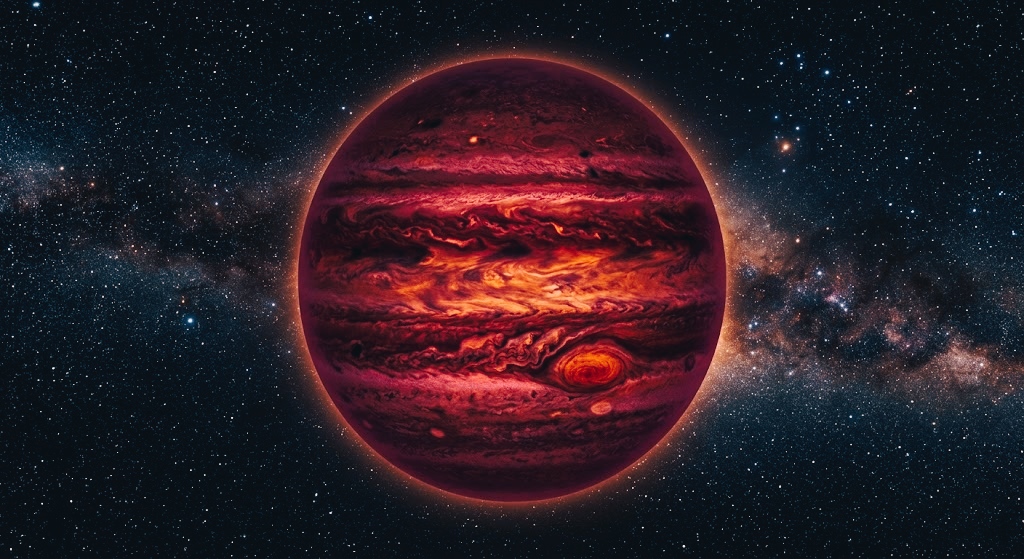
Brown dwarfs represent a distinct class of celestial bodies that bridge the gap between the most massive gas giant planets and the smallest stars. With masses typically ranging from 13 to 80 times that of Jupiter, these objects lack the necessary mass to sustain the hydrogen fusion that characterizes true stars. While many individual brown dwarfs have been cataloged to date, finding them in close binary orbits remains an exceptional challenge for the scientific community.
The specific components of ZTF J1239+8347 consist of two brown dwarfs with estimated masses between 60 and 80 Jupiter masses. The accreting object within this pair possesses a radius approximately 1.2 times that of Jupiter and maintains an atmospheric temperature near 1,500 K. These measurements provide vital data points for understanding the physical limits and evolutionary tracks of substellar objects undergoing active interaction.
The donor object in this binary arrangement is estimated to have a radius between 0.9 and 1.4 Jupiter radii, with an atmospheric temperature likely falling below 1,200 K. The interaction between these two bodies is defined by a remarkably short orbital period of approximately 57.41 minutes. This rapid orbit facilitates the stable transfer of matter from the donor to the accrector, marking it as a premier laboratory for studying accretion physics in low-mass systems.
Observational data and variability
Data gathered through the Zwicky Transient Facility’s variability survey revealed that ZTF J1239+8347 exhibits extreme amplitude variability at short optical wavelengths. This high degree of fluctuation suggests the existence of a localized “hot spot” on the accreting brown dwarf. Scientists believe this spot is slightly embedded within the atmosphere, caused by the kinetic energy of the transferred material impacting the surface of the primary body.
Despite the intense variability observed in the optical spectrum, the system presents a different profile when viewed through infrared lenses. In the near and mid-infrared bands, the accretion luminosity is relatively faint, allowing the thermal emission from the brown dwarfs’ actual atmospheres to contribute significantly to the total spectrum. This distinction is crucial for researchers attempting to separate the energy produced by the mass transfer from the heat naturally radiating from the objects themselves.
The presence of this thermal emission provides a rare opportunity to analyze the atmospheric compositions of the binary pair. By studying the light in these specific wavelengths, astronomers can begin to model the weather patterns and chemical makeup of these substellar atmospheres. The contrast between the violent optical variability and the steadier infrared glow highlights the complex energetic environment surrounding ZTF J1239+8347.
Future research and the role of JWST
The research team, led by Samuel Whitebook, emphasizes that further monitoring is essential to fully characterize the properties of this discovery. While ground-based telescopes have provided a foundational understanding, they lack the phase resolution necessary to measure the system’s mass ratio directly. To overcome these limitations, the scientific community is looking toward advanced space-based instrumentation to refine the current models of ZTF J1239+8347.
Future observations utilizing the James Webb Space Telescope are expected to provide much more precise constraints on the atmospheric temperatures of both the accreting and donor objects. The sensitivity of the JWST will likely allow for the direct detection of the donor’s atmosphere, which remains partially obscured in current datasets. Such high-resolution data is required to confirm the exact mass distribution between the two bodies and to understand the long-term stability of their orbit.
In definitiva, ZTF J1239+8347 rappresenta un caso di studio cruciale per l’evoluzione dei sistemi binari interagenti alle più basse masse. Affinando la nostra comprensione di come queste “stelle fallite” si scambiano materia, gli astronomi possono prevedere con maggiore precisione i cicli di vita di sistemi simili in tutta la galassia . Lo studio in corso di questa rara coppia promette di far luce sul complesso confine tra la scienza planetaria e l’astrofisica stellare.
The study is published in The Astrophysical Journal Letters.