A groundbreaking study indicates that Mercury’s polar water ice reservoirs could have been deposited in a single Mercurian day by a solitary celestial impact. The research suggests that previous theories underestimated both the size and speed of the hitting body. Instead, these updated simulations show that a larger, slower-moving impactor would create the exact atmospheric conditions needed to swiftly transport and lock the ice inside the planet’s polar cold traps.
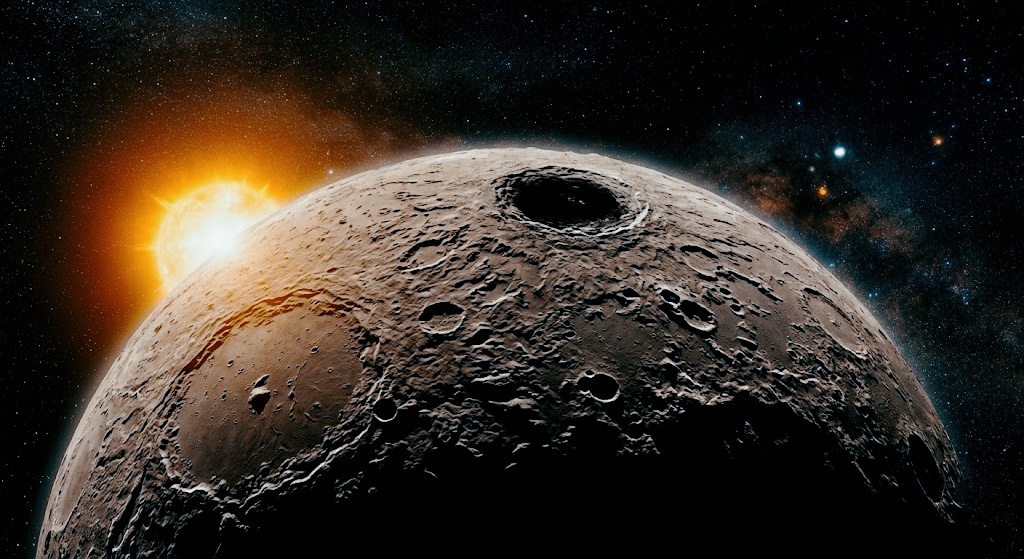
The origins of Mercurian polar ice: A single-impact hypothesis
As the closest planet to the Sun, Mercury experiences extreme daytime temperatures reaching up to 430 °C, and its lack of a substantial atmosphere means it cannot retain heat or gases efficiently. Instead, Mercury possesses a tenuous exosphere where gases are constantly lost to space and replenished by solar wind, conditions that should theoretically make water retention impossible. Despite this hostile environment, radar observations from Earth and spacecraft have identified highly reflective areas within permanently shadowed regions near the poles. These cold traps remain dark and freezing, allowing water ice to persist over geological timescales. Recent findings indicate this ice is remarkably pure and relatively young, pointing to a rapid, episodic delivery method rather than a slow, continuous process.
Modeling the Hokusai crater impact and atmospheric transport
To explore how a major collision would influence water distribution, the research team focused on an event capable of creating the 97-kilometer-wide Hokusai crater. They utilized advanced models incorporating updated maps of Mercury’s cold traps alongside realistic surface temperature data to simulate the dynamics of the vaporized volatile material. The team compared two distinct scenarios: one where water vapor is released into a thin, baseline exosphere, and another where the impact generates a temporary, dense atmosphere. This approach allowed them to update older transport efficiency estimates while testing a realistic range of parameters for the impacting body.
The simulations revealed that an impact of this scale could deliver approximately $2.3 \times 10^{13}\text{ kg}$ of water ice to the poles, meeting the lower limit of current total ice estimates. Within less than an hour of the collision, the generated water vapor would expand rapidly to completely envelope the planet, creating a transient, water-rich atmosphere. Under normal circumstances, solar photons would swiftly destroy this vapor through a process known as photolysis, breaking the molecules apart and causing them to escape into space.
However, the high volume of water vapor released in a Hokusai-scale event triggers a phenomenon known as atmospheric self-shielding, which dramatically alters the survival rate of the water. This self-shielding effect protects the inner layers of the temporary atmosphere from solar radiation, significantly reducing the fraction of water lost to photolysis. Consequently, a much higher percentage of the vapor survives long enough to migrate toward the poles and settle into the cold traps, resulting in a significantly more uniform distribution of ice between the northern and southern hemispheres than earlier, baseline models predicted.
Quantifying the self-shielding effect and polar deposition
The data gathered from the self-shielding simulations demonstrated a stark contrast to traditional, optically thin atmospheric models. At the end of one Mercurian solar day, roughly 96% of the water vapor in the non-collisional baseline simulation was destroyed by photolysis. In comparison, only about 46% of the water vapor was lost in the dense, impact-generated atmosphere simulation. This dramatic increase in survival capability allowed a far greater volume of water to successfully reach the safety of the polar cold traps.
Specifically, the authors of the study explained that 22.4% of the total modeled mass, which constitutes about 31% of the non-escaping vapor, becomes safely trapped as ice following the Hokusai-like impact. This stands in sharp contrast to the mere 3.4% of non-escaping vapor retained in the baseline scenario. Because the photolysis rate slows down so significantly, water vapor originating from an impact in the northern hemisphere is given enough time to migrate across the equator, heavily supplementing the cold traps located at the southern pole.
Despite the success of the delivery model, the researchers noticed a distinct anomaly when comparing the simulated ice deposits to actual observational data. Planetary radar measurements indicate that the real polar ice layers on Mercury are several meters thick. The simulations, however, yielded ice layers with a maximum thickness of only 37 centimeters, suggesting that while the total delivered mass aligns with lower-bound estimates, the physical structure of the simulated deposits remains insufficient.
Limitations of the study and future research directions
To reconcile the discrepancy in ice thickness, the research team suggests that the characteristics of the colliding body must be adjusted. If a single impact event truly accounts for the vast majority of Mercury’s polar ice, the impacting comet or asteroid likely needs to be larger and slower than the 17-kilometer-wide object traveling at 30 kilometers per second used in this specific model. A larger, slower impactor could potentially deposit a greater volume of volatiles without losing as much material to space during the initial blast.
The authors also emphasized that their current model has specific limitations, as it focused exclusively on water vapor and excluded other volatile chemical species that would realistically be present during a cometary or asteroidal impact. Additionally, the simulation only tracked environmental processes over the span of a single Mercurian solar day. It did not account for long-term planetary phenomena such as impact gardening, where subsequent micrometeorite bombardment churns the surface, or general space weathering, both of which alter ice layers over millions of years.
Moving forward, the team stresses the need for further modeling efforts that explore a broader matrix of impact parameters, including varied collision angles, velocities, and projectile sizes. Furthermore, upcoming data from planetary exploration missions, such as the BepiColombo spacecraft, are expected to provide highly detailed measurements regarding the exact thickness and distribution of the polar deposits. These future insights will be crucial in confirming whether a single celestial collision shaped the icy secrets of the innermost planet.
The study is published in the Journal of Geophysical Research: Planets.