
The successful launch and docking of the Shenzhou-23 crewed spacecraft represent a monumental advancement in China’s comprehensive aerospace strategy, serving as a critical stepping stone toward achieving a human presence on the lunar surface by the year 2030.
China’s leap toward the Moon: the Shenzhou-23 mission and the ambition for lunar exploration
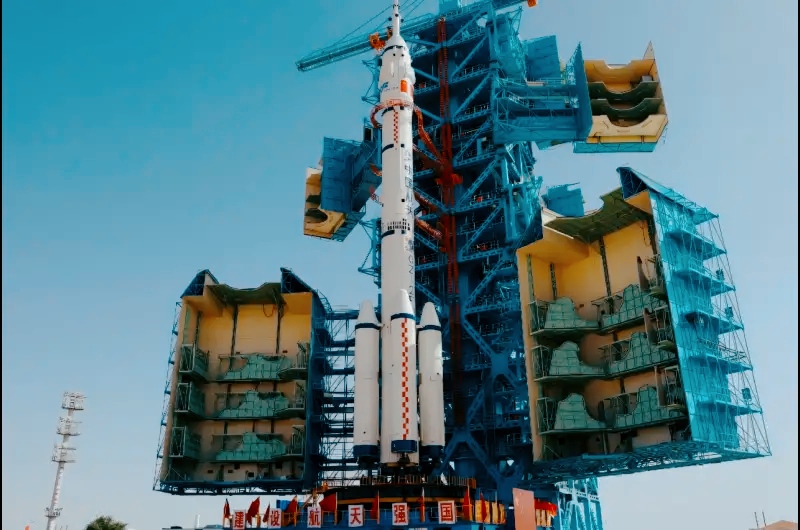
The Long March 2-F rocket lifted off punctually at 23:08 (15:08 GMT) on Sunday evening from the Jiuquan satellite launch center, situated within the expansive Gobi desert in northwestern China, ascending amidst a spectacular display of flames and smoke captured by the state broadcaster CCTV. Approximately ten minutes following the initial launch, the spacecraft successfully separated from its carrier rocket and entered its designated orbit, prompting an official statement on social media from the China Manned Space Agency (CMSA) confirming that the astronauts were in excellent condition and declaring the launch a complete success.
Following a precise flight lasting approximately three and a half hours, the vehicle achieved a seamless docking with the Tiangong space station in the early hours of Monday, as reported by the state-run Xinhua news agency.
This historic mission is distinguished by the inclusion of the first structural aerospace participant from Hong Kong, the forty-three-year-old Li Jiaying (known as Lai Ka-ying in Cantonese), who previously served as an officer within the Hong Kong police force. Joining her on this orbital voyage are two other distinguished crew members: Zhu Yangzhu, a thirty-nine-year-old space engineer with prior orbital experience, and Zhang Zhiyuan, also thirty-nine, a former military air force pilot marking his inaugural journey into space. Prior to the launch, a celebratory and enthusiastic crowd gathered at the send-off ceremony, waving national flags while a brass band played ceremonial music and the three selected astronauts expressed their gratitude from the stage.
The newly arrived crew is scheduled to execute a vast array of sophisticated scientific projects encompassing multiple cutting-edge disciplines, including life sciences, materials science, fluid dynamics, and space medicine. Through these experiments, the crew will collect vital data required to enhance operational capabilities in low Earth orbit. The deployment of this diverse team underscores the growing technical complexity of the Chinese space program as it transitions from intermittent exploration flights to continuous scientific utilization of its orbital infrastructure.
The human endurance test and long-duration operational challenges
A primary objective of the Shenzhou-23 mission involves an unprecedented endurance test wherein a single selected crew member will spend a full calendar year in orbit aboard the Tiangong space station. This long-duration experiment is designed to meticulously investigate the physiological and psychological effects of prolonged microgravity on the human body, providing essential foundational data for future lunar landings and deep-space expeditions to Mars. The specific astronaut designated for this year-long orbital stay will be formally announced at a later date, depending entirely on the operational progress and physiological evaluations conducted during the active phases of the current mission.
According to Richard de Grijs, an astrophysicist and professor at Macquarie University in Australia, extended exposure to space environments presents extreme physical hurdles, including significant loss of bone density, muscular atrophy, elevated radiation exposure, severe sleep disruption, and behavioral fatigue.
Furthermore, the academic emphasized that maintaining human life over such durations requires the implementation of highly reliable water and air recycling systems, alongside an enhanced capacity to autonomously manage complex medical emergencies far removed from terrestrial resources. Consequently, this extended stay is intended to stress-test both the physical endurance of the personnel and the technological limits of environmental control systems.
Professor de Grijs further observed that China is steadily accumulating invaluable operational experience regarding the prolonged occupation of its proprietary space station, marking a definitive shift toward complex deep-space readiness. Spending an entire year in orbit forces both the hardware systems and the human operators to adapt to a fundamentally different operational paradigm compared to the shorter, six-month Shenzhou flights that characterized the earlier phases of the national space program. Until this juncture, crews deployed to the Tiangong station had been limited to standard six-month rotations before being replaced by subsequent missions.
Geopolitical competition and the broader horizons of the space race
The execution of the Shenzhou-23 mission directly supports the overarching geopolitical objective of Beijing to land Chinese astronauts on the lunar surface before 2030, a milestone that places the nation in direct competition with the United States and its active Artemis program. To ensure the success of this endeavor, China is actively testing next-generation hardware, including an orbital test flight of its brand-new Mengzhou spacecraft scheduled for 2026. The Mengzhou spacecraft is designed to eventually replace the aging Shenzhou line of vehicles, serving as the primary vessel tasked with transporting Chinese crews to the Moon.
Looking further into the next decade, Beijing projects the completion of the initial phase of a permanent, crewed scientific outpost known as the International Lunar Research Station (ILRS) by the year 2035. In tandem with these lunar ambitions, international cooperation remains a key component of the Chinese strategy, with plans already underway to welcome the first foreign astronaut, originating from Pakistan, aboard the Tiangong space station before the conclusion of the current calendar year. This move highlights China’s desire to position its orbital infrastructure as a global hub for scientific collaboration, countering Western-led space initiatives.
Over the past three decades, the Asian superpower has aggressively expanded its aerospace capabilities, investing billions of dollars into research and development to narrow the technological gap with the United States, Russia, and Europe. These sustained investments yielded a historic world first in 2019 when the Chang’e-4 robotic probe successfully landed on the far side of the Moon, followed closely by the successful deployment of a small exploratory rover on the surface of Mars in 2021.
This rapid, independent technological evolution was largely accelerated after 2011, when the United States Congress formally barred the National Aeronautics and Space Administration (NASA) from cooperating with Beijing, effectively excluding China from the International Space Station (ISS) and compelling the nation to construct its own sovereign orbital path.
For more information, visit the official NASA website.