What if the next industrial revolution isn’t happening on Earth at all, but 385,000 kilometres above our heads?
Welcome, everyone. Whether you’re a seasoned space enthusiast, a student who stumbled across this article at midnight, or just someone who once looked up at the Moon and felt that quiet, electric wonder, this one is for you. We’re glad you’re here.
At FreeAstroScience.com, we believe that science doesn’t belong in ivory towers. It belongs in your hands, on your phone, at your breakfast table. We exist to explain complex scientific principles in plain, honest language‚ and to remind you, always, never to turn off your mind. Keep it active. Keep it questioning. As Francisco Goya once warned us: the sleep of reason breeds monsters.
The Moon has been many things to humanity: a religious icon, a navigation tool, a poet’s muse, a Cold War battleground. In July 1969, it became a trophy. Today, in 2026, it’s becoming something far more earthly‚ a business opportunity. And that shift raises questions worth sitting with for more than five minutes.

So grab a coffee, find a comfortable spot, and read this article all the way through. What you’ll learn might just change how you look up at the night sky.
What We Cover
- What makes Moon soil worth millions of dollars per handful?
- Could the Moon fuel our computers and power our cities?
- Who’s racing to get there ‚Äî and what’s their plan?
- What does NASA’s $20 billion Moon base mean for you?
- Can lunar mining actually turn a profit?
- Who owns the Moon — and does anyone have the right to mine it?
- Where do we go from here?
From Silent Satellite to Economic Powerhouse: The Moon’s Industrial Revolution Has Begun
What Makes Moon Soil Worth Millions of Dollars Per Handful?
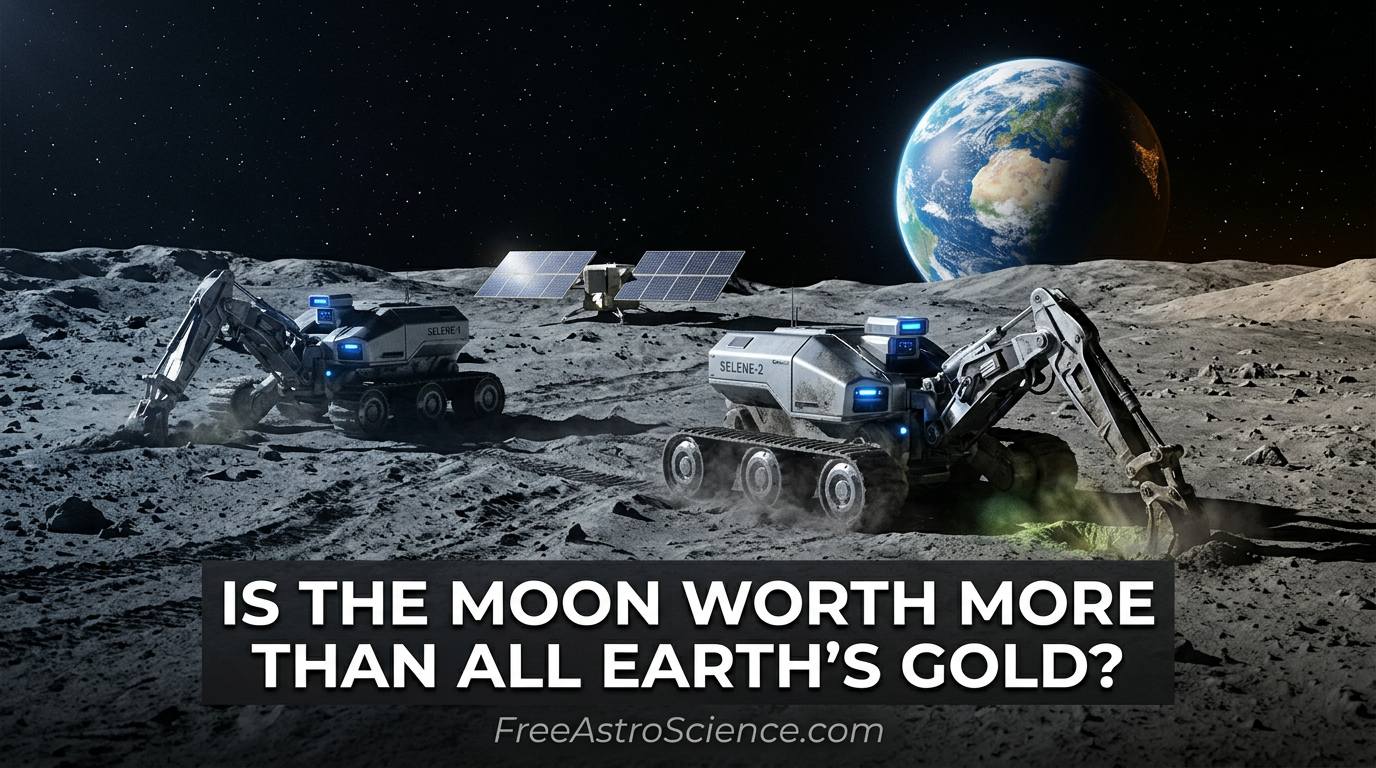
Picture five autonomous robots, each the size of a family car, grinding slowly across the Moon’s grey surface. They chew through rock and dust without pause, stopping only to recharge at solar power stations. Science fiction? Not anymore.
These machines ‚Äî planned by the Seattle-based startup Interlune ‚Äî are hunting for a gas so rare on Earth that a quantity you could hold in your palm might be worth millions of dollars. That gas is helium-3 (He-3), and it’s sitting in the Moon’s soil in quantities our planet simply cannot match.
Helium-3: The Rarest Treasure in the Solar System
Helium-3 is an isotope of helium ‚Äî same element, different atomic weight. It has two protons and one neutron, instead of helium-4’s two of each. That single missing neutron makes all the difference.
The Sun produces He-3 in its core and blasts it outward via the solar wind. On Earth, our magnetic field and atmosphere intercept almost all of it. The Moon has neither of those shields. Over billions of years, He-3 has been quietly embedding itself into the lunar regolith — the powdery top layer of Moon soil — at depths of a few metres. Earth holds less than 20 kilograms of it in total. The Moon is estimated to contain roughly one million tonnes.
Fast Fact: The current market rate for helium-3 is estimated at up to $20 million per kilogram. That’s roughly 400 times the price of gold. A single kilogram of Moon soil won’t get you there ‚Äî but a very efficient extraction process might.
Right now, He-3 already has real applications. It’s used in MRI-style lung imaging and in the ultra-cold cryogenic systems needed to run quantum computers. Demand is growing. Supply on Earth is barely moving. That gap is the business case.
Could the Moon Fuel Our Computers and Power Our Cities?
This is where things get genuinely exciting ‚Äî and where we need to be honest about what’s proven versus what’s theoretical.
Quantum computers don’t just need cold environments. They need insanely cold ones: around 0.010 Kelvin, which is colder than deep space. He-3 dilution refrigerators are the gold standard for reaching those temperatures. As quantum systems become central to industries from banking to drug discovery, the demand for He-3 will only grow.
On May 7, 2025, Interlune signed a deal with Maybell Quantum Industries ‚Äî its first paying customer‚ to supply thousands of litres of lunar He-3. The company has also struck agreements with Bluefors, the U.S. Department of Energy, and the U.S. Air Force. At last count, Interlune’s purchase orders and government contracts exceeded $500 million.
But the longer game? That’s nuclear fusion.
The Fusion Dream: Clean, Abundant, Non-Radioactive Energy
Standard fusion reactions — like the ones planned for ITER — fuse deuterium and tritium, producing radioactive neutrons as a byproduct. A He-3 + deuterium reaction is different. The products are a helium-4 nucleus and a proton, with no dangerous neutron radiation. That means:
Nuclear Fusion Reaction (Eq. 1) ²H (deuterium) + ³He (helium-3) → ⁴He + p⁺ + 18.3 MeV
What this means in plain English: Fusing one deuterium nucleus with one helium-3 nucleus releases 18.3 million electron-volts of energy — roughly the equivalent of burning tens of thousands of kilograms of coal — without producing radioactive waste or greenhouse gases. The ⁴He is safe, stable helium. The p⁺ is a simple proton.
A clean, compact fusion reactor running on He-3 would change energy production on Earth permanently. No carbon. No meltdown risk. No radioactive waste. The caveat? We don’t yet have a working commercial fusion reactor of any kind. The physics is sound; the engineering is still catching up. We’re honest about that here at FreeAstroScience.
“According to Rob Meyerson, the question of lunar extraction is no longer ‘if’ ‚Äî only ‘when.’ The business case exists right now, even before fusion becomes a reality.”
Who’s Racing to Get There ‚Äî and What’s Their Plan?
The Moon race of the 21st century looks very different from 1969. Back then, two governments poured national prestige into a single goal. Today, a growing constellation of private companies is making detailed business plans, signing customer contracts, and working to timelines that would have seemed audacious even five years ago.
Interlune: From Blue Origin to the Moon’s South Pole
Rob Meyerson didn’t arrive at lunar mining by accident. He spent years running the Space Shuttle program for NASA, then became president of Blue Origin‚ Jeff Bezos’s rocket company‚ and helped it grow into a serious player in commercial spaceflight. Now, he’s focused on a stretch of lunar soil about 385,000 km from his office.
Interlune launched with an initial investment round of $18 million, but the vision is anything but small. Their roadmap runs like this:
| Year | Mission / Milestone | Goal |
|---|---|---|
| 2026 | Multispectral Camera‚ Lunar South Pole | Map He-3 concentrations in regolith from orbit |
| 2027 | Resource Development Mission | Validate He-3 concentrations; test small-scale extraction |
| 2029 | Pilot Plant on the Moon | Prove every step of the chain; deliver first lunar He-3 to customers |
| Early 2030s | Full Commercial Operation | Continuous robotic harvesting and transport to Earth |
The camera, developed with NASA’s Ames Research Center, is expected to begin surveying the lunar terrain as early as summer 2026. Interlune is also working under a $150,000 NASA contract ‚ in partnership with the Colorado School of Mines‚ to develop excavation and trenching technology. That same technology could, in time, help build roads and base camps on the Moon.
Harrison Schmitt: The Geologist Who Walked on the Moon
Here’s a detail that stops you in your tracks. One of Interlune’s senior figures is Harrison Schmitt, the Apollo 17 astronaut who, in December 1972, became the only professional geologist ever to walk on the Moon. He didn’t just bring back rock samples ‚Äî he brought back a vision. Schmitt has been advocating for lunar He-3 extraction since the 1980s, long before anyone was writing serious business plans for it.
His presence at Interlune isn’t ceremonial. It’s scientific credibility in human form. When he tells you the regolith holds what they’re looking for, he’s speaking from direct, irreplaceable experience.
The Global Competition: ispace, Magna Petra, and China
Interlune isn’t alone. Japanese company ispace has joined forces with American firm Magna Petra to develop AI-driven extraction technologies from regolith ‚Äî aiming for non-destructive, energy-efficient processes that get better as launch costs fall. Meanwhile, China is pushing steadily toward its own crewed lunar landing before the end of this decade. The new Moon race has more participants, more capital, and much more commercial urgency than its Cold War predecessor.
| Organisation | Country | Focus | Key Partner / Fact |
|---|---|---|---|
| Interlune | üá∫üá∏ USA | He-3 extraction and sale | $500M+ in orders; first customer Maybell Quantum |
| ispace + Magna Petra | üáØüáµ Japan / üá∫üá∏ USA | AI-driven regolith mining | Non-destructive extraction; energy efficiency focus |
| NASA | üá∫üá∏ USA | Artemis program; Moon base | $20B investment; 2028 crewed landings targeted |
| China CNSA | üá®üá≥ China | Crewed lunar landing | Targeting landing before end of 2030 |
| SpaceX / Blue Origin | üá∫üá∏ USA | Launch cost reduction; landers | Underpinning all commercial Moon missions |
What Does NASA’s $20 Billion Moon Base Mean for You?
On March 24, 2026, NASA Administrator Jared Isaacman stood in Washington and laid out an audacious new plan. The agency will invest $20 billion over the next seven years to build a permanent base near the lunar south pole — complete with habitats, pressurised rovers, and nuclear power systems.
The revised Artemis architecture targets at least two crewed Moon landings in 2028 ‚Äî Artemis IV and Artemis V ‚Äî using landers developed by SpaceX and Blue Origin in open competition. NASA’s goal is to launch two Moon missions per year, eventually building a semi-permanent human presence on the surface. The Gateway space station in lunar orbit has been paused; its components will be repurposed for surface operations instead.
The Moon’s south pole wasn’t chosen by accident. It’s where permanently shadowed craters hold water ice ‚Äî a resource that could be split into hydrogen fuel and breathable oxygen. It’s also where He-3 concentrations are expected to be highest. Interlune’s multispectral camera will survey exactly this region.
üåç Why it matters to everyone: NASA’s Isaacman framed the effort as a matter of leadership ‚Äî “NASA is committed to achieving the near-impossible once again.” But beyond geopolitics, a working lunar base means cheaper access to deep-space resources, advances in solar and nuclear power tech, and spin-off innovations that tend to ripple through civilian industries for decades. The original Apollo program gave us memory foam, CAT scans, and water filters.
After more than 50 years since the last human footprint was left on the Moon ‚Äî on December 14, 1972, by Harrison Schmitt himself during Apollo 17 ‚Äî we’re heading back. This time, we intend to stay.
Can Lunar Mining Actually Turn a Profit?
Here we should pump the brakes just a little. Not to dampen excitement, but because honest science demands it.
Angel Abbud-Madrid, a professor at the Colorado School of Mines and one of the world’s leading experts on space resource utilisation, raises a sharp question: does He-3 exist in high enough concentrations to make extraction economically viable?
He uses a brilliant analogy. The Earth’s oceans contain millions of tonnes of dissolved gold. Does that mean we should mine the sea? No ‚Äî because the gold is so diluted that the cost of recovery would exceed its market value by orders of magnitude. He-3 in the lunar regolith might face the same problem.
That’s precisely why Interlune’s first step is a survey mission. The 2026 multispectral camera isn’t just a PR exercise ‚Äî it’s a financially critical data-gathering operation. If the He-3 is concentrated in accessible, exploitable deposits, the economics work. If it’s spread too thinly across vast areas of regolith, the whole project becomes a very expensive exercise in futurism.
‚öóÔ∏è The Technical Challenge: Extracting He-3 means heating large volumes of regolith to release the gas, then separating and purifying it. Interlune’s excavators plan to process enormous quantities of soil, operating in a vacuum, in lunar-gravity conditions, with no maintenance crew on standby. The engineering is genuinely unprecedented. Gary Lai, Interlune’s co-founder and CTO, said it plainly: “The high-rate excavation needed to harvest helium-3 from the Moon in large quantities has never been attempted before, let alone with high efficiency.”
We won’t know the answer until the surveys run. That’s the scientific reality ‚Äî and any source that tells you otherwise is selling you something.
Who Owns the Moon — and Does Anyone Have the Right to Mine It?
This might be the most uncomfortable section of this article. Bear with us ‚Äî it’s worth it.
The 1967 Problem: A Law That Didn’t Anticipate Private Business
The Outer Space Treaty of 1967 is the foundational legal document for everything beyond Earth’s atmosphere. It’s clear on one point: no nation can claim sovereignty over the Moon or any celestial body. The Moon belongs to everyone ‚Äî or, more precisely, to no one.
What the treaty doesn’t clearly address is whether private companies can extract and sell lunar resources. The United States took a position in 2015 with the U.S. Commercial Space Launch Competitiveness Act, granting American citizens the right to own resources they extract from space. But that’s a national law, not an international consensus. Legal scholars continue to disagree, and the gap between competing interpretations is exactly where future conflicts will live.
Does the Moon Deserve Protection?
Abbud-Madrid raises a point that goes beyond law and economics. Unlike a random asteroid, the Moon has a cultural, philosophical, and spiritual weight that spans every civilisation in human history. People have worshipped it, navigated by it, written poems to it, and named months after it. Does that give us the right to treat it as a quarry?
Interlune’s response has been linguistic ‚Äî and tellingly so. They’ve replaced the word “mining” with “harvesting”, presenting the activity as gentler and more purposeful. Critics call it greenwashing in space. Supporters say it reflects a genuinely different operational philosophy, one focused on extracting only what’s needed without large-scale surface destruction.
The scientific community has its own concerns. Martin Elvis, a senior astrophysicist at the Harvard-Smithsonian Center for Astrophysics, has pushed hard for the formal designation of lunar “off-limits zones.” The far side of the Moon ‚Äî permanently shielded from Earth’s radio noise ‚Äî is one of the most scientifically valuable locations in the solar system for radio astronomy. The lunar south pole’s permanently shadowed craters preserve pristine records of the early solar system. Once disturbed, that data is gone forever.
“The Moon’s far side is the quietest radio environment accessible to us. Once industry moves in without rules, you cannot un-ring that bell.” ‚Äî Based on statements by Martin Elvis, Harvard-Smithsonian CfA
Scientists are calling for internationally agreed protected zones before commercial operations begin — not as anti-progress sentiment, but as basic scientific stewardship. We at FreeAstroScience believe both things can be true: the Moon can be a site of economic activity and a protected scientific resource. We just need the governance to catch up with the ambition.
The Moon Has Always Been More Than a Destination
Let’s land (pun intended). Here’s what we know for certain, as of April 2026:
- The Moon holds an estimated 1 million tonnes of He-3 — a gas worth up to $20 million per kilogram that Earth can barely produce.
- Interlune — led by aerospace veterans and funded beyond the $500 million mark in orders — is targeting a first commercial harvest by the early 2030s.
- NASA is spending $20 billion on a permanent Moon base, with crewed landings planned for 2028.
- The applications are real and growing: quantum computing, medical imaging, and potentially clean fusion energy.
- The risks — economic, legal, and ethical — are equally real, and anyone who glosses over them is not giving you the full picture.
The Moon is no longer just a scientific trophy from the 20th century. It’s becoming the cornerstone of a new kind of economy ‚Äî one that plays out hundreds of thousands of kilometres from Earth, but whose consequences will land squarely on our doorstep.
What we choose to do up there will say something about who we are down here. Will we repeat old patterns of extraction without rules, or will we write smarter ones this time? That’s not a rhetorical question. It’s a policy question, a scientific question, and ultimately a human question.
Here at FreeAstroScience.com, we exist for exactly this moment ‚Äî when the science is moving faster than the public conversation, and someone needs to slow down and explain it clearly. We protect you from misinformation. We don’t do hype. We do context, evidence, and honesty.
Keep your mind open. Keep asking questions. Come back to FreeAstroScience.com whenever the universe does something worth talking about ‚Äî which, if you’ve been paying attention, is pretty much every week.
Because the sleep of reason breeds monsters. And we intend to stay awake.
üìö Sources & References
- Meloni, D. (2026, April 3). Luna: da traguardo scientifico a pilastro dell’economia spaziale. Reccom.org. reccom.org
- Interlune. (2026). Excavate, Sort, Extract, and Separate: Interlune Core Intellectual Property. interlune.space
- GeekWire. (2026, February 3). Interlune designs a moon digger for helium-3 and construction work. geekwire.com
- GeekWire. (2026, January 28). Interlune brings in fresh funding to support moon mining mission. geekwire.com
- CBS News. (2026, March 23). NASA unveils ambitious $20 billion plan to build moon base near lunar south pole. cbsnews.com
- Bloomberg. (2026, March 24). NASA to Spend $20 Billion on Moon Base, Create Mars Craft. bloomberg.com
- LiveScience. (2026, March 24). NASA announces ‘near-impossible’ space plans, including $20B Moon base. livescience.com
- Space.com. (2025, May 18). Moon mining machine: Interlune unveils helium-3 harvester prototype. space.com
- Space Settlement Progress. (2025, July 10). Interlune attracts customers for Helium-3 mined from the Moon. spacesettlementprogress.com
- LH3M. (2025, June 19). Quantum Computing Use Case For Helium-3. lh3m.com
- NASA. (2026). Artemis II: NASA’s First Crewed Lunar Flyby in 50 Years. nasa.gov
- Cosmic Log. (2026, February 3). Interlune digs into opportunities for lunar construction. cosmiclog.com