
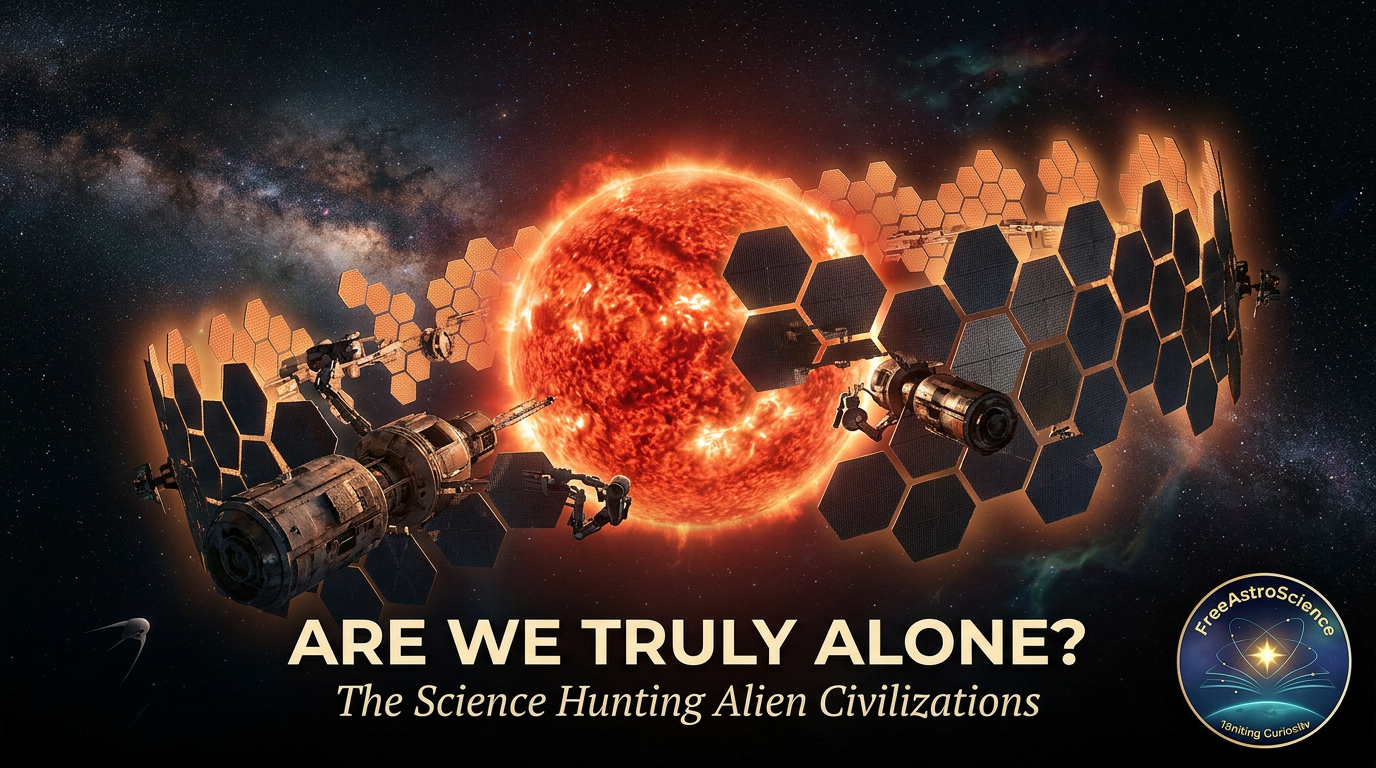
What if, somewhere out there, an alien engineer just finished bolting together the last solar panel of a structure the size of a star? It sounds like science fiction. Yet at this very moment, real astronomers at Uppsala University are sifting through data on five million stars, hunting for exactly that kind of object. Welcome, dear reader. We’re so glad you’re here. This article was written specifically for you by FreeAstroScience.com, where we break down complex scientific principles into plain language. Settle in, because we’ll walk you through three real methods scientists use to find alien civilizations, the famous Kardashev scale, and the seven stars that recently made astronomers raise an eyebrow. Read to the end—we promise the science is even stranger than the fiction.
📚 Table of Contents
- How Do We Hunt for Alien Civilizations?
- Why Hasn’t SETI Found Anyone Yet?
- Could Alien Artifacts Be Hiding in Our Solar System?
- What Is a Dyson Sphere?
- How Do We Rank Alien Civilizations?
- What Did Project Hephaistos Actually Find?
- Who Are the Seven Mystery Stars?
- Are They Really Alien Megastructures?
- What Does Our Own Energy Future Tell Us?
Hunting for Alien Megastructures: What Seven Strange Stars Might Be Telling Us
We’ve stared at the night sky for as long as we’ve had eyes. The question never changes: are we alone? Today, we don’t just stare anymore. We point sensitive instruments at faint stars, run their light through neural networks, and ask whether the numbers add up.
A team of Swedish astronomers asked exactly that question, and the answer surprised them.
How Do We Hunt for Alien Civilizations?
Astronomers have built three main paths to look for our cosmic neighbors. Each has its own logic. None has worked yet. All of them remain on the table.
The first path listens for messages. The second hunts for physical traces. The third looks for waste heat from giant engineering projects.
Let’s take them one at a time.
Why Hasn’t SETI Found Anyone Yet?
SETI stands for the Search for Extraterrestrial Intelligence. The idea is beautifully simple. If aliens use radio waves like we do, their signals could reach us across light-years.
Scientists point radiotelescopes at thousands of stars. They scan frequency by frequency, hoping for something artificial. A pattern. A pulse. Anything that nature wouldn’t make on its own.
So far? Silence.
The universe is enormous, and radio signals get weak fast. We might be looking in the wrong place, listening at the wrong frequency, or simply too early. Or too late. Other civilizations might not bother shouting across the cosmos at all.
Could Alien Artifacts Be Hiding in Our Solar System?
The second method is less glamorous but just as serious. Some researchers scan Mars, the icy moons of Jupiter and Saturn, even strange rocks on Earth, looking for anomalies that could hint at past alien visits.
No conclusive evidence has shown up yet. Missions like NASA’s Mars rovers keep scratching the surface—literally. But cosmic archaeology is hard work, and finding an alien fossil in our backyard remains an elusive goal.
What Is a Dyson Sphere?
Now we get to the wild one. In 1960, physicist Freeman Dyson published a short paper in Science with a thought experiment. He asked: what would an advanced civilization do once it ran out of energy on its home planet?
His answer: it would surround its star.
Picture a swarm of solar collectors, factories, and habitats orbiting in shells around a sun, soaking up its light. We call this a Dyson sphere. It wouldn’t have to be a solid shell (that’s physically impossible). It could be partial. Patchy. Built piece by piece over centuries.
Here’s the clever part. A Dyson sphere can’t hide. Energy that goes in must come out. The structure would absorb visible light and re-radiate it as infrared waste heat. So if we spot a star that’s dimmer than expected in the optical and abnormally bright in the mid-infrared, we might have a candidate.
That’s the signature astronomers chase.
How Do We Rank Alien Civilizations?
In the 1960s, Soviet astronomer Nikolai Kardashev proposed a simple scale to classify civilizations by how much energy they can harness. Three types. Each one a giant leap above the last.
| Type | Energy Source | Example Technology | Are We There? |
|---|---|---|---|
| Type I — Planetary | All energy reaching the home planet | Global solar, wind, geothermal grids | Almost. Not yet. |
| Type II — Stellar | The total output of a star | Dyson spheres or swarms | Nowhere close |
| Type III — Galactic | An entire galaxy’s energy | Star-system networks, galaxy-scale engineering | Pure speculation |
Type I: A Civilization Powered by Its Own Planet
We’re knocking on this door. We’re not through it. Fossil fuels still dominate our energy mix, and climate change shows how clumsy we still are with the energy we already have.
Type II: A Civilization That Captures Its Sun
Building a Dyson sphere isn’t a weekend project. Even a partial one would need more raw material than our entire solar system can offer. We’d have to disassemble planets. Asteroids. Maybe whole moons.
Type III: A Civilization That Runs a Galaxy
We have no evidence of anything close to this. Yet astronomers still scan distant galaxies for unusual infrared signatures, just in case.
What Did Project Hephaistos Actually Find?
This is where things get interesting. In May 2024, a team led by Matías Suazo and Erik Zackrisson at Uppsala University published the second paper of Project Hephaistos in Monthly Notices of the Royal Astronomical Society. (Yes, named after the Greek god of forges and craftsmanship—fitting for a hunt for alien builders.)
They didn’t just look at a few stars. They analyzed about five million sources from three different sky surveys:
- Gaia DR3 for optical light and distances
- 2MASS for near-infrared light
- WISE (AllWISE) for mid-infrared light
Their goal? Spot stars with a weird infrared excess that natural physics struggles to explain.
How Did They Narrow Down Five Million Stars to Seven?
The team built a pipeline. Each step threw out stars that didn’t fit.
| Filter Stage | Stars Remaining |
|---|---|
| Starting catalog within 300 parsecs | ≈ 5,000,000 |
| Detected in WISE W3 and W4 bands | ≈ 320,000 |
| Photometry matches Dyson sphere model (RMSE ≤ 0.2) | 11,243 |
| Not located in a nebula (CNN classifier) | 5,732 |
| Passed Hα, variability, RUWE, star probability cuts | 5,137 |
| Signal-to-noise > 3.5 in W3/W4 | 368 |
| Survived visual inspection | 7 |
Out of those 368 sources that reached the last step, 89.1% were blends (two unrelated objects overlapping in the image), 7.9% were irregular shapes, 1% were buried in nebular gas, and just 2.0% — seven stars — passed every test.
How Does the Math Work?
The model treats the star and the Dyson sphere as a combined system. When the sphere covers part of the star’s light, the star dims, and the sphere glows in the infrared. The combined magnitude follows this formula:
Combined magnitude of star + Dyson sphere:
M = −2.5 · log10( 10−M★/2.5 + 10−MDS/2.5 )
Covering factor (how much of the star the sphere blocks):
γ = LDS / L★, with 0 < γ ≤ 1
Dimming of the star by the sphere:
M★ = M★,O − 2.5 · log10(1 − γ)
The researchers generated 220,745 model spectra, comparing each one to the observed colors of every star in the catalog. They limited the sphere temperatures to a range of 100 to 700 Kelvin, which matches what WISE can detect.
Who Are the Seven Mystery Stars?
All seven candidates share something striking. They’re all M-dwarf stars — small, cool, red stars, the most common type in our galaxy. They sit between roughly 143 and 275 parsecs from us. That’s somewhere between 466 and 896 light-years.
| Label | Distance (pc) | Star Teff (K) | Sphere T (K) | Covering Factor γ |
|---|---|---|---|---|
| A | 142.9 ± 1.0 | — | 138 ± 6 | 0.08 ± 0.01 |
| B | 211.6 ± 3.5 | 3,574 | 275 ± 40 | 0.06 ± 0.008 |
| C | 219.4 ± 6.2 | 3,238 | 187 ± 16 | 0.14 ± 0.016 |
| D | 211.5 ± 5.8 | 3,473 | 178 ± 20 | 0.16 ± 0.03 |
| E | 274.7 ± 6.1 | 3,556 | 180 ± 26 | 0.08 ± 0.02 |
| F | 265.0 ± 2.6 | 3,674 | 137 ± 16 | 0.03 ± 0.008 |
| G | 249.9 ± 3.7 | 3,480 | 100 ± 9 | 0.13 ± 0.02 |
Each star shows a clean signal in the mid-infrared at 12 and 22 micrometers. No nebular fog. No obvious twin star blending the image. No strong optical variability that would suggest a young, dusty stellar nursery.
Are They Really Alien Megastructures?
Now for the honest part. The Uppsala team is careful — almost stubbornly so. They don’t claim aliens. They simply say: we found seven stars whose infrared excess we can’t easily explain.
Other natural explanations remain possible.
- Warm debris discs. Dust around stars, heated by starlight, often glows in the infrared. The catch? Debris discs around M-dwarfs are very rare, and these candidates have unusually high fractional luminosities — closer to extreme debris discs, which have never been seen around M-dwarfs before.
- Background galaxies. A distant galaxy that just happens to line up with a star can fake the signal. The team estimates that roughly two of their final sources could be such chance alignments.
- Young accreting stars. Hot disks around forming stars also shine in the infrared. But the optical variability check (the Gvar parameter) and the astrometry check (the RUWE parameter) suggest these stars are not young.
So what are they? Strange old M-dwarfs with peculiar dust? Galaxies in the background? Or something we don’t yet have a name for?
The team is the first to admit the data quality is modest. They call for follow-up spectroscopy, especially around the Hα line and in the mid-infrared, to settle the matter.
What Does Our Own Energy Future Tell Us?
Here’s a twist worth pausing on. The Kardashev scale assumes civilizations always need more energy. Yet on Earth, our growth in energy consumption has slowed since the 1960s. Smartphones do more than mainframes ever did, using a tiny fraction of the power. Performance per watt keeps improving.
Maybe a truly advanced civilization doesn’t build a Dyson sphere at all. Maybe it gets smaller, more efficient, more elegant. Maybe it whispers instead of shouts.
That doesn’t make the hunt pointless. It makes it humble. We’re searching for signals shaped by our own assumptions about progress. Other minds may have made other choices.
What We Take Away from All of This
We started with a question that humans have been asking for thousands of years. We end with seven faint red stars and a careful “we don’t know yet.”
That’s the heart of science. Patient observation. Honest uncertainty. The willingness to look again.
The Project Hephaistos team didn’t prove aliens exist. They didn’t prove they don’t. They gave us seven targets, a sharper method, and a reminder that the sky still holds questions we can chase with real instruments and real math.
At FreeAstroScience.com, we want you to keep your mind awake. Curiosity is a muscle. Skepticism is its training partner. The sleep of reason breeds monsters — we always carry that warning with us. Whether tomorrow brings spectra that reveal an alien sun-farm or a perfectly ordinary dust disc, the act of looking matters.
Come back to FreeAstroScience.com whenever you want to think harder, feel more, and see the universe with fresh eyes. We’ll keep the lights on. Or, if we’re lucky, the infrared telescope.
📖 References
- Suazo, M., Zackrisson, E., Mahto, P. K., Lundell, F., Nettelblad, C., Korn, A. J., Wright, J. T., & Majumdar, S. (2024). Project Hephaistos – II. Dyson sphere candidates from Gaia DR3, 2MASS, and WISE. Monthly Notices of the Royal Astronomical Society, 531, 695–707. https://doi.org/10.1093/mnras/stae1186
- Dyson, F. J. (1960). Search for Artificial Stellar Sources of Infrared Radiation. Science, 131, 1667.
- Tarantino, G. A. (2026, May 12). Civiltà aliene: 3 metodi per approcciarle e individuarle. Reccom Network. https://reccom.org
- Project Hephaistos official page, Uppsala University. https://www.astro.uu.se/~ez/hephaistos/hephaistos.html
- Gaia Collaboration (2023). Gaia DR3 Documentation. European Space Agency. https://www.cosmos.esa.int/gaia
Written for you by Gerd Dani, President of FreeAstroScience — because the sky deserves your full, awake attention.