Have you ever looked up at the Moon on a clear night and wondered: what does it actually feel like to fly toward it?
Welcome, friends, to another journey here at FreeAstroScience.com — the place where we take the universe apart, piece by piece, and put it back together in words you can actually understand. We’re glad you’re here. Whether you’ve been following space news for years or you just stumbled upon us, this article was written for you.
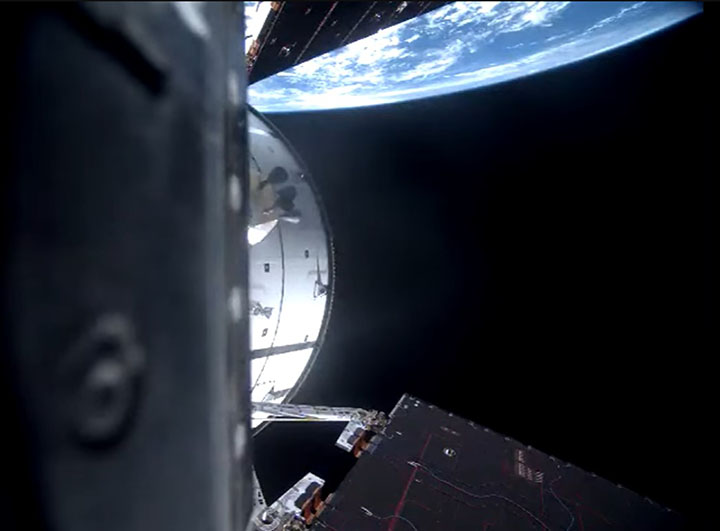
Because right now — as you’re reading this — four human beings are hurtling through deep space for the first time in over half a century. Their spacecraft, a NASA Orion capsule they’ve named “Integrity,” is on its way to the Moon. It launched on April 2, 2026. The world held its breath. And history happened again.
Stay with us to the end. We promise you’ll come away understanding not just the mission, but why this moment matters — for science, for humanity, and maybe even for you personally.
📖 Table of Contents
- What Is Artemis 2, and Why Is Everyone Talking About It?
- Who Are the Four Astronauts Making History?
- How Did Orion Break Free from Earth’s Gravity?
- How Far Will Artemis 2 Go? The Distance Record Explained
- What’s Life Like Inside Orion — 400,000 km from Home?
- What Will Happen During the Lunar Flyby on April 6?
- What Science Is Happening Right Now on Board?
- What Comes After Artemis 2?
- Our Final Thoughts
The Return to Deep Space: Why Artemis 2 Is the Mission the World Has Been Waiting For
Here’s a fact that might hit harder than you expect: the last time a human being traveled beyond low Earth orbit was December 1972. That was Apollo 17. Eugene Cernan stepped off the Moon, climbed back into the lunar module, and became the last person to stand on another world. For 54 years, we never went back.
Until now.
The Artemis 2 mission is NASA’s first crewed lunar flight test — the second flight of the mighty Space Launch System (SLS) rocket and the Orion spacecraft. It won’t land on the Moon this time. But it will take four astronauts on a free-return trajectory around it — looping past the far side, snapping photos, running experiments, and proving that Orion and its systems can keep humans alive in deep space.
This 10-day mission is the dress rehearsal. And the audience is eight billion people watching from Earth.
Who Are the Four Astronauts Making History?
These aren’t just four names on a flight manifest. Each one carries a story — and a piece of history that belongs to all of us.
| Name | Role | Agency | Historic First |
|---|---|---|---|
| Reid Wiseman | Commander | NASA | Leads the first crewed deep-space mission since Apollo 17 |
| Victor Glover Jr. | Pilot | NASA | First Black person to travel to the Moon |
| Christina Koch | Mission Specialist | NASA | First woman to travel on a lunar mission |
| Jeremy Hansen | Mission Specialist | CSA (Canada) | First Canadian to travel to the Moon |
NASA announced this crew back in April 2023. Three of them — Wiseman, Glover, and Koch — are seasoned astronauts with Space Station experience. For Hansen, Artemis 2 is his first-ever spaceflight. Imagine that: your first trip to space, and you’re flying past the Moon.
What makes this crew even more meaningful is what they represent as a collective. For the first time, a woman and a person of color are heading toward lunar space. That’s not just symbolism — it’s a statement about who science belongs to. It belongs to everyone. It always has.
How Did Orion Break Free from Earth’s Gravity?
The Launch: April 2, 2026, 00:35 Italian Time
The SLS rocket lifted off from Launch Pad 39B at Kennedy Space Center. Watching a rocket leave this pad feels almost mythological — it’s the same pad where Saturn V sent Apollo crews to the Moon. At 00:35 Italian time on April 2, SLS did it again, depositing Orion into Earth orbit with flawless precision.
Once in orbit, the crew deployed four solar panels — together they span about 19 meters, like the wingspan of a small regional plane. For the next 24 hours, engineers ran system checks while the crew rested. Their alarm clock? The song “Sleepyhead” by Young and Sick, playing through Mission Control at 13:06 Italian time. Not a bad way to wake up in orbit.
The TLI Burn: The Moment That Changed Everything
The critical moment — the point of no return — came at 01:49 on April 3. That’s when Orion fired its main engine in what engineers call the Trans-Lunar Injection (TLI) burn.
Think of it this way: Earth’s gravity is like a giant bowl. Orion was sitting at the rim. The TLI burn was the push that sent it flying over the edge — past the point where Earth can pull it back, and toward the Moon.
⚙️ The Physics Behind the TLI BurnΔv = v_escape − v_orbitΔv ≈ 388 m/s (≈ 1,274 ft/s for Artemis 2)Propellant burned ≈ 450 kgBurn duration: 5 min 55 secSpacecraft mass at TLI: ≈ 26,000 kgWhere Δv = velocity change needed to transition from Earth orbit to trans-lunar trajectory. Source: NASA / Focus.it
The burn lasted exactly 5 minutes and 55 seconds. The engine consumed around 450 kg of propellant to accelerate a spacecraft weighing 26,000 kg fast enough to escape Earth’s gravitational grip. Mission controller Chris Birch broke the silence: “Integrity, that looks like a good burn.”
For the first time since Apollo 17 in December 1972, human beings were heading toward the Moon.
How Far Will Artemis 2 Go? The Distance Record, Explained
Here’s where the numbers get genuinely jaw-dropping.
The furthest any crewed spacecraft has ever traveled from Earth was set during Apollo 13 in April 1970. Due to an oxygen tank explosion, the crew had to swing around the Moon without landing, reaching a maximum distance of 400,171 km (248,655 miles). For 56 years, that record stood unchallenged.
| Mission | Year | Max Distance from Earth | Crewed? |
|---|---|---|---|
| Apollo 8 | 1968 | ~377,349 km | Yes |
| Apollo 11 | 1969 | ~384,400 km (orbit) | Yes |
| Apollo 13 (prev. record) | 1970 | 400,171 km | Yes |
| Artemis 1 (uncrewed) | 2022 | > 432,000 km | No |
| 🚀 Artemis 2 (Integrity) | 2026 | ~403,233 km | Yes ✓ |
At its furthest point, Orion “Integrity” will carry its crew to approximately 403,233 km from Earth. That’s the new human crewed distance record. A figure that will stand in history books alongside the names of Wiseman, Glover, Koch, and Hansen.
What’s Life Like Inside Orion — 400,000 km from Home?
Space travel looks glamorous in films. The reality inside Orion is more like camping in a car-sized fridge. The temperature dropped quite cold after launch — cold enough that pilot Victor Glover reportedly wished he’d brought different sleeping bags. Mission Control is working on warming the cabin. Even at the cutting edge of spaceflight, comfort is a work in progress.
Exercise in Zero Gravity: 14 kg, 180 kg of Load
Without gravity, muscles weaken fast. The crew uses an ingenious flywheel device weighing only 14 kg, yet simulating resistance loads of up to 180 kg. It works through inertia — spin the flywheel, then resist its deceleration. A full aerobic and resistance workout, in a capsule with strict mass limits. Clever engineering at its finest.
Science Already Running on Day One
Before the TLI burn, the crew had completed a manual piloting demonstration — approaching the spent ICPS upper stage, essentially practicing a future docking maneuver in space. They also deployed four CubeSats into Earth orbit. Small satellites, significant science: each carries instruments feeding data back to researchers on the ground.
What Will Happen During the Lunar Flyby on April 6?
Mark your calendar: Monday, April 6, 2026. That’s when Artemis 2 reaches its closest approach to the Moon, skimming the far side at an altitude of approximately 6,513 km. The flyby will last about six hours of observations — long enough to change how we see the Moon forever.
The crew will photograph the lunar surface at high resolution. Ancient lava flows, ridge systems, crater chains — all studied from an angle no Apollo crew ever had. The Sun’s low grazing angle at lunar dawn will cast long shadows across the terrain, making every geological feature pop like a sculpture under raking light.
A Solar Eclipse That Only Four People Will Ever See (From There)
Toward the end of the flyby, something remarkable happens. From Orion’s perspective, the Sun will pass behind the Moon — creating a solar eclipse lasting nearly one hour. Only four humans will witness it from that exact vantage point.
During that eclipse, the crew can observe the solar corona — the Sun’s outer atmosphere, normally invisible from Earth’s surface except during a brief total eclipse. They’ll also watch for sudden flashes: the bright, brief signatures of meteoroid impacts on the lunar surface. And if they look outward into the darkness, past the Moon, they may spot deep-space objects — planets floating in a black sky, undistorted by any atmosphere.
What Science Is Happening Right Now on Board?
One experiment already has our attention: AVATAR. Not the film. AVATAR is a scientific study examining the effects of deep-space radiation on biological tissue — specifically on “organ-on-chip” devices. These tiny engineered structures mimic how human organs behave. Exposing them to the radiation environment beyond Earth orbit gives researchers data no laboratory can replicate.
Why does this matter? Before we send humans to Mars — a journey lasting two or more years — we need to understand exactly what deep-space radiation does to a human body, cell by cell. AVATAR is a small experiment with enormous implications.
What Comes After Artemis 2?
Artemis 2 isn’t the destination. It’s the proving ground. If Orion performs well — if life support, guidance, and reentry systems all check out — the path opens to Artemis 3, which plans to land astronauts on the lunar south pole. From there, a sustained human presence near the Moon becomes possible, including the Gateway orbital outpost.
And beyond the Moon? The long game is Mars. Every lesson learned on Artemis 2 — from managing deep-space radiation to keeping four humans warm and healthy in a confined capsule for 10 days — feeds directly into plans for interplanetary travel. We’re not just going back to the Moon. We’re using it as a stepping stone.
Why This Moment Belongs to All of Us
Let’s be honest — space exploration can feel distant. Like something that happens on screens, far from everyday life. But Artemis 2 is a reminder that every single one of us is connected to this. The Moon doesn’t belong to any one country, agency, or crew. It belongs to the species that keeps looking up.
Four people are out there right now. Riding a spacecraft through the void, 400,000 km from anything resembling home. And they’re doing it for all of us — for every child who ever pressed their face against a window on a clear night and felt something shift inside them.
Here at FreeAstroScience, staying curious is an act of resistance. The sleep of reason breeds monsters — and science is one of the most powerful torches we carry. Our mission is to make sure you never feel alone in the questions you ask about the universe. We walk this road alongside you, from the launch pad to the far side of the Moon and beyond.
We also take our responsibility to accuracy seriously. In a world drowning in misinformation, FreeAstroScience protects you — by going to primary sources, checking the numbers, and explaining science with honesty. You deserve nothing less.
Come back to FreeAstroScience.com as Artemis 2 continues its journey. We’ll be tracking every burn, every photograph, and every milestone. The Moon is calling. Let’s listen together.