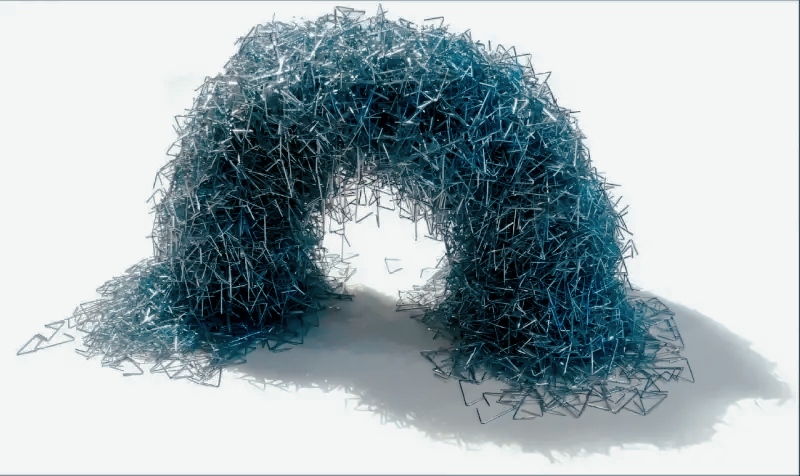
Researchers at CU Boulder are investigating how the simple “entanglement” of objects like paperclips can inspire a new class of materials. By focusing on particle geometry rather than chemical bonds, they are developing structures that combine surprising strength with the ability to be easily disassembled and recycled.
From natural blueprints to geometrical engineering
The concept of structural entanglement is deeply rooted in the natural world, where disparate elements combine to form cohesive units without the need for chemical adhesives. Bird nests, constructed from brittle twigs, and the matrix of minerals and proteins in bone serve as primary examples of how interlocking geometries provide exceptional durability. By shifting the focus from the chemical composition of a material to the specific shape of its constituents, engineers are learning to replicate these natural bonds in synthetic environments.
Traditional materials, such as sand, fail to achieve this level of cohesion because their convex, smooth surfaces prevent interlocking. However, by utilizing Monte Carlo simulations and advanced computational analysis, the research team identified that modifying particle geometry—specifically by introducing “legs” or hook-like protrusions—allows for a dramatic increase in mechanical stability. This transition from convex to non-convex shapes enables particles to snag and weave into one another, creating a unified mass that resists separation.
The research group emphasizes that this approach moves beyond the limitations of traditional materials science. By treating the shape of the particle as the primary driver of performance, they can tune the mechanical response of the entire system. This methodology allows for the creation of materials that are not only strong but also fundamentally predictable in their behavior across various physical scales.
The duality of strength and reversible assembly
One of the most significant findings of the study is the simultaneous achievement of high tensile strength and toughness, a combination rarely found in conventional materials. In a series of pull-out tests, particles shaped like two-legged clips demonstrated a remarkable ability to distribute stress across the entire network. This collective behavior allows the “tangled” mass to function as a solid object under tension, yet remain flexible enough to absorb energy without catastrophic failure.
Beyond static strength, these materials exhibit a unique property of controlled reconfigurability through mechanical vibration. The researchers discovered that specific vibrational patterns could either tighten the entanglement, reinforcing the structure, or cause it to unravel completely into its individual components. This capacity for rapid assembly and disassembly suggests a future where materials are not permanently fixed in one state, but can be transitioned between solid-state rigidity and fluid-like flow on demand.
Professor Barthelat and his team find the “exotic” sensation of these materials particularly intriguing, as they occupy a middle ground between solids and liquids. This strange physical state is what allows the material to be manipulated with such precision. The ability to switch between these states using simple external stimuli like vibration represents a major leap forward in the design of adaptive engineering systems.
Sustainable infrastructure and the future of robotics
The practical applications for these interlocking materials extend into the realms of sustainable engineering and advanced robotics. Because the particles are held together by geometry rather than permanent bonds, large-scale structures like bridges or buildings could theoretically be “unzipped” and recycled at the end of their lifecycle. This modular approach to construction would significantly reduce waste and allow for the immediate reuse of building components in new configurations, aligning with global goals for a circular economy.
Furthermore, the technology holds transformative potential for “swarm robotics,” where small, independent units could interlock to form complex tools or structures before separating to perform individual tasks. While large-scale manufacturing remains a challenge, the team is currently experimenting with even more complex geometries, such as burr-like particles with multiple protrusions. By maintaining a focus on counterintuitive designs and bio-inspired mechanics, these engineers are paving the way for a new generation of adaptable, resilient, and eco-friendly materials.
The ultimate goal of the CU Boulder team is to refine these shapes to the point where they can be produced at an industrial scale. Current experiments with hooked, “burr-like” shapes suggest that the next generation of these materials will be even more tenacious and versatile. Despite the complexity of the task, the researchers remain committed to this unconventional path, driven by the belief that the most resilient solutions are often hidden in the simplest geometries.
The study is published in the Journal of Applied Physics.