Recent observations conducted with the James Webb Space Telescope (JWST) have challenged established models of galactic evolution. An international team of astronomers, led by Roberto Maiolino of the University of Cambridge, has provided evidence suggesting that supermassive black holes may have formed before the galaxies that eventually surrounded them. This discovery offers a potential resolution to long-standing enigmas regarding the origins of these immense cosmic objects.
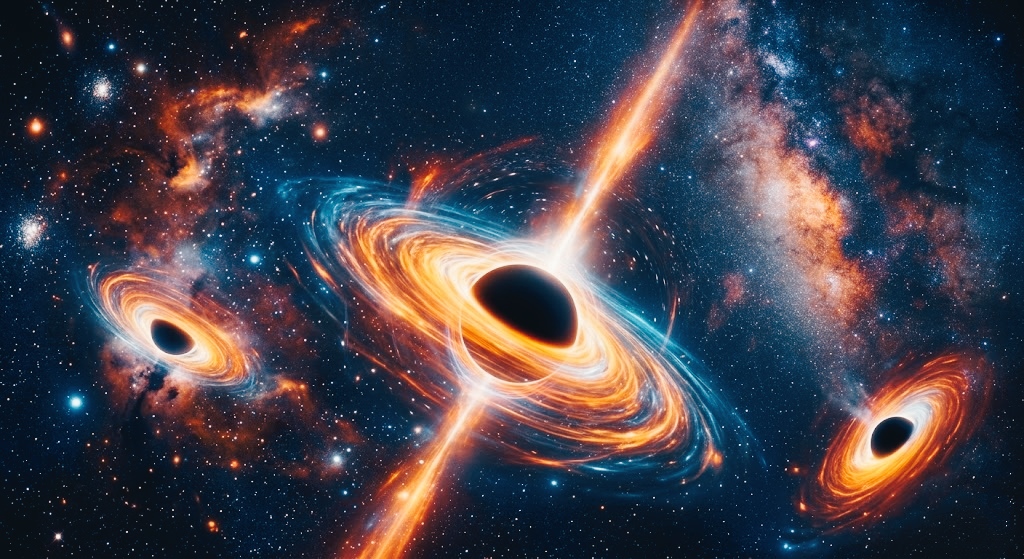
The primacy of supermassive black holes in the early universe
Supermassive black holes possess masses billions of times greater than that of the Sun, representing a significant challenge for current cosmological models. According to traditional theories, these objects grow by consuming gas from surrounding disks, but their expansion is theoretically limited by the Eddington threshold. Beyond this point, radiation pressure becomes so intense that it overcomes gravitational pull, effectively halting the accretion of new material.
The primary difficulty for astronomers is that supermassive black holes have been observed just a few hundred million years after the Big Bang. This timeframe is considered too brief for stellar-remnant black holes to reach such massive proportions while adhering to the accretion limits imposed by physics. Consequently, scientists have proposed alternative scenarios, including periods of hyper-rapid growth or the existence of massive “heavy seeds” present at the dawn of time.
In the heavy seed scenario, supermassive black holes form already massive through the direct collapse of vast primordial matter clouds. This mechanism allows for the presence of immense objects in the early universe without the need for billions of years of gradual growth. The research conducted by Maiolino’s team focused on evaluating these early-stage formation theories to explain the rapid emergence of cosmic giants in the infant universe.
Spectroscopic analysis of QSO1 and little red dots
To investigate these possibilities, the team performed a comprehensive analysis of QSO1, a supermassive black hole visible from a time when the universe was only 700 million years old. This object belongs to a class known as “Little Red Dots,” which are enigmatic sources observed for the first time by the JWST. By utilizing gravitational lensing from a foreground galaxy cluster, the researchers were able to magnify the light from QSO1 for a clearer view.
The researchers employed integral field spectroscopy to resolve the “sphere of influence” of the black hole, where gas movements are dictated entirely by its gravity. This technique allowed for the direct measurement of the black hole’s mass with unprecedented accuracy. Furthermore, the high-resolution data enabled the team to analyze the chemical composition of the surrounding gas by measuring emissions of ionized hydrogen and oxygen.
The resulting data provided a detailed look at a nascent system where the gravitational signature of the central body is disproportionately strong. Unlike typical black holes in the local universe, QSO1 lacks the standard X-ray signatures often associated with advanced accretion. This specific observational focus provided the clarity needed to distinguish between the mass of the black hole and the stars within its fledgling host galaxy.
Chemical composition and the heavy seed hypothesis
The spectroscopic analysis revealed that QSO1 is immersed in an environment with an extremely low level of chemical enrichment. Heavier elements can only be produced through nuclear fusion within stars and dispersed via supernova explosions. The team discovered that the abundance of oxygen relative to hydrogen near QSO1 is less than one percent of the solar value, indicating a nearly pristine, metal-poor gas composition.
This chemical purity suggests that very few stars had formed in the vicinity of QSO1, implying that the black hole is significantly more massive than its surrounding galactic system. These findings support a scenario where the black hole forms first, acting as a gravitational anchor before the majority of the host galaxy develops. This directly contradicts the traditional assumption that black holes grow within pre-existing, star-rich environments.
Ultimately, these results align most closely with the “heavy seed” model of black hole formation. Maiolino’s team hopes that this discovery will lead to a long-awaited breakthrough in our understanding of how the most massive structures in the cosmos were born. By identifying that black holes can precede their host galaxies, the study fundamentally alters the timeline of early cosmic construction and the evolution of the first galatic systems.
This study has been published in the Monthly Notices of the Royal Astronomical Society.