When Black Holes Turn Into Cosmic Detectors
What if the biggest missing piece in modern physics has been sitting quietly on a hard drive for the past seven years, waiting for someone to ask the right question?
Welcome, dear reader. We’re glad you’re here. This article was written for you by FreeAstroScience.com, where we take knotty scientific ideas and explain them in plain words. Today we’re looking at a fresh and genuinely exciting claim: archived gravitational wave data might hold the first faint fingerprint of dark matter. We’ll walk through the discovery, the science behind it, and — because we respect your intelligence — the reasons to stay calm. Stick with us to the end. The full picture is more honest, and more beautiful, than any headline can capture.
What you’ll find on this page
- How did we learn to hear the universe?
- What happens when black holes crash inside a dark matter cloud?
- Which signal made physicists stop and stare?
- Why are the scientists themselves telling us to slow down?
- What could dark matter actually be?
- Why does turning black holes into laboratories change the game?
How did we learn to hear the universe? {#hear-universe}
For most of human history, we studied the cosmos with our eyes. Light was the only messenger we knew how to read.
Then, in 1916, Albert Einstein changed the rules. His theory of general relativity described gravity not as a mysterious pulling force, but as the shape of spacetime itself, bent by mass. He went further. He predicted that violently moving giants — colliding black holes, for instance — would shake spacetime and send out ripples travelling at the speed of light.
Beautiful idea. The trouble was proof.
Einstein’s ripples stayed unconfirmed for almost a century. A small, stubborn doubt lingered in the scientific community. Were these waves real, or just elegant math?
The answer arrived in 2015. Ground-based observatories caught a cosmic ripple for the very first time. Imagine waiting a hundred years for a phone to ring — and then it rings.
In the decade that followed, scientists recorded hundreds of these events. Each one is a tiny message. Each one carries precise information about the masses of the objects involved and the violent dynamics of their final embrace. Most detections describe black hole mergers of many sizes, neutron stars smashing together, or a black hole swallowing a stellar leftover. A few rare signals show oddities strange enough to make researchers whisper about wormholes.
So here’s the question the field is now asking. Inside these crowded, complicated signals, could there be clues to other great cosmic puzzles?
One puzzle stands taller than the rest. Einstein’s idea, in one line
Gμν = (8πG ÷ c4) · Tμν Read it plainly: the curve of spacetime on the left equals the matter and energy on the right. Mass tells space how to bend. Bent space tells matter how to move. Gravitational waves are that bending, set loose and racing outward at the speed of light.
What happens when black holes crash inside a dark matter cloud? {#dark-matter-cloud}
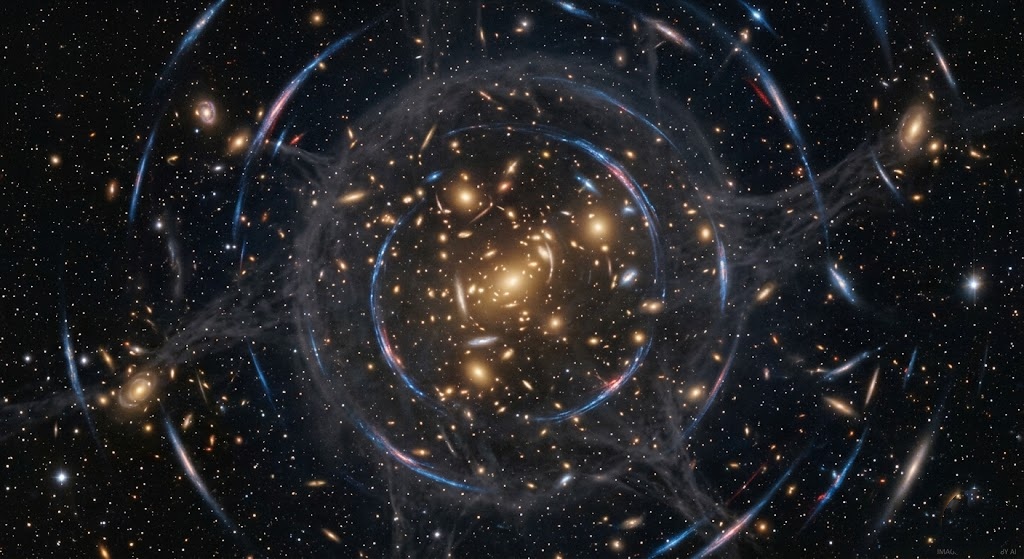
Dark matter is the longest-running mystery in astronomy. We’ve never seen it, touched it, or caught a single particle of it. Yet we keep inviting it to the table, because galaxies behave as though something invisible holds them together. Whatever it is, it seems to talk to ordinary matter through one language only: gravity.
One respected model proposes that dark matter is built from ultralight particles. So light, in fact, that in extreme places they stop acting like separate specks and start behaving like a single collective wave.
Now picture a spinning black hole. Its gravity is monstrous. That gravity could grab the dark matter around it and drag it along, building a thick cloud — almost a fog of invisible substance — circling the black hole.
Here’s where it gets clever.
When two black holes spiral toward each other inside such a fog, the fog pushes back. This drag is called dynamical friction. It nudges the black holes, changes their speed, and bends their path during the long approach before impact. And a changed dance produces a changed song. The gravitational waves leaving that merger would carry specific frequencies and geometric features — small details that set them apart from waves born in empty space.
The research team modelled this carefully. They simulated how a “fog-altered” signal would look by the time it reached our detectors on Earth.
The table below shows the contrast they were hunting for. Highlight the suspicious signal
| Feature of the event | Merger in the vacuum | Merger inside a dark matter cloud |
|---|---|---|
| Surrounding environment | Empty interstellar space | A dense fog of invisible substance |
| Path of the black holes | A clean, undisturbed spiral | Speed and trajectory shifted by dynamical friction |
| Shape of the wave signal | Standard, predictable pattern | Extra geometric features and specific frequencies |
| Count among 28 LVK signals tested | 27 events matched this profile | 1 event matched — GW190728 |
Which signal made physicists stop and stare? {#gw190728}
The team took their mathematical model and pointed it at the real archive. They tested 28 actual signals collected by the LVK network — the global partnership that links the LIGO, Virgo, and KAGRA observatories.
Twenty-seven of those events behaved exactly as a clean, vacuum-born merger should. Ordinary, in the best sense of the word.
One did not.
An event named GW190728 showed a pattern that lined up perfectly with two black holes colliding while wrapped inside a dense dark matter cloud. Not a forced fit. Not a stretch. A clean match with the prediction.
Sit with that for a moment. A signal recorded in 2019, archived, catalogued, and seemingly understood — turned out to possibly hold a message we didn’t yet have the tools to read. The data didn’t change. Our questions did. That’s how science often moves: not by collecting something new, but by finally knowing what to look for in what we already have.
Why are the scientists themselves telling us to slow down? {#slow-down}
Here is the part a responsible blog cannot skip. We promised you the honest picture, so let’s keep that promise.
The authors of the study are not popping champagne. They’re asking everyone — themselves included — to resist drawing fast conclusions.
Why the caution? One promising signal is not a discovery. The statistical strength of a single event isn’t high enough to plant a flag. In physics, a real claim needs independent research groups to run their own tests, with their own methods, and reach the same result. Until that happens, GW190728 is a fascinating candidate, not a verdict.
There’s a quieter point hidden in this caution, and it might be the most valuable takeaway of all. The researchers warn that without new models like theirs, mergers happening inside dark matter would keep being filed as ordinary events. We could be misreading our own archive — not from carelessness, but from a lack of the right lens. That alone is worth the price of admission.
Honest uncertainty isn’t weakness. It’s the engine. A field that knows the limits of its own evidence is a field you can trust.
What could dark matter actually be? {#what-is-dark-matter}
Part of the reason this road is long: we still don’t know what dark matter is. Its true form remains unknown, and the list of suspects is wide open.
- WIMPs — weakly interacting massive particles, a long-favoured candidate.
- Ultralight wave-like particles — the model behind the black-hole-fog idea in this study.
- Compact macroscopic bodies — larger, dense objects rather than tiny particles.
- Primordial black holes — minuscule black holes formed in the universe’s first moments.
- No dark matter at all — perhaps the anomalies are telling us our theory of gravity itself needs a rewrite.
That last option deserves respect. Maybe nothing invisible is hiding out there. Maybe Einstein’s masterpiece, for all its triumphs, is incomplete at cosmic scales. Good scientists keep that door open. The messenger’s speed
vgravitational wave = c Gravitational waves travel at exactly the speed of light, c ≈ 299,792 km/s. That’s why a ripple from a collision billions of light-years away can still reach a detector on Earth — and why a cloud of dark matter along the way would leave its mark on the journey.
Why does turning black holes into laboratories change the game? {#laboratories}
Step back, and the bigger meaning comes into focus.
For decades, we’ve chased dark matter with detectors buried deep underground and instruments scanning the sky. This approach flips the strategy. It treats black holes as natural laboratories — instruments the universe built for us, free of charge.
The payoff is remarkable. Gravitational waves let us probe space at astonishingly tiny geometric scales, right around the merging black holes. Knowing the environment where stellar collisions happen does two jobs at once. It helps us map where dark matter sits. And it sharpens our models of how stars live and die.
We won’t have certainty soon. Confirming any of this will take fresh data and a new generation of more sensitive detectors. The open question is genuinely thrilling: did humanity, back in 2019, brush right up against the solution to one of the universe’s deepest riddles — and simply not realise it at the time?
The new research has been published in the journal Physical Review Letters.
A final thought from all of us at FreeAstroScience
Let’s gather the threads. Einstein imagined gravitational waves in 1916. We caught our first one in 2015. A new theoretical model now suggests that black holes colliding inside dark matter would sing a slightly different song — and when researchers applied that model to 28 archived signals, the event GW190728 stood out as a possible match. It’s not proof. It’s a lead, an honest one, that needs independent confirmation and better instruments.
What stays with us isn’t the single signal. It’s the lesson underneath it. The breakthrough didn’t come from new data. It came from a new question asked of old data. Knowledge already in our hands changed meaning the moment we looked at it differently.
That’s why FreeAstroScience exists, and why we wrote this for you. We want you to never switch off your mind, never stop questioning, never let curiosity go quiet. The sleep of reason breeds monsters. An awake, curious mind is the finest instrument any of us will ever own — more sensitive, in its own way, than LIGO itself.
And if the cosmos can feel vast and lonely, remember this: every person who has ever looked up and wondered is standing right beside you. You’re not alone in the dark. You’re part of the long, stubborn, hopeful effort to understand it.
Come back to FreeAstroScience.com soon. There’s always more sky to read together.
Sources & further reading
- Meloni, D. — “Materia oscura: i dati d’archivio delle onde gravitazionali offrono una possibile svolta”, Reccom Network, 19 May 2026.
- Original peer-reviewed study published in Physical Review Letters.
- Background on the global detector network: LIGO, Virgo and KAGRA (the LVK collaboration).
This article was researched and written for you by FreeAstroScience.com, where we explain complex scientific principles in simple terms — so you can keep your mind awake, always.