
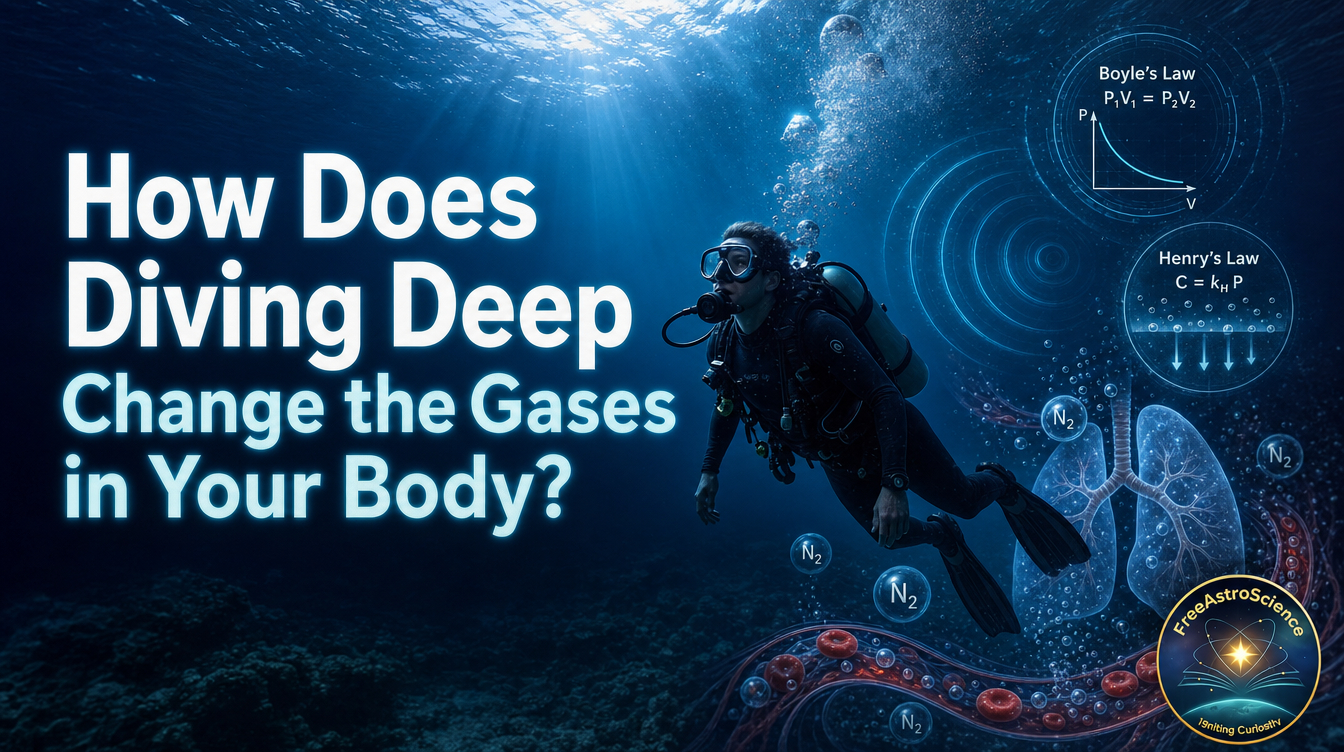
Have you ever wondered what really happens to the air you breathe when you plunge beneath the waves? Welcome to FreeAstroScience.com, where we break down the science that keeps you alive underwater. I’m Gerd Dani—blogger, copywriter, physicist, and President of Free Astroscience. Today, we’re going to explore the invisible forces that shape every breath you take as a diver. Here, we believe that turning off your mind is never an option—because the sleep of reason breeds monsters. So, whether you’re a seasoned diver, a science lover, or just curious, stick with us to the end. You’ll see how the laws of physics become your closest friends—and sometimes your fiercest enemies—when you go deep.
Table of Contents
- The Ocean Has Its Own Rules: Understanding Pressure Underwater
- Boyle’s Law: How Depth Squeezes the Air Out of Everything
- Dalton’s Law: Every Gas in the Mix Has Its Own Pressure
- Henry’s Law: What Happens to Nitrogen in Your Body When You Dive
- Nitrogen Narcosis: The Martini Effect at 30 Meters
- Oxygen Toxicity: When Life’s Most Essential Gas Becomes a Threat
- Decompression Sickness: Why Coming Up Too Fast Can Kill You
- Beyond Air: Nitrox, Trimix, and Why Deep Divers Breathe Helium
- How Does a Scuba Regulator Actually Work?
- The Numbers That Keep Divers Alive — At a Glance
- Conclusion: Physics Is the Real Dive Master
When You Go Deep, Physics Takes Over
The Ocean Has Its Own Rules: Understanding Pressure Underwater
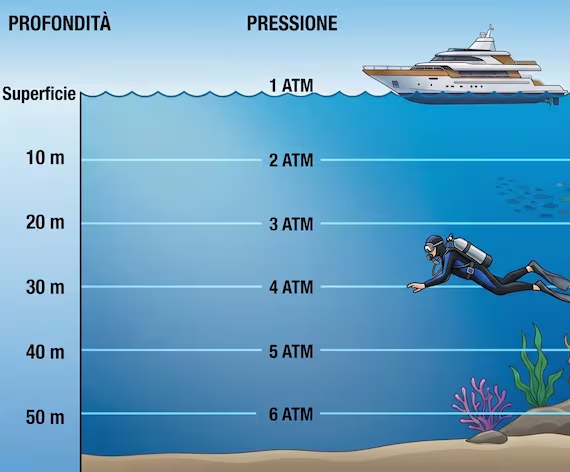
Let’s start with the basics. At the surface, we live under 1 atmosphere (atm) of pressure—about 1 kilogram per square centimeter pressing on every bit of our skin. We don’t notice it, because our bodies are built to handle it. But water is a different beast. It’s about 800 times denser than air. For every 10 meters (33 feet) you descend, the pressure goes up by another 1 atm. So, at 10 meters, you’re under 2 atm. At 30 meters, it’s 4 atm. At 40 meters, you’re feeling 5 atm. That’s five times the pressure you’re used to.
This extra weight changes everything. It squeezes the air in your lungs, your mask, your buoyancy control device (BCD)—even the bubbles in your blood. The deeper you go, the more the rules of the surface world fade away. Down here, physics calls the shots.
Boyle’s Law: How Depth Squeezes the Air Out of Everything
The Formula That Can Save Your Life
Boyle’s Law:P1V1 = P2V2
(At constant temperature, the pressure and volume of a gas are inversely related.)
If you double the pressure, the gas volume halves. Triple the pressure, and the volume shrinks to a third. At 10 meters (2 atm), the air in your lungs or BCD is half its surface volume. At 30 meters (4 atm), it’s just a quarter.
What This Means When You’re 30 Meters Down
Your scuba regulator is a marvel. It delivers air at the same pressure as the water around you. That’s why you can breathe at depth at all. But here’s the catch: if you hold your breath and ascend, the air in your lungs expands as the pressure drops. That can tear lung tissue—causing arterial gas embolism, pneumothorax, or mediastinal emphysema. Never, ever hold your breath on the way up.
Air consumption is another surprise. An 80-cubic-foot tank might last an hour at the surface. At 20 meters (3 atm), it’s down to about 20 minutes. At 30 meters (4 atm), you get just 15 minutes. And don’t forget your BCD: you’ll need to add air as you go down (to stay neutrally buoyant) and vent it as you come up, or you’ll shoot to the surface like a cork.
Dalton’s Law: Every Gas in the Mix Has Its Own Pressure
Dalton’s Law:Ptotal = P1 + P2 + … + Pn
(The total pressure is the sum of the partial pressures of each gas in the mix.)
Air is about 21% oxygen and 79% nitrogen. At the surface (1 atm), the partial pressure of oxygen (pO₂) is 0.21 atm, and nitrogen (pN₂) is 0.79 atm. At 30 meters (4 atm), pO₂ jumps to 0.84 atm, and pN₂ to 3.16 atm. These numbers matter. They set the limits for safe diving. Go too deep, and you risk nitrogen narcosis or oxygen toxicity. Dalton’s Law is the backbone of every dive table and computer.
Henry’s Law: What Happens to Nitrogen in Your Body When You Dive
Henry’s Law:C = kH × P
(The amount of gas dissolved in a liquid is proportional to its partial pressure.)
As you go deeper, the pressure rises, and more nitrogen dissolves into your blood and tissues. Fast tissues like blood and brain soak it up quickly. Slow tissues—like fat and bone—take their time. The longer and deeper you stay, the more nitrogen your body absorbs. This is called “nitrogen loading.”
Cold water makes things worse: gases dissolve more easily. Take a hot shower right after a dive, and you might speed up bubble formation as the gas comes out of solution. If you ascend too fast, nitrogen leaves your tissues faster than your lungs can get rid of it. Bubbles form. That’s decompression sickness—the bends. That’s why we make decompression stops: to let nitrogen escape safely.
Nitrogen Narcosis: The Martini Effect at 30 Meters
Some call it “rapture of the deep.” Sounds poetic, but it’s deadly serious. The Meyer-Overton hypothesis says nitrogen dissolves into the fatty membranes of nerve cells, scrambling the signals. At around 30 meters (pN₂ ~3 atm), most divers start to feel it. At 40 meters, it can be dangerous.
There’s an old joke: every 10 meters down is like drinking a martini. You might feel euphoric, but your judgment, memory, and coordination slip away. Some get anxious, others hallucinate. At extreme depths, you can slip into a stupor or even coma. The real danger? You might not realize you’re impaired. Bad decisions—like a panicked ascent—can be fatal.
The good news: symptoms vanish within minutes as you ascend. But fatigue, cold, anxiety, alcohol, and high CO₂ make narcosis worse. That’s why most agencies cap recreational air dives at 40 meters. Technical divers swap nitrogen for helium (in trimix) to dodge narcosis.
Oxygen Toxicity: When Life’s Most Essential Gas Becomes a Threat
Oxygen keeps us alive, but at depth, it can turn against us. The higher the pressure, the more oxygen you breathe in each lungful. CNS oxygen toxicity is the big risk. The safe working limit is a pO₂ of 1.4 bar. The absolute max—1.6 bar—is only for decompression stops, when you’re resting.
With standard air (21% O₂), you hit 1.4 bar at about 57 meters, and 1.6 bar at 67 meters. Breathe pure oxygen, and you reach 1.6 bar at just 6 meters. Symptoms? Tunnel vision, nausea, muscle twitching, dizziness, and—without warning—seizures. Underwater, a seizure almost always means drowning.
Pulmonary toxicity (lung damage) happens with long exposures to pO₂ above 0.5 bar. That’s more of a problem for commercial or saturation divers. Everyone’s risk is different, but high CO₂, exercise, cold, and immersion all make oxygen toxicity more likely. Dive computers track your exposure to keep you safe.
Decompression Sickness: Why Coming Up Too Fast Can Kill You
What Are the Symptoms of Decompression Sickness?
Decompression sickness (DCS) is the price you pay for breaking the rules of ascent. Type I DCS is mild: joint pain (the classic “bends”), skin rash, or swollen lymph nodes. It usually shows up within 15 minutes to 6 hours after surfacing. Type II is much worse: numbness, tingling, paralysis, chest pain, coughing blood, dizziness, vision problems, or even unconsciousness. Sometimes, symptoms are delayed up to 48 hours.
Bubbles block blood vessels, spark inflammation, and damage tissue. If they hit your brain or spinal cord, the damage can be permanent. In sport diving, DCS strikes about 3 times in every 10,000 dives.
How Is It Prevented and Treated?
Prevention is simple, but strict. Ascend slowly—no faster than 9 to 18 meters per minute. Always make a safety stop: 3 to 5 minutes at 5 meters. Stick to your dive tables or computer’s no-decompression limits (NDLs). Plan conservatively. And don’t fly for at least 12 to 18 hours after diving—airplane cabins are low-pressure, which can trigger DCS.
If DCS strikes, get to a hyperbaric chamber fast. High-flow 100% oxygen should be given right away. The sooner you get treatment, the better your chances.
Beyond Air: Nitrox, Trimix, and Why Deep Divers Breathe Helium
Air isn’t always enough. Nitrox—enriched air with 32–36% oxygen—lets you stay down longer at recreational depths, because there’s less nitrogen to absorb. But the higher oxygen means you hit toxicity limits sooner.
For dives beyond 40 meters, technical divers use trimix: a blend of oxygen, nitrogen, and helium. Helium has almost no narcotic effect and is much less dense than nitrogen, making it easier to breathe at depth. A typical trimix might be 21% O₂, 35% He, 44% N₂. For dives past 100 meters, helium can make up more than 80% of the mix.
But helium isn’t perfect. It conducts heat six times faster than air, so you get cold fast. It’s expensive and needs special decompression procedures, because it saturates and leaves tissues quickly. At extreme depths (over 150 meters), even helium can cause high-pressure nervous syndrome (HPNS), so a little nitrogen is kept in the mix to balance things out.
Every gas mix is calculated for the planned depth. Technical diving isn’t just about guts—it’s about math, training, and respect for the laws of physics.
How Does a Scuba Regulator Actually Work?
Your regulator is your lifeline. It takes the 200–300 bar (3000–4500 psi) in your tank and drops it down to what you can actually breathe.
It works in two stages:
- Stage 1: Attaches to the tank, drops the pressure to about 9–10 bar above the water pressure around you.
- Stage 2: The mouthpiece you breathe from. It matches the pressure of the water at your depth—so your lungs can inflate and deflate normally.
If your regulator gave you surface-pressure air at 30 meters, your lungs wouldn’t stand a chance against the 4 atm of water pressing in. At depth, air is denser, so breathing gets harder. That’s why helium, with its low density, is a favorite for deep dives. Modern regulators are built to work past 100 meters, but even the best gear can’t change the laws of physics. Work too hard at depth, and you risk CO₂ buildup and fatigue.
The Numbers That Keep Divers Alive — At a Glance
| Depth (m/ft) | Abs. Pressure (atm) | pO₂ in Air (bar) | pN₂ in Air (bar) | Gas Volume (vs. Surface) | Key Effects / Safety Notes |
|---|---|---|---|---|---|
| 0 / 0 | 1 | 0.21 | 0.79 | 1.0 | Normal breathing. Baseline for all calculations. |
| 10 / 33 | 2 | 0.42 | 1.58 | 0.5 | Air volume halves. Buoyancy drops. Air consumption doubles. |
| 20 / 66 | 3 | 0.63 | 2.37 | 0.33 | Air volume one-third. Nitrogen loading increases. Air use triples. |
| 30 / 99 | 4 | 0.84 | 3.16 | 0.25 | Nitrogen narcosis risk. Air use quadruples. DCS risk rises. |
| 40 / 132 | 5 | 1.05 | 3.95 | 0.20 | Max recreational depth. Severe narcosis. Air use x5. DCS risk high. |
| 50 / 165 | 6 | 1.26 | 4.74 | 0.17 | Technical only. Oxygen toxicity risk. Special gas mixes needed. |
| 60 / 198 | 7 | 1.47 | 5.53 | 0.14 | Technical only. CNS O₂ toxicity. Helium required. DCS risk extreme. |
| 100+ / 330+ | 11+ | 2.31+ | 8.69+ | 0.09 | Extreme technical. Heliox/Trimix only. HPNS, hypothermia, fatal risk. |
Conclusion: Physics Is the Real Dive Master
Three gas laws—Boyle’s, Dalton’s, and Henry’s—shape every moment underwater. They decide how much air you breathe, how your body absorbs gases, and what happens if you break the rules. The ocean doesn’t care about our biology or our dreams. Down there, physics is non-negotiable.
Every diver who checks their tables, watches their ascent, and respects the limits is doing physics homework with their life on the line. That’s not just smart—it’s heroic. At FreeAstroScience, we want you to keep your mind awake and your curiosity alive. The sleep of reason breeds monsters, but knowledge keeps you safe.
Come back to FreeAstroScience.com for more science, explained in plain language, with all the heart and honesty you deserve. The ocean is waiting. So is your next question.
References & Further Reading
- PADI: Professional Association of Diving Instructors
- Divers Alert Network (DAN)
- NCBI/NIH: Decompression Sickness and Diving Medicine
- Scuba Diving Magazine: The Physics of Scuba Diving
- NOAA: National Oceanic and Atmospheric Administration
- FreeAstroScience.com
- Filippo Bonaventura, Cosa succede ai gas che respiriamo quando scendiamo in profondità: la fisica delle immersioni subacq



Phim Heo HD, Xem Phim Heo Gái Bướm Múp Không Che Hay Nhất