What If Everything You Know About Time Is Wrong?
Stop for a second. Take a breath. Feel that moment pass?
Now — what if that “passing” never really happened? What if the ticking of every clock, the aging of every face, the fading of every sunset is not woven into the fabric of the universe, but is instead something your mind invented?
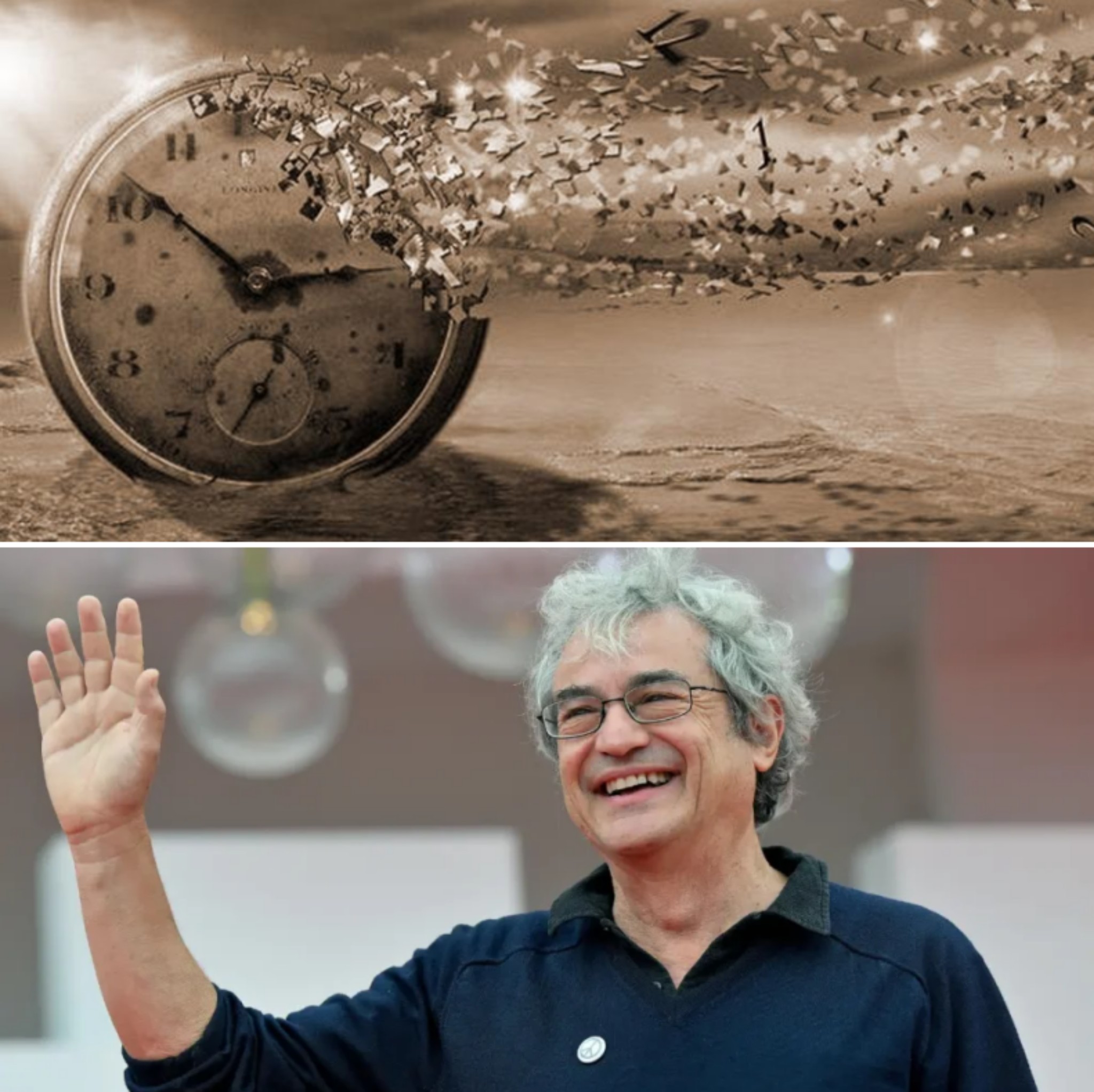
That’s exactly what theoretical physicist Carlo Rovelli argues. And he doesn’t say it lightly. He says it backed by decades of research in quantum gravity, armed with equations that describe the cosmos — equations where time simply doesn’t show up.
Welcome to FreeAstroScience.com, where we break down complex scientific ideas into language that feels like a conversation between friends. We’re here because we believe science belongs to everyone — not just those with PhDs. Whether you’re a physics student, a curious soul, or someone who just wonders why the clock on the wall keeps moving, this article is for you.

Stick with us. By the end, you’ll see time — the thing you’ve taken for granted your whole life — in a completely different light. And we promise: it won’t feel like homework. It’ll feel like a discovery.
📑 Table of Contents
- 1. Who Is Carlo Rovelli — and Why Should You Care?
- 2. Why Does Time Unravel in Modern Physics?
- 3. The Five Pillars of Time That Physics Demolishes
- 4. What Does a World Without Time Actually Look Like?
- 5. The Wheeler–DeWitt Equation: A Universe with No Clock
- 6. So Where Does Our Sense of Time Come From?
- 7. Not Everyone Agrees — And That’s Okay
- 8. What Does This Mean for You and Me?
1. Who Is Carlo Rovelli — and Why Should You Care?
Carlo Rovelli is an Italian theoretical physicist, a professor, and one of the founders of loop quantum gravity (LQG) — one of the most promising attempts to marry general relativity with quantum mechanics . He’s also a bestselling author. His 2017 book The Order of Time became a global sensation, translated into over 40 languages, read by millions of people who’d never cracked open a physics textbook.
But here’s what makes Rovelli different from your average physicist. He writes like a poet. He thinks like a philosopher. And he says things that make you stop mid-sentence and stare at the ceiling.
Things like: “There is no time variable in the fundamental equations that describe the world.”
That’s not a metaphor. That’s not clickbait. That is a direct statement about what happens when you look at the deepest equations of physics. Time — the thing we build our entire lives around — simply isn’t there.
2. Why Does Time Unravel in Modern Physics?
Let’s walk through this step by step, because it does sound wild at first. We get it. You check your watch. You feel the minutes drag during a meeting. You know Tuesday comes after Monday. So how can time not exist?
The short answer: the “time” you experience is real — to you. But the fundamental universe doesn’t need it. The longer answer requires a little trip through 20th- and 21st-century physics.
Einstein Rewrote the Rules
In 1905 and again in 1915, Albert Einstein showed us something shocking. Time doesn’t flow the same way for everyone.
A clock at sea level ticks slower than a clock on a mountaintop. A clock on a moving spaceship ticks slower than one sitting still. These aren’t tiny differences — GPS satellites have to correct for them every day, or your phone’s map would be off by kilometers.
What Einstein proved is that time is relative. It bends. It stretches. It depends on where you are and how fast you’re moving .
Quantum Mechanics Made It Stranger
At the quantum level — the level of atoms and subatomic particles — things get even weirder. The neat distinction between past and future starts to blur . If you filmed a sequence of particle interactions and played it backwards, you couldn’t tell the difference. Forward or reverse, both directions look equally valid .
The “arrow of time” we take for granted? At the smallest scales, it vanishes.
No Cosmic Metronome
Put it all together, and you arrive at Rovelli’s conclusion: contemporary physics does not need a universal cosmic metronome to function . There is no master clock ticking away somewhere in the background, counting the seconds for the whole cosmos.
3. The Five Pillars of Time That Physics Demolishes
In The Order of Time, Rovelli doesn’t just wave his hand and say “time isn’t real.” He’s more methodical than that. He dismantles time piece by piece, tearing apart five core assumptions we’ve held for centuries .
Let’s look at all five.
| Property | What We Assumed | What Physics Tells Us |
|---|---|---|
| Unity | Time flows at one universal rate. | Time is relative — it runs at different speeds depending on gravity and velocity. |
| Directionality | Time has an arrow: past → future. | At the particle level, physics equations work the same forwards and backwards. |
| The Present | There is a universal “now.” | There’s no shared present — “now” is local, not cosmic. Light cones define causal reach. |
| Independence | Time is an absolute backdrop. | Time is part of the gravitational field — it bends with matter and energy. |
| Continuity | Time flows smoothly, infinitely divisible. | At the Planck scale (~5.39 × 10⁻⁴⁴ s), time may be granular — it “jumps” rather than flows. |
Every single column on the right side of that table comes from our best physics — relativity, quantum mechanics, and loop quantum gravity .
No Universal “Now”
Let’s linger on the third row, because it’s a mind-bender. Imagine someone living on a planet four light-years away. What are they doing right now? The question has no answer. By the time light reaches us, four years have passed. If they’d been traveling near the speed of light, their clocks and ours have drifted apart beyond recognition .
The “present” isn’t a thin knife-edge slicing through the universe. It’s a bubble — your own personal, local bubble.
Granular Time at the Planck Scale
And that last row? Quantum mechanics suggests that below the Planck time — roughly 5.39 × 10⁻⁴⁴ seconds — time doesn’t flow continuously at all. It’s not a river. It’s more like a staircase, jumping from one step to the next with no in-between .
Planck Time
tP = √(ℏG / c5) ≈ 5.39 × 10−44 s
Where ℏ is the reduced Planck constant, G is the gravitational constant, and c is the speed of light. Below this scale, the standard concept of continuous time may break down entirely.
4. What Does a World Without Time Actually Look Like?
This is where people usually push back. “Fine,” they say, “you’ve dismantled time. So what’s left? A frozen, static universe?”
No. That’s the beautiful part. Rovelli insists the world without fundamental time is not static. It’s not dead. It’s actually more alive — just messier.
Events, Not Things
Here’s the key shift in thinking. Without time, we can’t have “things” in the traditional sense, because things need to persist across moments. Instead, Rovelli says reality is made of events — happenings, interactions, processes .
A rock isn’t a thing. It’s a slow event. A flame isn’t a thing. It’s a fast event. You aren’t a thing. You’re a pattern of events, constantly changing, constantly interacting.
Rovelli compares this to a storm. A storm isn’t an object sitting still somewhere. It’s a collection of occurrences — wind, rain, lightning, pressure shifts — all tangled together . That’s the universe. Not a museum of static objects, but a living storm of happenings.
Naples, Not Singapore
Here’s one of our favorite lines from Rovelli. He says a world without absolute time resembles Naples more than Singapore: “disorderly, vibrant, full of events that crowd together in an anarchic manner rather than lining up in an orderly fashion” .
If that doesn’t make you smile, read it again. The universe is a messy Italian city, not a perfectly organized airport. Events happen. Change is real. Things interact, evolve, surprise each other. They just don’t do it on a neat timeline.
5. The Wheeler–DeWitt Equation: A Universe with No Clock
Now let’s get a little more technical — but just a little. We won’t leave anyone behind.
In the 1960s, physicists Bryce DeWitt and John Archibald Wheeler wrote down an equation meant to describe the quantum state of the entire universe. It’s called the Wheeler–DeWitt equation, and it’s one of the most famous formulas in theoretical physics .
Here’s the jaw-dropping thing about it: the equation contains no time variable.
The Wheeler–DeWitt Equation (Simplified Form)
Ĥ |Ψ⟩ = 0
Where Ĥ is the Hamiltonian constraint operator and |Ψ⟩ is the wave function of the universe. Notice: there’s no t (time) anywhere. The equation describes a universe in which the quantum state simply is — it doesn’t evolve in time.
Compare that to the Schrödinger equation in ordinary quantum mechanics, which explicitly tracks how a quantum state changes over time:
Schrödinger Equation (Time-Dependent)
iℏ ∂|Ψ⟩/∂t = Ĥ |Ψ⟩
Here, t appears explicitly — the equation describes how the quantum state evolves in time.
The Wheeler–DeWitt equation wipes that t away entirely. In Rovelli’s framework of loop quantum gravity, this isn’t a bug — it’s a feature. The universe, at its most fundamental level, doesn’t need a clock .
6. So Where Does Our Sense of Time Come From?
If the fundamental equations don’t contain time, why does every fiber of your being scream that time is real? Why do you remember breakfast but not dinner tonight? Why do wrinkles only go one way?
Rovelli has an answer, and it’s one of the most elegant ideas in modern physics. Our sense of time emerges from entropy .
The Second Law: The Only Law That Cares About Direction
Here’s a fact that still gives us chills every time we read it:
Out of all the laws of physics — mechanics, electromagnetism, relativity, quantum mechanics — only one distinguishes past from future. Just one. The second law of thermodynamics .
🔥 The Second Law of Thermodynamics
Heat flows from hot objects to cold ones — never the other way around. Entropy (the measure of disorder) in a closed system tends to increase over time.
ΔS ≥ 0
This is the only equation in fundamental physics where reversing the direction of events produces something forbidden.
Every other law works just fine in reverse. Drop a ball, and the equations of gravity can run backwards — the ball flies back up. But a broken egg doesn’t unscramble. A cup of coffee doesn’t spontaneously heat up by cooling its surroundings.
In Rovelli’s words: “In the elementary equations of the world, the arrow of time appears only where there is heat.”
Three Ingredients That Create “Time” for Us
Rovelli identifies three sources that brew our everyday sense of time :
1. Thermodynamics and entropy. We remember the past because it was more ordered. We anticipate the future because disorder tends to increase. The arrow of time isn’t written into the fundamental laws — it’s a statistical tendency we observe because of how entropy works.
2. Thermalization and information. We don’t know every microscopic detail about the world around us. That ignorance — that blurred, incomplete picture — makes events appear irreversible at the macroscopic level. We see the cream swirl into the coffee and call it “time passing.”
3. Memory and the brain. Our neurons create memories. Those memories create a narrative. That narrative is what we call “the flow of time.” Without memory, there’s no past. Without anticipation, there’s no future. Time, in a very real sense, is a story our brains tell us.
As Rovelli puts it: “To understand time, physics in the strict sense is not enough. Time concerns thermodynamics, biology, psychology, our brain…”
7. Not Everyone Agrees — And That’s Okay
We wouldn’t be doing our job at FreeAstroScience if we pretended there’s a universal consensus on this. There isn’t — and that tension is part of what makes this topic so alive.
The Case Against Removing Time
A 2026 paper published on Zenodo directly challenges Rovelli’s position, arguing that the complete removal of time from fundamental theory is “neither mathematically consistent nor physically viable” . The authors argue that core structures in physics — quantum evolution, wave propagation, conservation laws, thermodynamics, even cosmological expansion — all require a time parameter to retain physical meaning.
Their position: “Time may be refined, reinterpreted, or extended — but it cannot be eliminated.”
That’s a fair counterpoint. And it highlights something worth remembering: science thrives on disagreement. The fact that brilliant people disagree about whether time exists at the fundamental level doesn’t mean one side is foolish. It means we’re standing at the edge of human understanding, squinting into the fog.
Skeptics Point to Missing Evidence
Others note that loop quantum gravity — the framework within which Rovelli’s timeless physics operates — lacks direct experimental confirmation. The quantization of space-time in LQG remains a theoretical prediction, not an observed fact .
That doesn’t make Rovelli wrong. It means the jury is still out. And that’s honest science.
8. What Does This Mean for You and Me?
Let’s bring this home, because we know what you might be thinking: “Okay, the equations don’t have time in them. But I’m still aging. My deadline is still tomorrow. What does this actually mean for my life?”
The Color Analogy
Rovelli himself offers the most comforting answer we’ve encountered. He compares time to color :
“Take colors, for example… science teaches us that they are the result of light interacting with the receptors in the retina… but we don’t need that to describe the physics of light.”
Red doesn’t exist as a fundamental property of electromagnetic waves. A photon with a wavelength of about 700 nanometers isn’t “red” — it’s just a wave. The redness lives in your eyes, in your neurons, in your experience. But that doesn’t make red any less real to you.
Time is the same way. The universe doesn’t tick. But your experience of time passing — the warmth of nostalgia, the ache of waiting, the sweetness of a moment with someone you love — all of that is genuinely real. It’s just not fundamental.
As Rovelli says: “Time is not an illusion; it is real.”
It’s emergent. It’s personal. It’s born from the interaction between you and the cosmos. And in a strange way, that makes it more beautiful, not less.
A World That’s Still Alive
A world without fundamental time isn’t a dead world. It’s a world of constant change, constant interaction, constant becoming. It’s a world where the static illusion of permanence drops away, and what remains is pure happening.
That’s not nihilism. That’s wonder.
Conclusion: The Sleep of Reason Breeds Monsters
We started this article with a question: What if everything you know about time is wrong?
Carlo Rovelli’s work in loop quantum gravity and his book The Order of Time suggest that time — as a universal, independent, continuous flow — doesn’t exist at the deepest level of physics. The Wheeler–DeWitt equation has no time variable. The fundamental laws of the universe (with one exception — the second law of thermodynamics) don’t distinguish past from future. What we experience as “time” emerges from entropy, from information, from the way our brains stitch together memories into a narrative.
And yet — and this is the part we don’t want you to forget — time as you experience it is real. Not fundamental, but real. Like color. Like music. Like love.
At FreeAstroScience, we exist to explain ideas like these in terms anyone can grasp. We believe science should never be locked behind jargon or academic paywalls. We believe the universe belongs to all of us. And we believe in one thing above all: never turn off your mind. Keep it active, keep it curious, keep it hungry — because, as Goya once warned us, the sleep of reason breeds monsters.
Come back to FreeAstroScience.com whenever you’re ready for the next question. We’ll be here. And the universe? It’ll still be happening — endlessly, beautifully, without a clock.
📚 References & Sources
- Rovelli, C. (2018). The Order of Time. Riverhead Books. Reviewed at Absurd Being Blog.
- Rovelli, C. (1993). “The statistical state of the universe.” Classical and Quantum Gravity, 10, 1549–1566. Discussion on Physics StackExchange.
- The Guardian. “‘There is no such thing as past or future’: physicist Carlo Rovelli on changing how we think about time.” The Guardian.
- Quartz. “This physicist’s ideas of time will blow your mind.” Quartz.
- Zenodo (2026). “Why Prof. Carlo Rovelli’s View on Time is actually Wrong?” Zenodo.
- BusinessToday (2025). “‘Time doesn’t exist’: Groundbreaking physics rewrites the rules of the universe.” BusinessToday.