Cosmologists have long debated whether the accelerated expansion of the universe is driven by a simple, unchanging cosmological constant or if the influence of dark energy evolves over cosmic time. A new analysis by Samsuzzaman Afroz and Suvodip Mukherjee from the Tata Institute of Fundamental Research in Mumbai has identified a subtle yet critical impact on how the nature of dark energy is inferred. Their work highlights a minute discrepancy between a fundamental cosmic distance relationship and two key observational datasets used to measure the properties of dark energy.
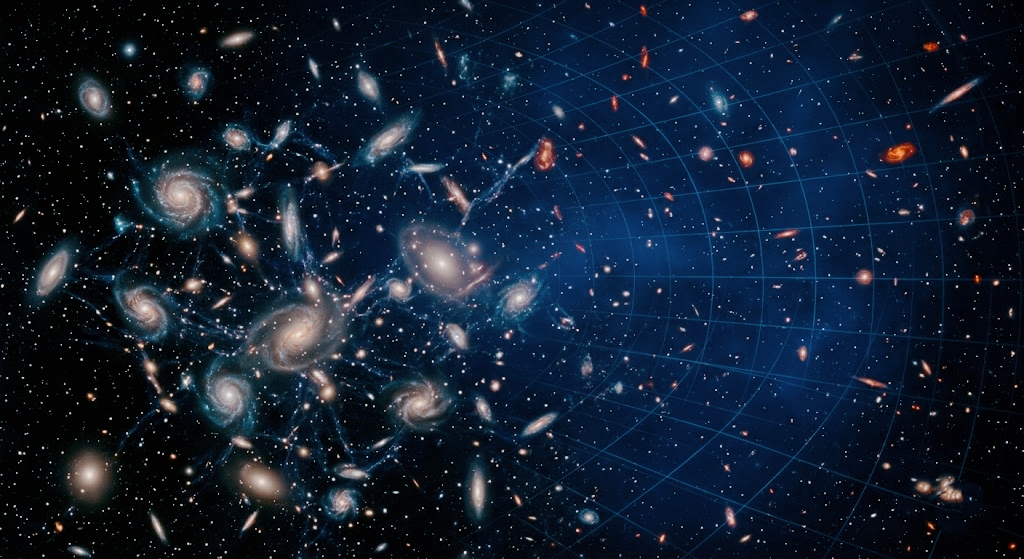
Cosmological distance relation casts doubt on dynamic dark energy
This compelling result introduces fresh skepticism regarding recent claims that dark energy might change over time, challenging what some hoped was the solution to one of modern cosmology’s most persistent problems. Dark energy itself remains an unexplained phenomenon, widely invoked by scientists to account for why the universe is expanding at an ever-increasing rate. The concept originally emerged from Albert Einstein’s theory of general relativity, but its potential to evolve has remained a core mystery with profound implications for the ultimate fate of the cosmos.
The key to unlocking this mystery lies in the equation of state of dark energy, a relationship that describes the ratio of its pressure to its energy density. Scientists measure this parameter by observing distant astronomical objects and calculating how fast they are receding from us, a speed determined by their redshift. The dark energy spectroscopic instrument collaboration recently reported intriguing hints suggesting that this equation of state might indeed change with redshift, a finding that would represent a monumental discovery if proven correct.
The cosmic distance duality relation and dataset robustness
Beyond observations from the collaboration, various cosmological probes have been deployed to constrain the dark energy equation of state, yet few attempts have been made to verify if these distinct methodologies are truly robust. Afroz and Mukherjee sought to address this pressing challenge by testing whether the datasets comply with core cosmological principles. One of the most reliable ways to validate the consistency of independent measurements is to ensure they satisfy mathematical relationships that must hold true within the framework of general relativity.
At the center of their methodology is the cosmic distance duality relation, which dictates how two independent measures of cosmological distance must be intrinsically connected across spacetime. In their analysis, the researchers proposed a novel technique to determine the dark energy equation of state using two separate probes, while simultaneously testing their overall reliability. The investigation focused specifically on type one a supernovae data and baryon acoustic oscillations, which represent the frozen imprints of acoustic waves that traveled through the primordial plasma of the early universe.
The research revealed that while both the supernovae and the acoustic oscillation datasets are largely consistent with the distance duality relation, a small but undeniable discrepancy exists between them. Crucially, the researchers discovered that this marginal inconsistency directly correlates with a shift in the calculated dark energy parameters away from the expected values of a standard cosmological constant. The finding demonstrates that even a minor observational mismatch can mimic the signature of evolving dark energy, potentially distorting our understanding of cosmic history.
Rethinking dynamic dark energy and future probes
The implications of this study hold true across several different mathematical parameterizations used to test the distance duality relation, confirming the internal validity of the analysis. The persistence of the discrepancy under various testing conditions strongly reinforces the conclusion that claiming a definitive detection of dynamic dark energy is premature. Systematic errors or subtle calibration differences between instruments might easily be mistaken for new physics, highlighting the need for extreme caution before abandoning established cosmological models.
If confirmed by future studies, this research will have far-reaching consequences for how cosmologists analyze data and interpret the nature of the vacuum energy. By demonstrating that minor discrepancies between datasets can skew theoretical inferences, the study provides a vital framework for cross-checking independent cosmic probes. This analytical approach offers a pathway to improve data compatibility, ensuring that different telescopes and surveys can be combined without introducing artificial signals.
The new technique developed by the team will be highly valuable for the joint analysis of the massive influx of data expected from next-generation sky surveys. By allowing researchers to estimate and mitigate systematic biases between disparate datasets, this method paves the way for reliable conclusions about the cosmic equation of state. Ultimately, ensuring such rigorous data harmony is the only way the scientific community can achieve a truly robust understanding of the enigmatic acceleration of our Universe.
The study is published in Physical Review D.