The scientific community has reached a significant milestone in extragalactic astronomy through the detailed analysis of data provided by the Whole Earth Blazar Telescope. An international team of researchers has identified a remarkable quasi-periodic oscillation within the bright quasar 3C 454.3, marking one of the most enduring optical signals of its kind ever recorded. This discovery offers a rare window into the complex behavioral patterns of active galactic nuclei and the massive black holes that power them.
Persistent optical oscillations discovered in quasar 3C 454.3
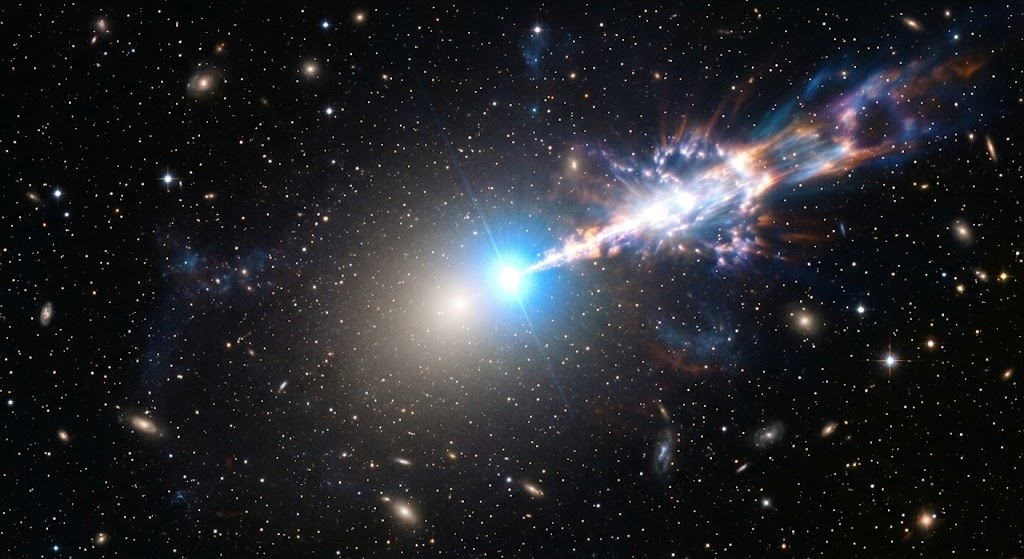
Blazars represent a highly energetic class of compact quasars situated at the centers of giant elliptical galaxies, characterized by the presence of supermassive black holes. These objects are distinguished by relativistic jets that are oriented almost directly toward our planet, making them the most numerous extragalactic sources of gamma rays. Within this category, 3C 454.3 is classified as a flat-spectrum radio quasar, a group defined by broad and prominent optical emission lines that differ from the more muted features of BL Lacertae objects.
Located at a redshift of 0.86, 3C 454.3 is one of the most extensively monitored flat-spectrum radio quasars in the sky. It exhibits intense optical polarization and significant variability across the entire electromagnetic spectrum, driven largely by non-thermal emission processes. The central engine of this blazar is a supermassive black hole with a staggering mass estimated to be between 0.5 and 2.3 billion times that of the sun.
While quasi-periodic oscillations have traditionally been studied within the X-ray band and associated with the inner edges of accretion disks, their detection in the optical band suggests different physical origins. In cases such as 3C 454.3, these optical fluctuations may arise from the outer regions of the accretion disk or represent reprocessed X-ray light. The persistence of such signals provides crucial data for understanding how matter and energy interact in the extreme environments surrounding supermassive black holes.
Long term observations and discovery
The breakthrough was led by Karan Dogra of the Aryabhatta Research Institute of Observational Sciences in India, who spearheaded a comprehensive review of the Whole Earth Blazar Telescope archives. The team examined nineteen years of longitudinal data to search for consistent patterns that previous studies had only hinted at. This massive dataset was further bolstered by contributions from the Small and Medium Aperture Research Telescope System and the Steward Observatory.
Through rigorous analysis, the astronomers successfully isolated an optical quasi-periodic oscillation with a cycle of 433 days. This specific signal remained remarkably consistent between the years 2009 and 2018, establishing it as one of the longest-lasting optical oscillations ever identified in a blazar. Such a discovery is statistically significant because it moves beyond the realm of transient noise, pointing toward a stable and recurring physical mechanism.
The identification of this 433-day period required the integration of multiple terrestrial and orbital observation points to ensure the continuity of the light curves. By bridging gaps in the data, the researchers were able to confirm that the oscillation was not a localized event but a systemic feature of the quasar’s luminosity. This longevity provides a robust foundation for testing theoretical models regarding the dynamics of matter falling into black holes.
Theoretical implications and future research
To interpret the origin of the detected oscillations, the research team applied various theoretical frameworks focusing on both accretion disk dynamics and jet-based emission models. While both scenarios remain scientifically relevant, the astronomers indicated that processes occurring within the relativistic jets appear to be the most plausible explanation for the signatures observed in 3C 454.3. However, the complexity of the data prevents a definitive exclusion of accretion disk involvement at this stage.
The current findings highlight a critical challenge in modern astrophysics regarding the distinction between dynamic persistent mechanisms and stochastic variability. Although the jet models align well with the observed non-thermal emissions, the possibility remains that the oscillation could be a long-lived but ultimately transient manifestation of random fluctuations. This ambiguity underscores the necessity for even more refined modeling of the magnetic fields and particle acceleration within blazar jets.
In their concluding remarks, the scientists emphasized that only continued long-term monitoring will resolve the remaining mysteries surrounding the physical origin of these oscillations. Future observations will be vital in determining whether the 433-day period is a permanent fixture of the quasar’s architecture or a temporary phenomenon. Such insights will ultimately deepen our understanding of the fundamental forces governing the most luminous and distant objects in the known universe.
The study is published on arXiv.