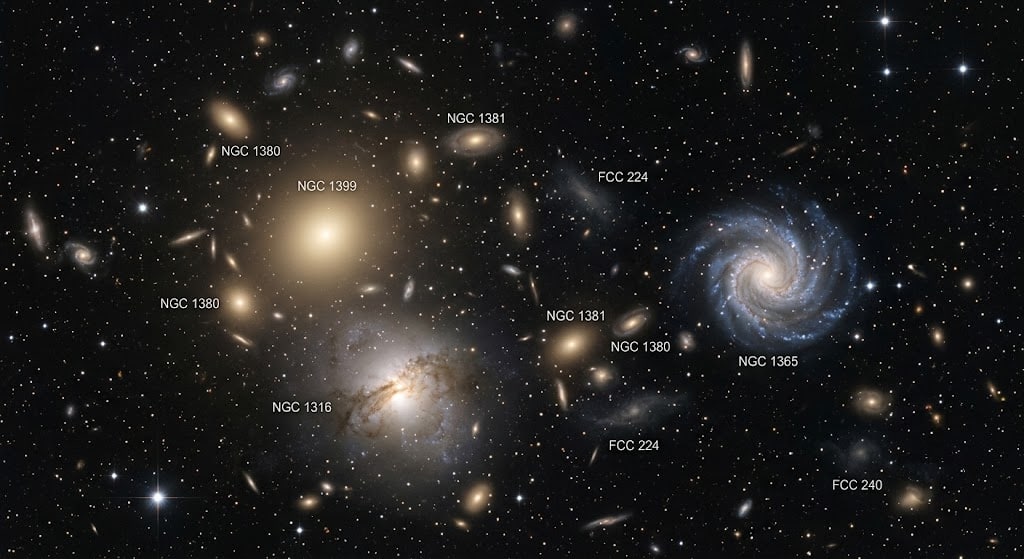
Astronomers have recently identified a compelling new instance of one of the most perplexing phenomena in modern astrophysics: galaxies that appear to contain minimal to no dark matter. The newly analyzed galactic pair, designated FCC 224 and FCC 240, resides on the periphery of the Fornax cluster and shares several extraordinary characteristics with the only other known, and highly debated, pair of dark matter-deficient galaxies. This discovery challenges conventional models of galactic formation and suggests that such systems might not be isolated anomalies.
The debate surrounding ultra-diffuse systems
Ultra-diffuse galaxies represent a peculiar class of stellar systems that possess physical dimensions comparable to the Milky Way but exhibit significantly lower mass and far fewer stars. For over a decade, these objects have been at the center of intense astrophysical debate, primarily because observations have revealed two starkly contrasting populations regarding their dark matter content. This discrepancy has forced scientists to reconsider the mechanisms that govern the lifecycle and structural integrity of low-density galaxies.
On one hand, ultra-diffuse galaxies rich in dark matter are relatively well understood within current cosmological frameworks. Investigators theorize that these are essentially failed galaxies that quenched prematurely in their evolutionary history, thereby failing to accumulate substantial stellar mass while successfully retaining numerous globular clusters. This preservation of dark matter alos aligns with standard predictions of galaxy survival within dense cosmic environments.
Conversely, the opposite extreme presents a far more enigmatic scenario. A small subset of ultra-diffuse galaxies appears to be almost entirely devoid of dark matter, while simultaneously hosting globular clusters that are anomalously luminous. Researchers hypothesize that the precise mechanism driving this excessive cluster luminosity might also be directly responsible for the absence of dark matter within these rare and atypical systems.
Investigation of the Fornax cluster pair
Until recently, only two such dark matter-deficient galaxies had been confirmed, namely NGC 1052-DF2 and NGC 1052-DF4, both of which are gravitationally associated with the NGC 1052 group. This limited sample size raised fundamental questions as to whether the phenomenon was merely a localized, unique aberration rather than a widespread cosmic occurrence. The detection of a third deficient dwarf galaxy, FCC 224, outside the NGC 1052 environment provided a crucial opportunity for broader comparative analysis.
In a recent study, a team of astronomers utilized the advanced MUSE instrument on the Very Large Telescope to conduct a comprehensive examination of FCC 224 and its nearby companion, FCC 240. The primary objective of this investigation was to determine whether these two stellar systems form an analogue pair to the previously discovered DF2 and DF4. By analyzing their internal dynamics, the researchers sought to confirm if the lack of dark matter is a recurring trait under specific cosmic conditions.
To explain the origin of these stars, the team tested the bullet dwarf scenario, which proposes that high-velocity collisions between dwarf galaxies can dynamically separate normal stellar matter from its dark matter counterpart. The subsequent analysis revealed extremely low velocity dispersions within both galaxies, indicating that their internal gravitational potential can be entirely accounted for by visible stars alone. Furthermore, both systems host unusually bright globular clusters with an upward-skewed luminosity function that closely mirrors that of the NGC 1052 pair.
Evolutionary timelines and structural differences
The empirical data further indicate that FCC 224 and FCC 240 share an almost identical age of approximately 10 billion years, with their globular clusters exhibiting the same metallicity as the surrounding diffuse stellar bodies. This synchronized chronology implies that the stars and their associated clusters materialized concurrently during a single, highly intense burst of star formation. Such a synchronized birth event represents one of the most robust predictions generated by the dwarf-galaxy collision model.
Despite these striking similarities, the Fornax pair exhibits a notable structural divergence from the NGC 1052 systems. While DF2 and DF4 are separated by a vast distance of roughly 240 kiloparsecs and are embedded in an extended debris trail of low-surface-brightness galaxies, FCC 224 and FCC 240 are situated much closer to one another, separated by a mere 75 kiloparsecs. This spatial proximity, combined with a low relative velocity, suggests a long-lived, compactly bound pair rather than an elongated chain of stellar fragments.
While this structural variance introduces the possibility that the two galaxies evolved independently and share identical traits by mere coincidence, the research team maintains that it likely represents a geometric variation of the same collisional phenomenon. They estimate that any dark matter remnants ejected during the initial impact should be located further along the projection axis, offering a promising target for future observational verification. Ultimately, these findings strongly imply that the mechanisms generating dark matter-deficient galaxies are active beyond the confines of the NGC 1052 group.
The study is available as a preprint on arXiv.