Chrysalis: The Shattered Moon Behind Saturn’s Iconic Rings
What if the most photographed feature in our solar system was born from a cosmic tragedy just 100 million years ago, when dinosaurs still roamed our planet?
Welcome, dear reader. We’re glad you stopped by FreeAstroScience.com today. Pour yourself a coffee, get comfortable, and stick with us to the very end. We promise a story that mixes hard physics, planetary forensics, and a moon that didn’t survive its last dance with a giant. By the close of this article, you’ll see Saturn’s rings with completely new eyes.
Table of Contents
Jump to a section:
- Why are Saturn’s rings such a puzzle?
- Who was Chrysalis, and where did this idea start?
- How did the new 2026 study test the theory?
- What did the simulations actually reveal?
- What happened to Chrysalis’s rocky heart?
- Why should we care about this discovery?
- Final thoughts
Why are Saturn’s rings such a puzzle?
Saturn’s rings look eternal. They aren’t.
Data collected by the Voyager and Cassini missions told us something shocking: those rings could be as young as 100 million years, and they’re made of almost pure water ice . That’s a strange combination. If the rings had been there since Saturn’s birth 4.5 billion years ago, micrometeorite dust should have darkened them long ago. Yet they sparkle like fresh snow.
So a tough question hangs in the air. How do you build a giant icy ring system around a planet, fairly recently, in cosmic terms? Several models have tried to explain this. One stands out, and it has a name straight out of a sci-fi novel: Chrysalis.
Who was Chrysalis, and where did this idea start?
Back in 2022, MIT planetary scientist Jack Wisdom proposed something bold . Saturn, he argued, used to have one more moon. He called it Chrysalis.
Wisdom’s idea ties together three characters: Saturn, its biggest moon Titan, and the distant planet Neptune. For billions of years, Saturn and Neptune sat locked in an orbital resonance that tilted Saturn’s axis. Titan, slowly drifting outward, eventually destabilized the whole arrangement. Chrysalis got pushed too close to Saturn .
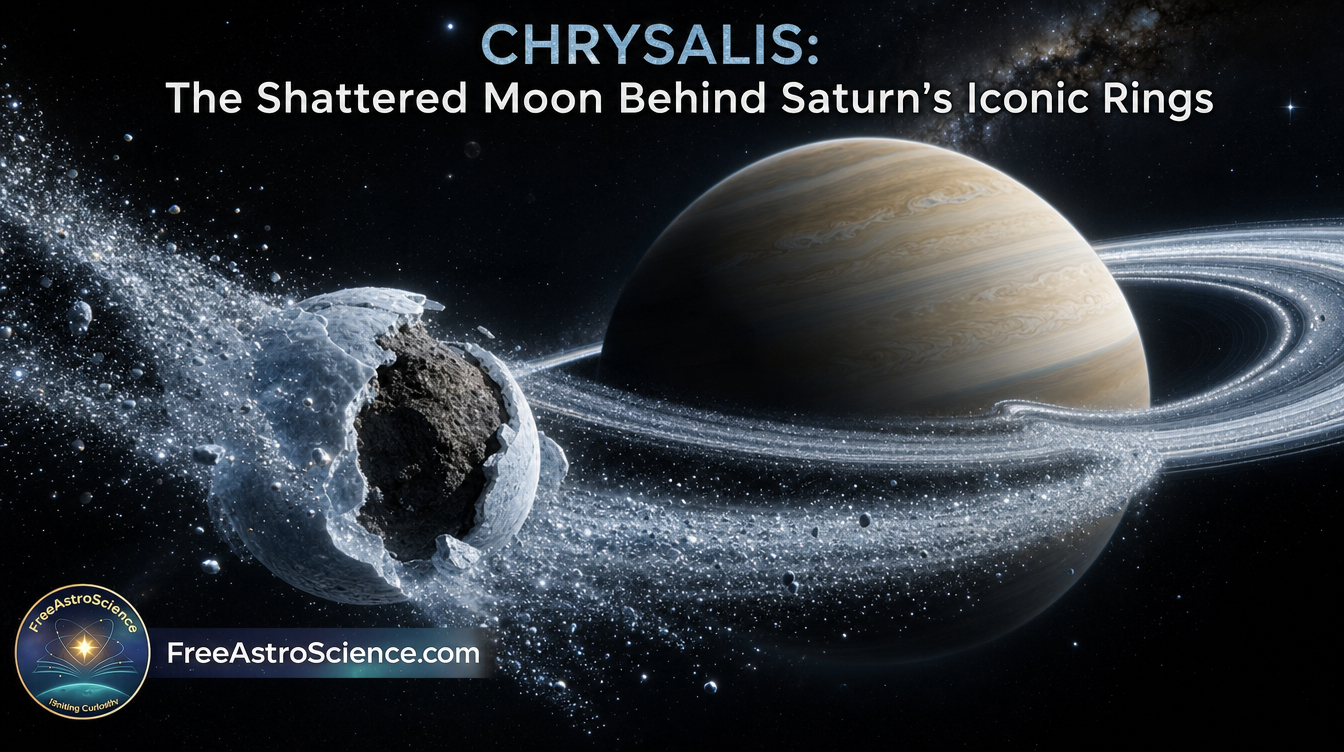
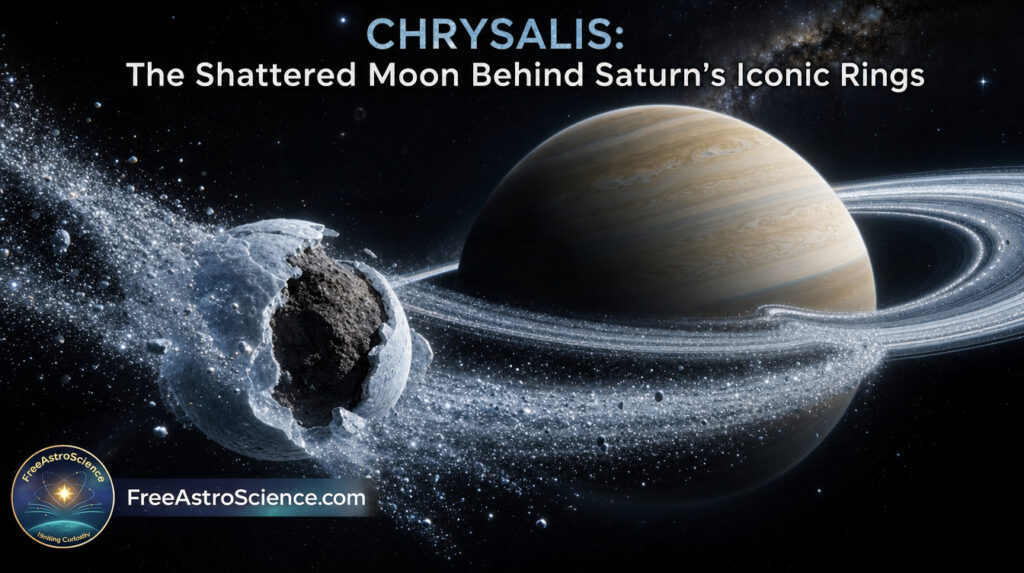
Once a moon crosses a certain line, Saturn’s gravity doesn’t just pull on it. It pulls harder on the near side than on the far side. That difference, called a tidal force, can rip a body apart. Wisdom suggested that’s exactly what happened to Chrysalis, scattering ice and rock into orbit. The ice settled into rings. The rocky core? That’s a separate mystery.
The theory had nice fingerprints. It matched the rings’ young age. It matched their almost-pure ice composition. It even explained Saturn’s tilted axis. But for years, it stayed a sketch on a napkin. Nobody had run the full physics.
How did the new 2026 study test the theory?
That’s where Yifei Jiao and his team come in. Working across UC Santa Cruz, Tsinghua University in Beijing, and MIT, they ran the calculation Wisdom couldn’t . Their paper appeared at the 57th Lunar and Planetary Science Conference in 2026.
They used a method called Smoothed Particle Hydrodynamics, or SPH. Think of it as breaking a moon into millions of tiny particles, each one obeying physics, then watching what happens when you swing it past a giant planet. SPH is the gold standard for modeling impacts and tidal disruptions .
Here’s how they set things up:
| Parameter | Scenario A (Dione-like) | Scenario B (Iapetus-like) |
|---|---|---|
| Ice mass fraction | 50 wt.% | 80 wt.% |
| Core composition | Silicate rock | Silicate rock |
| Initial semi-major axis | 200 RS | 200 RS |
| Periapsis range tested | 1.0 – 1.5 RS | 1.0 – 1.5 RS |
| Simulation duration | ~50 hours | ~50 hours |
RS = Saturn radius (about 58,232 km). Data from .
One Saturn radius is roughly 58,000 km. So Chrysalis started about 11.6 million km away, then swung in on a parabolic path to a closest approach somewhere between 58,000 and 87,000 km from Saturn’s center .
That’s the disruption zone. Get any closer and even rock breaks apart. Stay too far and nothing happens.
The physics in one simple equation
The tidal force between Saturn and Chrysalis scales with distance like this:
Ftidal ∝ 2 G MS Rc d3
Where G is the gravitational constant, MS is Saturn’s mass, Rc is Chrysalis’s radius, and d is the distance to Saturn. Notice the cube in the denominator. Halve the distance, and the tidal force becomes eight times stronger. That’s why getting close matters so much.
What did the simulations actually reveal?
The result was striking. When Chrysalis swung past Saturn at a periapsis between 1.0 and 1.5 RS, the tidal forces were strong enough to peel the icy mantle clean off, but not strong enough to crack the rocky core .
Imagine biting the chocolate shell off an ice cream truffle and leaving the filling intact. That’s roughly what Saturn did to Chrysalis.
The stripped ice didn’t just float away. It split into two groups:
- Escapees: Some ice particles gained energy from the encounter and shot off into deep space, lost to Saturn forever.
- Captives: Other particles lost orbital energy, dropped closer to the planet, and over time spread into a flat, circular ring around Saturn’s equator .
Both the mass and the composition of the resulting ring matched what we see today. The simulations even handled the fact that Saturn’s other moons, especially Titan, keep nudging ring particles and can erase up to 70% of the original ring mass over time . So Chrysalis had to deliver several times more ice than we see now. The math worked.
The 80% ice scenario (Iapetus-like) produced cleaner, purer ice rings than the 50% scenario (Dione-like). That favors a Chrysalis composition closer to Iapetus, which fits Wisdom’s original guess from 2022 .
What happened to Chrysalis’s rocky heart?
Here’s where the story gets haunting.
The rocky core survived the first close pass with only minor orbital changes . So it kept going. But it was already on a dangerous path, and the team thinks it likely had more encounters with Saturn after that. Each pass would have stripped more ice and made the leftover body denser and smaller.
Two endings are possible, according to Jiao and colleagues:
- It crashed into Saturn. A final fatal plunge into the gas giant.
- It escaped. A gravitational slingshot threw it out of the Saturn system entirely, sending the remnant on a one-way trip into the outer solar system .
Somewhere out there, a chunk of rock that used to be the heart of a moon might still be drifting. We don’t know which ending is correct. The researchers admit that openly, and that honesty is what good science looks like.
Why should we care about this discovery?
This study isn’t only about pretty rings. It connects several puzzles into one coherent picture:
- Saturn’s tilted axis (26.7°) finds an explanation in the lost resonance with Neptune that Chrysalis used to maintain .
- The young age of the rings (100–200 million years) stops being a coincidence and becomes a consequence .
- The nearly pure water-ice composition matches what you get when you strip an icy mantle and leave the rock behind .
- Strange craters on icy moons like Tethys might be old wounds from Chrysalis debris raining down .
That’s the elegance of the Chrysalis hypothesis. One event ties up several loose ends at once.
Of course, we still don’t have direct proof. We can’t visit 100 million years ago. But simulations like Jiao’s are the closest thing we have to a time machine, and they’re telling us the story holds together.
Final thoughts
We started with a question: could a lost moon really have created Saturn’s rings? After walking through the 2022 hypothesis and the 2026 simulations, the answer looks increasingly like a confident yes, probably.
Chrysalis lived. Chrysalis died. And what remained of her icy skin still circles Saturn, glittering for telescopes and probes to admire. When you look at a photo of Saturn’s rings now, you’re looking at a memorial.
This article was written specifically for you by FreeAstroScience.com, where we explain complex scientific principles in simple terms. We want you to never switch off your mind, because — as Goya warned us — the sleep of reason breeds monsters. Keep your curiosity awake. Come back soon. We have more cosmic stories waiting for you.
References
- Wisdom, J. et al. (2022). Loss of a satellite could explain Saturn’s obliquity and young rings. Science, 377(6612), 1285-1289. View paper
- Jiao, Y., Nimmo, F., Wisdom, J., & Dbouk, R. (2026). Tidal stripping of Chrysalis as the origin of Saturn’s young icy rings. 57th Lunar and Planetary Science Conference, Abstract #1132. Conference page
- Iess, L. et al. (2019). Measurement and implications of Saturn’s gravity field and ring mass. Science, 364(6445), eaat2965.
- Hyodo, R. et al. (2017). Ring formation around giant planets by tidal disruption of a single passing large Kuiper belt object. Icarus, 282, 195-213.
- Crida, A. et al. (2025). Saturn’s rings: formation and evolution. Space Science Reviews, 221(5), 66.