Can a football match really carry the weight of the whole world on its shoulders? Tonight, June 11, 2026, the ball rolls at the Estadio Azteca in Mexico City, and the answer looks like a loud, complicated yes. Welcome, dear friends of FreeAstroScience.com — the place where we take complex things, from black holes to billion-dollar tournaments, and explain them in plain words. We’re thrilled you’re here with us. This piece was written specifically for you, our readers, and we ask one small favor: stay with us to the very end. The 2026 FIFA World Cup is far more than goals and glitter, and the full picture only emerges in the final paragraphs.
What You’ll Find in This Article
- What Makes the 2026 World Cup the Biggest Ever Played?
- Who’s Singing at the Three Opening Ceremonies?
- Why Is This Being Called the Least Peaceful World Cup?
- What Do the Money Numbers Really Tell Us?
- Is This Also the World Cup of Migrants and Marathon Travel?
- Our Final Whistle
- FAQ — Quick Answers
- Sources
When Football Meets the Real World: Our Honest Look at the 2026 World Cup Kick-Off
We’ve read the press coverage from Los Angeles and Mexico City so you don’t have to dig through it yourself. What we found is a tournament of superlatives — the richest, the most expensive, the most widespread — and, in the words of veteran sports journalist Emanuela Audisio, the least peaceful. Let’s take it apart, piece by piece.
What Makes the 2026 World Cup the Biggest Ever Played?
The raw numbers are staggering. For the first time in history, 48 national teams will play 104 matches in 39 days, fielding 1,248 players across three host countries: the United States, Canada, and Mexico. One organizing family, three very different households.
Want a feel for the pace? Here’s the simple arithmetic: On average, nearly three World Cup matches every single day for five and a half weeks.
Club football feels the squeeze too. English clubs alone release 206 players to this tournament — Manchester City tops the list with 19 — while Italian clubs send 70. The opening match, Mexico vs South Africa, kicks off at 21:00 (Italian time) in front of 87,500 spectators at the Azteca. The same stadium, by the way, where Gianni Rivera scored the winner in the legendary Italy–Germany 4-3 of 1970. Rivera himself will be in the stands tonight. Some circles do close.
Who’s Singing at the Three Opening Ceremonies?
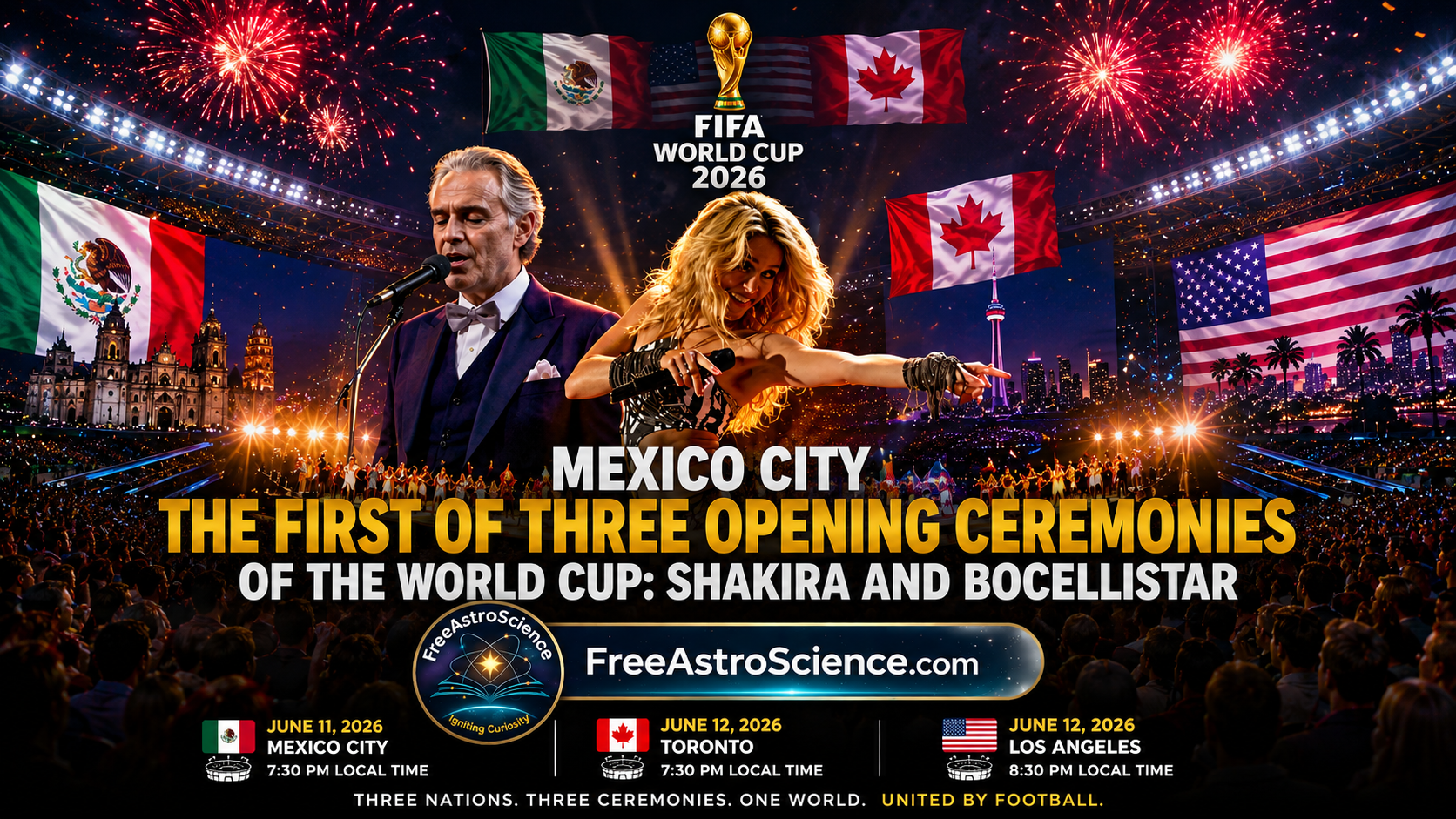
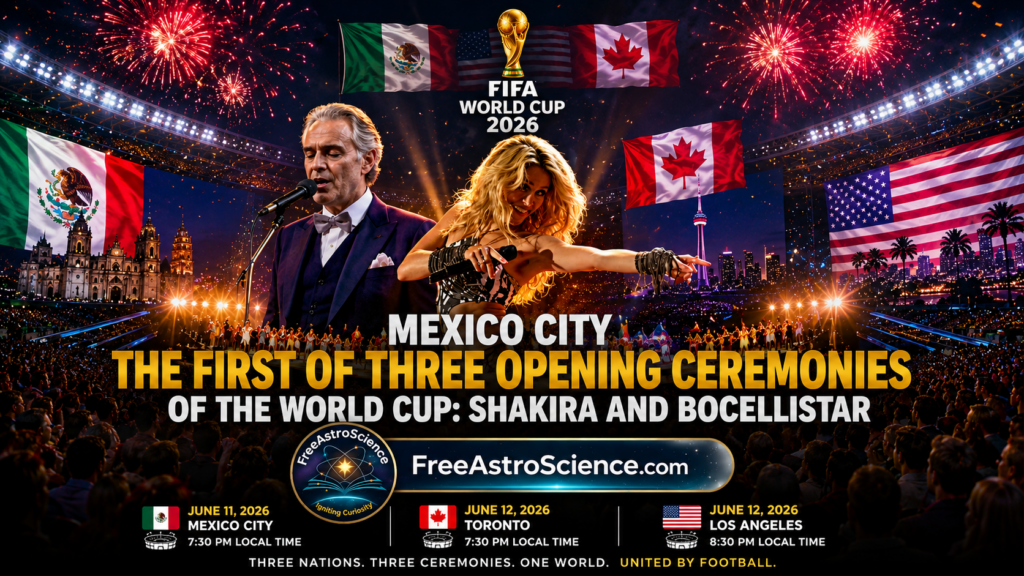
Here’s a genuine first: every host country gets its own opening ceremony. Three nights, three cities, three different musical souls. We’ve laid them out for you in one clean table.
| Date & Time (Italy) | City & Venue | Headline Artists | Match That Follows |
|---|---|---|---|
| June 11, 19:30 | Mexico City — Estadio Azteca | Shakira, Andrea Bocelli, Burna Boy, Ejae, Tyla, J Balvin, Alejandro Fernández, Lila Downs, Belinda, Danny Ocean, Maná, Los Ángeles Azules | Mexico vs South Africa (21:00) |
| June 12, 19:30 | Toronto — BMO Field | Alanis Morissette, Michael Bublé, Vegedream, Nora Fatehi | Canada vs Bosnia and Herzegovina |
| June 13, 01:30 | Los Angeles | Katy Perry, Future, Anitta | USA vs Paraguay (03:00) |
Tonight in Mexico City, Shakira — a four-time Grammy winner — performs the official tournament song “Dai Dai” alongside Nigerian star Burna Boy. For her, it’s an encore: she gave us “Waka Waka (This Time for Africa)” back in 2010. Andrea Bocelli, singing with Ejae, delivers the official anthem, titled “Dna”.
“Football has always been part of my life,” Bocelli said in a FIFA statement, adding that beautiful, honest football belongs to that beauty which — as Dostoevsky wrote — will save the world.
The Mexican ceremony tells the country’s story through papel picado, the delicate, festive paper-cutting art that Mexicans use for joyful decorations — a symbol of tradition and craft. Italian fans wanting the Los Angeles show will pay in sleep: it starts at 1:30 at night, with fireworks lighting up the sky before the USA–Paraguay kick-off at 3:00.
Why Is This Being Called the Least Peaceful World Cup?
Now we get to the heart of the matter. For the first time ever, an organizing country hosts a nation it is at war with, plus others it has declared enemies — while not exactly getting along with its own co-hosts. Bombing a country and then opening your stadium gates to its team creates, let’s say, some awkwardness. To twist the old line from General Carl von Clausewitz: sport is the continuation of war by other means.
What Happened to the Somali Referee?
The tournament opened with a red card before a single whistle blew. Omar Abdulkakie Artan, rated the best African referee, landed in Miami and was sent straight home after 11 hours of checks — visa and diplomatic passport in hand. The reason? His name matched that of an Al Shabab militant leader. He never touched a ball. Back in Mogadishu, crowds welcomed him like a hero. Former FIFA president Sepp Blatter didn’t mince words: if a country refuses entry to a referee, he argued, the World Cup shouldn’t be held there. Current president Gianni Infantino called it “an unfortunate case.” Nineteen countries currently sit on the US blacklist.
What About Iran, Congo, and the Shirt Controversies?
The stories pile up fast, and each one stings:
- Iran’s golden pins. The team arrived at its Tijuana camp wearing pins marked 168 — honoring the victims, mostly young girls, of the February American bombing of an elementary school in Minab. The squad, guarded by 500 security agents, trains at a center owned by Jorge Hank, a Mexican politician accused by the US of drug-trafficking links; an army raid on his villa in 2011 turned up 89 firearms. To play in Los Angeles, Iran holds a one-day visa — valid only for match time.
- DR Congo’s quarantine. The White House asked the Congolese national team to spend three weeks in quarantine in Belgium before entering the US, fearing Ebola. “Let them stay in their bubble,” said task-force director Andrew Giuliani.
- The Partey case. Ghana’s vice-captain Thomas Partey, formerly of Arsenal and now at Villarreal, plays while standing trial in the UK on seven counts of rape and one of sexual assault, dating back to 2022.
- Shirt politics. Haiti must change its jersey over a logo deemed political. In Colombia, a presidential candidate told his fans to wear the national shirt as campaign clothing days before the vote. And Mexico? The plan to have 150 Nahua artisan women from the mountain village of Naupan craft the jersey ended with their traditional handwork replaced by modern techniques — at a wage of $2.06 per hour, for a shirt that sells for over $200.
We won’t pretend to untangle all of this in one blog post. Honestly, nobody can. But noticing it — refusing to look away — is exactly the kind of mental exercise we believe in.
What Do the Money Numbers Really Tell Us?
Follow the money, and the picture sharpens. This World Cup should generate around $13 billion in revenue, more than any edition before it. Yet for fans on the ground, the most-used word is reportedly “extortion.”
| Item | Cost / Figure | Why It Matters |
|---|---|---|
| Most expensive group-stage ticket in history | €17,199 | One seat, Spain vs Uruguay in Guadalajara |
| Stadium parking | $300 | Just to leave your car |
| Public transport to the stadium | $98 | A ride, not a ticket to the match |
| Tickets on the resale market | 180,000 | Fans denied visas can’t use theirs |
| Expected total revenue | $13 billion | Set to beat every previous edition |
There were small wins for ordinary workers, to be fair. At the SoFi Stadium in Inglewood, a strike by the union representing two thousand bartenders, waiters, cooks, and venue staff was averted with a pay raise — a relief, since American sport without hot dogs, donuts, and popcorn simply doesn’t function. And yes, alcohol returns to the stands.
Is This Also the World Cup of Migrants and Marathon Travel?
Here’s a statistic that says more about our century than any anthem: almost one in four players represents a country different from the one where they were born. Brothers sometimes wear different shirts. Hunger, opportunity, and the search for a different destiny shape football as much as talent does. France leads the export table with 98 players — eight percent of the entire tournament — scattered across other national teams. More than half of all head coaches sit on a foreign bench too: Italy alone contributes Ancelotti, Montella, and Cannavaro.
Then there’s the geography problem. Three enormous countries mean enormous distances, and the draw wasn’t kind to everyone: In the group stage alone, Algeria will travel roughly 20 times farther than Egypt — with time zones thrown in for free.
Distance, jet lag, recovery time: physics doesn’t care about seeding. As people who spend our days explaining orbital mechanics, we can confirm — you can’t argue with kilometers.
Our Final Whistle
So, where does this leave us? With a tournament that is at once a party and a mirror. Shakira sings “Dai Dai” while a referee is deported over a name. Bocelli quotes Dostoevsky on beauty saving the world, while a team needs a one-day visa to play. Fans pay €17,199 for a seat while the women who were meant to sew the host’s jersey earn $2.06 an hour. Nelson Mandela once said that sport has the power to change the world — but, as Audisio dryly notes, he didn’t mean for the worse. Even Pope Leo offered his own tactical wisdom: “Whoever doesn’t pass the ball, loses.”
We at FreeAstroScience.com wrote this for you not to spoil the football — we’ll be watching too, probably yelling at the screen — but to remind you of our founding principle: never turn off your mind, and keep it active at all times, for the sleep of reason breeds monsters. Watch the matches. Enjoy the goals. And keep asking who pays, who profits, and who gets left at the airport. Come back to FreeAstroScience.com soon: there’s always more to question, and questioning together is how knowledge grows.↑ Back to top
FAQ — Quick Answers About the 2026 World Cup
When and where does the 2026 FIFA World Cup start?
It opens on June 11, 2026, with Mexico vs South Africa at the Estadio Azteca in Mexico City (21:00 Italian time), in front of 87,500 spectators. The opening ceremony begins 90 minutes earlier, at 19:30. Who sings the official song and anthem of the 2026 World Cup?
Shakira performs the official song “Dai Dai” with Burna Boy, while Andrea Bocelli sings the official anthem “Dna” together with Ejae. Performers across the three ceremonies also include Alanis Morissette, Michael Bublé, Katy Perry, Future, and Anitta. How many teams and matches does the 2026 World Cup have?
For the first time, 48 teams play 104 matches over 39 days across the United States, Canada, and Mexico, involving 1,248 players — roughly 2.7 matches per day on average. What is the most expensive ticket at the 2026 World Cup?
A fan paid €17,199 for a single seat at Spain vs Uruguay in Guadalajara — the most expensive group-stage ticket in World Cup history. Stadium parking can cost $300, and public transport to the venue around $98. Why is the 2026 World Cup considered controversial?
Key reasons include the deportation of Somali referee Omar Abdulkakie Artan from Miami after 11 hours of checks, Iran’s one-day match visa, the three-week quarantine requested of DR Congo’s squad, jersey disputes involving Haiti, Colombia, and Mexico, and steep costs for fans despite expected revenues of $13 billion.
Sources
This article is based exclusively on the following reporting, published June 11, 2026:
- Jacopo Manfredi, “A Città del Messico la prima delle tre cerimonie inaugurali dei mondiali: Shakira e Bocelli star”, la Repubblica, June 11, 2026.
- Emanuela Audisio, “Tutti i mali del mondo: tra conflitti e divieti, che coppa abbiamo noi”, la Repubblica, June 11, 2026.