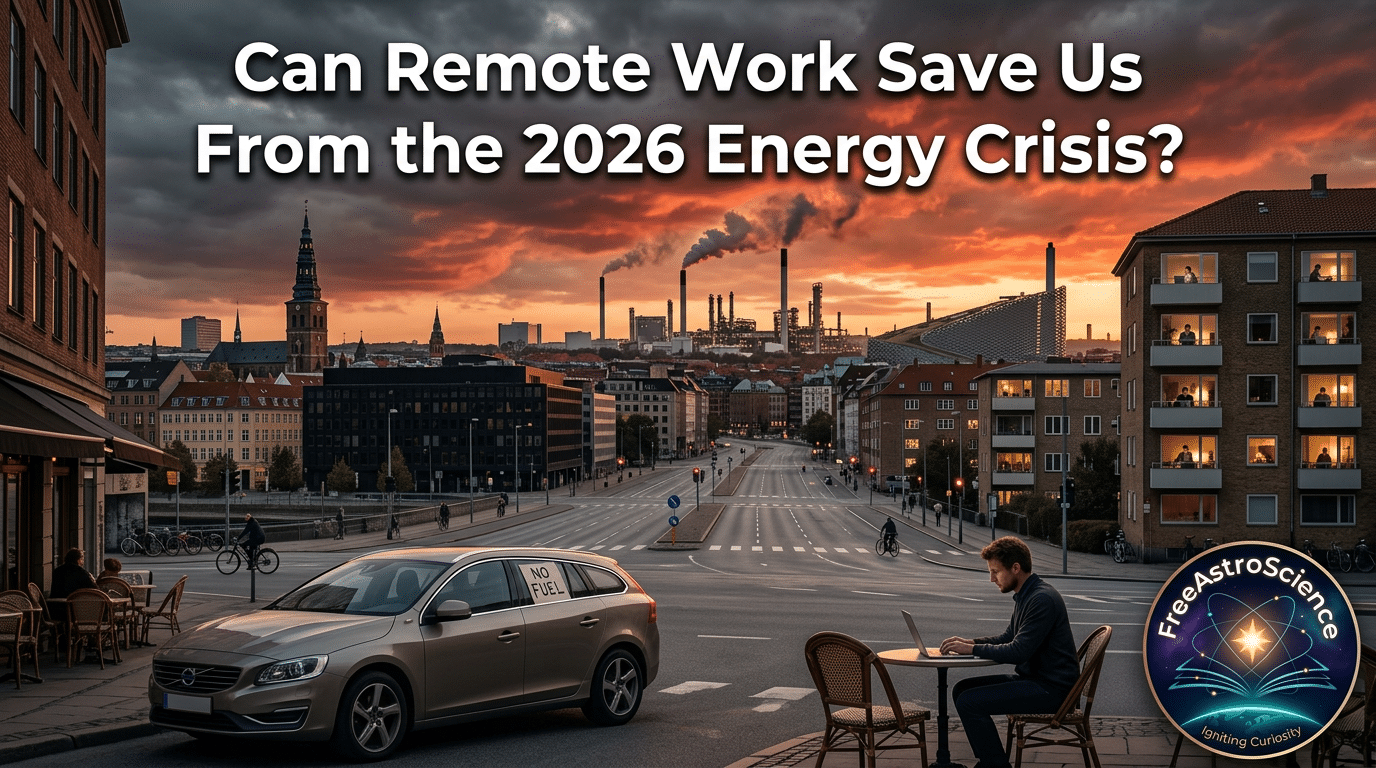
What if the simplest answer to a global energy crisis was already sitting in your living room?
Welcome back to FreeAstroScience.com ‚ where we don’t just explain what the stars are made of. We explain what the world is made of. Today, that world is wrestling with fuel shortages, rising energy prices, and a geopolitical crisis that’s shaking oil markets from the Gulf to Geneva. And the solution that’s resurfacing might surprise you: working from home.
Remote work was the hero of the pandemic era, then the villain of the “return to office” narrative, and now ‚ in April 2026 ‚ it’s back as a legitimate energy policy tool. Governments from Denmark to Sri Lanka, from Italy to Indonesia, are either encouraging, mandating, or debating its return. The numbers behind this shift are real, and they matter.
We wrote this article for you‚ whether you’re a student, a worker, a policy enthusiast, or just someone tired of watching energy bills climb. Stick with us. By the end, you’ll understand not just what is happening, but why it matters‚ and what the data actually says about remote work’s impact on our planet’s energy appetite.
📄 Table of Contents
- What’s Driving the 2026 Energy Crisis?
- The IEA’s 10-Point Plan: What Does It Actually Say?
- How Much Fuel Does Remote Work Really Save?
- What Are European Countries Doing Right Now?
- From Sri Lanka to Pakistan: A World Rethinking Work
- Working Under Fire: Remote Work in War Zones
- What’s Happening in Italy?
- The Hidden Carbon Math You Need to Know
- Final Thoughts
- References & Sources
The Global Energy Crisis of 2026 Is Reshaping How We Work
What’s Behind the 2026 Energy Crunch?
Let’s be direct: the world is in the middle of a serious energy disruption. The conflict in the Middle East ‚Äî specifically the US-Israel-Iran war ‚Äî has triggered what the International Energy Agency (IEA) describes as “the largest supply disruption in the history of the global oil market.”
Fatih Birol, IEA Executive Director, put it plainly in March 2026: “The war in the Middle East is creating a major energy crisis. In the absence of a swift resolution, the impacts on energy markets and economies are set to become more and more severe.”
The IEA has already authorized the release of 400 million barrels of oil from emergency reserves ‚Äî the largest such release in the agency’s 50-year history. But here’s the uncomfortable truth: supply releases alone won’t fix this. Demand must come down too. And fast.
Road transport ‚ cars, trucks, buses ‚ accounts for roughly 45% of global oil demand. That makes it the most obvious and fastest place to cut. Passenger cars alone drive about 60% of road energy use in wealthier economies. The math isn’t complicated. If fewer people commute, less fuel burns.
The IEA’s 10-Point Plan: What Does It Actually Say?
On March 20, 2026, the IEA published a 10-point demand-reduction plan and sent it directly to world governments. It’s not a wish list. It’s a strategic roadmap for immediate action. Here’s what the plan covers:
- Work from home where possible, to reduce commuting fuel use
- Lower motorway speed limits by at least 10 km/h
- Increase public transport use
- Promote car-sharing and carpooling
- Introduce alternate-day private vehicle access in major cities
- Encourage efficient driving habits
- Reduce non-essential air travel, especially business flights
- Limit energy use in buildings and offices
- Incentivize cycling and walking for short journeys
- Government-led public awareness campaigns on energy saving
The EU didn’t just read the plan‚ EU Energy Commissioner Dan Jorgensen urged all member states, including Italy, to adopt it as a reference framework. Speaking after an emergency meeting of European energy ministers in Brussels, Jorgensen noted that the EU is “better equipped” than in the 2022 crisis, thanks to expanded renewable capacity and diversified energy sourcing. The estimated cost of rising prices to European economies? ‚Ǩ14 billion.
How Much Fuel Does Remote Work Really Save?
We like numbers here at FreeAstroScience. Not vague estimates ‚Äî real, sourced, peer-reviewed data. So let’s look at what the science says.
The IEA reported that working from home, where possible, can reduce national fuel demand for commuting by up to 6%. That sounds modest. But when you apply it to millions of daily commuters, it becomes a massive aggregate saving.
Want a deeper dive? A landmark study by Cornell University and Microsoft, published in the Proceedings of the National Academy of Sciences, calculated remote work’s carbon impact with surgical precision:
| Remote Work Days/Week | Estimated CO‚ÇÇ Reduction | Main Driver |
|---|---|---|
| 1 day/week | ~2% | Less commuting |
| 2‚4 days/week | 11%‚Äì29% | Reduced transport + lower office energy demand |
| Full-time remote | up to 54% | No commute + minimal office utilities |
These aren’t marginal gains. A 54% reduction in personal carbon footprint for full-time remote workers is a number that would make any climate scientist stop and take notice. Of course, the picture isn’t perfectly clean‚ home heating, cooling, and electronics do consume more when people work from home. But the net balance, especially when offices genuinely scale down their baseline energy consumption, favors remote work significantly.
There’s also the air travel angle. The IEA estimates that reducing business flights ‚Äî where viable alternatives exist‚ could cut jet fuel demand by 7% to 15%. In the short term, corporate travel alone could drop by around 40% if companies commit to remote meetings over in-person travel.
What Are European Countries Doing Right Now?
Denmark: A Government That Actually Said It Out Loud
Denmark didn’t hedge. Lars Aagaard, Denmark’s Minister of Energy and Public Utilities, spoke directly to citizens: “If there’s any energy consumption you can do without ‚Äî if it’s not strictly necessary to drive, then don’t do it.” That’s not a suggestion buried in a policy document. That’s a minister talking to his nation like a neighbor across the fence.
Slovenia: When Rationing Becomes Necessary
Slovenia took a harder line. The country introduced fuel rationing rules: private individuals can fill up to 50 liters per day, while companies are capped at 200 liters per day. When a European country starts managing how much petrol you can buy in a single day, you know the situation is serious.
From Sri Lanka to Pakistan: A World Rethinking Work
This is where the story gets genuinely global. The policy response to the energy crisis isn’t a European story. It’s a planet-wide rethink of how, where, and when people work. Here’s a snapshot of what different countries are doing:
| Country | Measure Adopted | Sector |
|---|---|---|
| Denmark | Government actively encourages remote work and reduced driving | Public & Private |
| Slovenia | Fuel rationing: 50L/day (private), 200L/day (companies) | All citizens |
| Egypt | Evaluating 1–2 WFH days/week; early closure of shops & restaurants | Public sector |
| India (New Delhi) | GPL gas cylinder restrictions for businesses; families prioritized | Commercial |
| Sri Lanka | 4-day work week; Wednesday declared a national holiday | Public sector |
| Philippines | 4-day week for government workers; national energy emergency declared by President Marcos Jr | Government |
| Pakistan | Shorter work week + partial remote work + fuel allowance cuts + school closures | Public sector |
| Indonesia | 1 remote day/week mandated for public employees; private sector encouraged | Public sector |
| Malaysia | Flexible remote work started in public sector; no fixed day count | Public sector |
| Thailand & Vietnam | Remote work recommended; reduced commuting; office energy savings promoted | Advisory |
Sri Lanka’s decision is particularly striking. Declaring an entire day of the week ‚Äî Wednesday ‚Äî as a fuel-saving holiday isn’t a minor administrative tweak. It’s a structural redesign of the working week driven by energy scarcity. The Philippines went even further, with President Ferdinand Marcos Jr formally declaring a national energy emergency, unlocking extraordinary powers to manage supply and contain costs.
Working Under Fire: What Happens in Conflict Zones?
Some workers don’t choose remote work because of an app or a policy memo. They choose it to stay alive.
In Iran, workers rotate in shifts — some inside buildings, others waiting outside at a safe distance. In regions hit by military strikes, even skilled professionals have rapidly shifted back to home-based work, drawing on habits built during both the pandemic and recent conflict. In Israel, venture capitalists and startup founders have abandoned in-person meetings entirely, working from home where they can reach bomb shelters quickly when alert systems sound. At the Dubai International Financial Centre — home to global banks and investment funds — most international staff shifted to remote operations when the conflict first escalated.
These aren’t edge cases. They’re a reminder that remote work isn’t just a tech-sector luxury or a sustainability strategy. In the right circumstances, it’s a survival mechanism. And that realization changes how we should think about it permanently.
What’s Happening in Italy Right Now?
Italy isn’t sitting still. In early April 2026, the union FP CGIL sent a formal letter to Paolo Zangrillo, Italy’s Minister for Public Administration, requesting an immediate expansion of smart working in the public sector. The goal: reduce the financial burden of high fuel costs on workers and cut the country’s overall energy consumption.
Tiziana Cignarelli, FP CGIL’s Secretary General, didn’t mince words: “It’s a common-sense choice ‚Äî cut energy consumption and costs for both workers and public administrations.”
At the same time, FLEPAR — the Federation of Legal Professionals and Public Administration Specialists — issued its own request for a government directive to strengthen remote work in the PA. Their position: the measure should start with the public sector, but eventually extend across the whole Italian labour market.
This debate is real. It isn’t theoretical. If you commute 30 minutes each way in Italy on a salary that doesn’t absorb fuel price hikes, the math of working from home isn’t abstract ‚Äî it’s the difference between a comfortable month and a difficult one.
The Hidden Carbon Math: What Your Commute Is Really Costing
Let’s make this personal. You drive to work five days a week. Your commute is average ‚Äî say, 25 kilometers each way. You’re burning fuel, producing CO‚ÇÇ, sitting in traffic, and paying for the privilege. Now imagine two or three of those days simply disappeared.
According to the Cornell-Microsoft study, going from five office days to three days in-office can cut your personal carbon footprint by up to 29%. That’s not an estimate from a sustainability consultant’s slide deck. That’s peer-reviewed science published in one of the world’s most prestigious academic journals.
There’s a nuance worth acknowledging. Working from home isn’t automatically “green.” If your home heating system runs on oil, or you crank the air conditioning all day while your empty office building keeps its baseline systems running anyway, the net benefit shrinks. The real environmental gains appear when companies genuinely scale down their office infrastructure ‚Äî not just put up a hybrid work policy while keeping the lights on in empty buildings five days a week.
Still, the trend is clear. Hybrid and remote work, done honestly, move the needle. At a moment when every barrel of oil counts, that matters.
A Quiet Revolution in How We Live and Work
Smart working started as an emergency fix during a pandemic. It got vilified as a productivity risk by managers who confused presence with performance. And now, in 2026, it’s back ‚Äî not because a virus forced it, but because the planet’s energy systems are under acute stress and governments are running out of easy options.
From Ljubljana to Lahore, from Copenhagen to Colombo, the message is converging: commuting less saves energy, saves money, and reduces the carbon load we’re placing on an already strained atmosphere. That’s not ideology. It’s physics. And here at FreeAstroScience, we take physics seriously.
We also know that not everyone can work from home. Essential workers ‚Äî nurses, construction workers, drivers, teachers in physical classrooms ‚Äî don’t have that option. This makes the remote work debate also a conversation about equity. Those who can work remotely carry a responsibility to do so when it genuinely helps, precisely because millions of others can’t.
At FreeAstroScience, we believe the sleep of reason breeds monsters. We’re here to keep your mind awake, critical, and curious ‚Äî especially when the headlines move fast and the facts need context. We protect you from misinformation by always going back to the data, the sources, and the science. That’s a promise we keep every single day.
Keep coming back to FreeAstroScience.com. There’s always more to understand, more to question, and more to discover. The world is complex ‚Äî but it’s never beyond your grasp.
📚 References & Sources
- Irene Maria Scalise, “Smart working per la crisi energetica. Ecco le soluzioni di chi lo sta gi√† facendo” ‚Äî La Repubblica, 5 April 2026.
- International Energy Agency (IEA), “10-Point Plan to Reduce Oil Demand” ‚Äî IEA.org, March 2026.
- Euronews, “IEA urges swift cuts in oil demand, encourages remote work” ‚Äî euronews.com, 20 March 2026.
- Reuters, “Work from home, avoid air travel to deal with higher energy prices, IEA says” ‚Äî reuters.com, 20 March 2026.
- BBC News, “Work from home and drive more slowly to save energy, global watchdog advises” ‚Äî bbc.com, 20 March 2026.
- CNBC, “How to weather the global energy crisis” ‚Äî cnbc.com, 20 March 2026.
- AdnKronos, “Boom prezzi petrolio e bollette, UE ‘raccomanda’ smart working” ‚Äî adnkronos.com, 30 March 2026.
- Allwork.space, “Is Remote Work Actually Better For The Environment?” ‚Äî allwork.space, April 2025.
- Cornell University & Microsoft, “Environmental impact of remote work” ‚Äî Proceedings of the National Academy of Sciences (PNAS).
- Il Metropolitano, “UE allarme carburanti: meno voli e pi√π smart working” ‚Äî ilmetropolitano.it, 1 April 2026.