
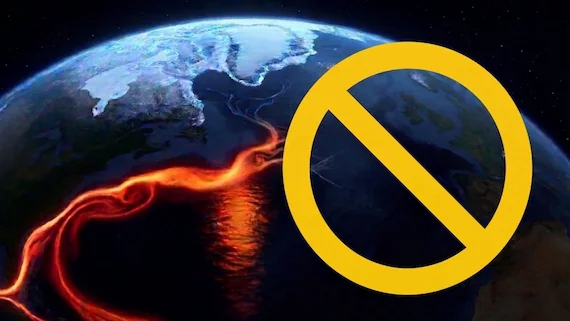
Why Is the Atlantic Slowing Down Faster Than We Thought?
**Have you ever wondered what keeps Rome warmer than New York, even though they sit at almost the same latitude?** The answer flows beneath the Atlantic Ocean — a quiet, immense river of water that has shaped European life for thousands of years. Today, that river is losing its strength. Welcome, dear reader. We’re glad you’re here. We wrote this piece for you at FreeAstroScience.com, where we make complex science feel like a friend explaining things over coffee. Stay with us to the very end. By the time you finish, you’ll see why scientists across Europe are losing sleep over something most of us never think about — and what it means for the lives we’re building right now.
What’s actually happening to the AMOC right now?
Let’s start with a name that sounds intimidating but isn’t: the **Atlantic Meridional Overturning Circulation**, or AMOC for short. Think of it as Earth’s central heating system. Warm surface water travels from the tropics up to the northern Atlantic. Cold, dense water sinks and flows back south at depth. The cycle never stops. It carries about **1.5 petawatts of heat** northward at 26°N — roughly a million times the entire electricity consumption of Italy.
We’ve been measuring the AMOC directly since 2004, using sensor arrays planted across the Atlantic. The reading at 26°N has averaged 16.9 ± 1.2 sverdrups between 2004 and 2024. (One sverdrup equals one million cubic metres of water per second — try to picture that flowing past you, every second, forever.)
Here’s where it gets uncomfortable. Sea surface temperature patterns suggest the AMOC has weakened by about 3 ± 1 sverdrups since 1950. Proxy records from ocean sediments push the timeline further: the AMOC is currently in its **weakest state in more than a thousand years**. A machine-learning reconstruction published in 2025 backs this up. Not every dataset agrees — some array measurements show no long-term decline since the 1980s — but the weight of evidence is starting to tilt.
In November 2025, Iceland’s government formally classified the risk of AMOC disruption as **a threat to national security**. That’s not the kind of language politicians use lightly.
How does this giant ocean conveyor really work?
The whole thing runs on something we all learned in school: cold, salty water is denser than warm, fresh water. Dense water sinks. That’s it. That simple physics moves more energy than every power plant on Earth combined.
Here’s how the loop closes. Wind-driven surface currents — including the famous Gulf Stream — push warm tropical water north. As it travels, the water evaporates and gets saltier. By the time it reaches the seas around Iceland and Greenland, it’s cold and salty enough to sink kilometres deep. From there, it slides southward along the ocean floor, all the way to Antarctica. Mixing brings it back up. The cycle starts again.
When you grasp this, you start to see why scientists worry so much about freshwater. Pour enough fresh water into the northern Atlantic — say, from a melting Greenland — and the surface stops being salty enough to sink. The pump stalls. Everything downstream slows.
Why is the AMOC weakening — and why so fast?
We humans are part of this story. Greenhouse gas emissions warm the atmosphere. Warmer air melts Arctic ice, especially the Greenland Ice Sheet. That meltwater enters the North Atlantic as fresh water. The surface gets less salty, less dense. The pump weakens.
Then the trouble feeds on itself. A weaker AMOC carries less salty Atlantic water northward — so the north becomes even fresher. Less salty water sinks even less. The system spirals. Scientists call this the **salt-advection feedback**, and it’s the dominant force pulling the AMOC toward weakness in the most advanced climate models we have, including the Community Earth System Model (CESM).
The latest projections from CMIP6 climate models suggest that the AMOC will weaken by 34–45% of its present-day strength by 2100 under most emission scenarios. A 2025 study cited by *Science Advances* put the possible weakening as high as 51% by century’s end — far steeper than the IPCC’s earlier estimates of around 32%.
| Scenario | Description | Projected AMOC weakening by 2100 | Risk level |
|---|---|---|---|
| SSP1-2.6 | Strong climate action, low emissions | ≈ 30% | Moderate |
| SSP2-4.5 | Middle-of-the-road emissions (+2°C by 2100) | ≈ 35–40% | Elevated |
| SSP3-7.0 | High emissions, weak cooperation | ≈ 40–45% | High |
| SSP5-8.5 | Very high emissions, fossil-fuel intensive | ≈ 45% (up to 51% in 2025 study) | Very High |
Direct observations at 26.5°N have already shown a drop of roughly 1 sverdrup per decade since the array went online. That’s small in absolute terms — but the AMOC is a system where small changes can trigger very large consequences.
Could it collapse completely? The tipping point question
Here’s where things get serious. The AMOC isn’t like a dimmer switch you can slide gently up and down. Many of our best climate models suggest it behaves more like a light switch — bistable, meaning it has two preferred states: full strength and almost entirely off. Push the system far enough, and it doesn’t just keep slowing. It flips.
This isn’t science-fiction speculation. We have geological evidence that the AMOC has shut down before. About 12,000 years ago, at the end of the last ice age, a massive pulse of glacial meltwater into the North Atlantic flipped the switch. Greenland temperatures plunged by roughly 10°C within decades, even as the planet was warming overall. The cold period that followed lasted more than a thousand years.
Scientists categorise three ways the AMOC could tip in the coming century:
- Bifurcation-induced tipping — slow forcing pushes the system past a critical threshold, and the AMOC slides irreversibly into its weak state.
- Rate-induced tipping — the forcing happens too fast for the system to adjust, and it collapses even before reaching the threshold.
- Noise-induced tipping — random climate fluctuations push the AMOC across the threshold, even without a steady trend.
The 2026 review by Dijkstra and van Westen in the *Annual Review of Marine Science* puts it bluntly: of all the CMIP6 models studied, only one matches both the observed AMOC strength and the freshwater transport indicator (called FovS) that signals proximity to tipping — and even that match seems to be a coincidence built on other biases. In plain English: the most expensive climate models we have aren’t yet good enough to tell us, with confidence, how close we are to the edge.
What would Europe feel under a collapsed AMOC?
Now we come to the part that may keep you up tonight. A May 2025 study in *Geophysical Research Letters* by van Westen and Baatsen modelled, day by day, what European weather would look like under different AMOC scenarios. The numbers are striking.
The team used the historic Dutch observation station at De Bilt (5.18°E, 52.1°N) as a reference. They had 100 years of temperature records to compare against. Then they ran the Community Earth System Model under three states: AMOC on (today’s situation), AMOC off (full collapse, pre-industrial CO₂), and AMOC collapse under intermediate warming (RCP4.5, +2°C global mean).
| Climate indicator | AMOC on (today) | AMOC off (full collapse) | AMOC collapse + 2°C warming |
|---|---|---|---|
| 1-in-10-year cold extreme (Tmin) | −6.4 °C | −37.6 °C | −20.0 °C |
| Frost days per year (avg) | 12.4 | 153.2 | moderate increase |
| Most extreme winter (frost days) | 37 | 186 | — |
| Day-to-day temperature variance | 1.50 K² | 21.6 K² (×14) | elevated |
| Sea-ice edge in January | Far north | Down to 50°N | Retreated north |
Read those numbers again. Under a full AMOC collapse without climate change, the Netherlands would average 153 frost days per year — eight months of winter, essentially. The coldest decade-defining night would hit −37.6°C. London could see lows around −20°C. Oslo, perhaps −48°C. These aren’t worst-case sensationalism. They come from a peer-reviewed simulation using one of the world’s most respected climate models.
And here’s the cruel twist: under a collapse with moderate global warming (+2°C), Europe still cools harshly in winter but warms in summer — meaning **the seasonal temperature swing becomes much more extreme**. North Atlantic storm tracks intensify. Winter winds blow harder. Day-to-day temperatures whiplash by 14 times the variance we know today.
There’s more. A 2015 study in *Nature Communications* attributed a 128 mm rise in sea level at New York during 2009–2010 to a temporary AMOC dip. A full collapse would push that effect dramatically higher. Some Atlantic coastlines could see dynamic sea-level rise of more than 70 cm purely from the AMOC change, on top of any thermal expansion or ice-melt contribution.
Agriculture? A 2020 *Nature Food* study found that AMOC collapse could cause “wide-scale interruption of intensive farming” in the United Kingdom, with crop losses an **order of magnitude greater** than climate change alone would inflict. Rainfall patterns would shift across the Amazon, where the dry season could become the wet season and vice versa. The whole atmospheric circulation reorganises.
How close are we to the point of no return?
Honest answer: we don’t know. Anyone who tells you they do is selling something.
The IPCC’s Sixth Assessment Report stated, with “medium confidence,” that no abrupt collapse will happen before 2100. That was the consensus view in 2021. Since then, several studies have rattled that confidence. Ditlevsen and Ditlevsen, in a 2023 Nature Communications paper, used reanalysis data to estimate a possible collapse onset as early as 2057, with a 90% confidence range of 2025–2095. Their methodology has been criticised — the subpolar gyre temperature data may produce false positives — but the paper sent shockwaves through the climate community.
What we know with reasonable confidence is this. The AMOC is weakening. The trend is faster than earlier projections suggested. The system has tipped before in Earth’s history. Some climate models now show clear bistable behaviour. And the indicators we have — like the freshwater transport at 34°S — are pointing in worrying directions.
What we don’t know is precisely how close we are. The tipping point could be five sverdrups below today’s strength. Or it could be ten. We could already have crossed it without realising. Or it could be decades away. The honest scientific answer is that the uncertainty is large — but the consequences of being wrong are so severe that even small probabilities, around one in ten thousand, are worth treating with seriousness in any responsible risk analysis.
What can we — you and I — actually do about it?
This isn’t the part where I tell you to feel guilty about your last flight. That’s not how systems change. But it is the part where we acknowledge a hard truth: the AMOC’s future depends partly on us. The same greenhouse gas emissions that warm our atmosphere drive the meltwater that’s weakening the pump. Less CO₂ in the air means slower warming, slower melting, more time for the system to stabilise or for us to understand it better.
In 2024, more than 40 climate researchers wrote an open letter to the Nordic Council of Ministers, asking northern European governments to treat AMOC risk as the security issue it is. Iceland listened. Other governments are starting to. Public awareness matters because political will follows public attention. Every conversation you have about this — at dinner, at work, online — adds weight to the side of action.
You can also do something more personal: stay curious. The science of the AMOC is moving fast. Rare-event algorithms, machine-learning approaches, higher-resolution models — researchers are working hard to narrow the uncertainty. The story we’ll tell in 2030 will be sharper than the one we’re telling today. Stay informed. Ask hard questions. Don’t accept “it’ll be fine” or “we’re doomed” as final answers. Both are too easy.
Where we stand, and where we go from here
The Atlantic that keeps Europe mild has been doing its quiet work for thousands of years. We grew our cities, our farms, our entire civilisations assuming it would keep flowing. Now we know it might not.
This isn’t a story of certain doom. It’s a story of a system under stress, watched by some of the smartest scientists alive, with consequences large enough that even uncertainty deserves our attention. If the AMOC collapses, life in Europe changes in ways our grandparents wouldn’t recognise. If it doesn’t, we’ve still learned something profound about how delicately our planet is balanced — and how much our choices, even small ones, can shift the scales.
You’re not alone in feeling unsettled by all this. Many of us at FreeAstroScience feel it too. But here’s what we hold onto: a clear-eyed look at hard truths is the first step toward doing something useful about them. Pretending the AMOC is fine doesn’t make it fine. Panicking doesn’t help either. Understanding does.
This article was written specifically for you by FreeAstroScience.com, where we explain complex scientific principles in simple words — because we believe that the sleep of reason breeds monsters, as Francisco Goya warned us two centuries ago. Our mission is to keep your mind awake, asking questions, demanding evidence, refusing easy answers. Come back to us soon. There’s always more to learn, and you’ll always find us here, ready to share it with you.
Written for you by FreeAstroScience.com
Where complex science becomes a friend. Keep your mind awake — the sleep of reason breeds monsters.



Thank you so much for sharing such wonderful content! Your writing is professional yet approachable, and every part of this post delivers real value. I gained plenty of new skills and clear understandings that have solved many of my existing doubts.