

Have you ever wondered why your ears suddenly feel like someone shoved invisible plugs inside them the second your plane leaves the runway?
Maybe it happened while driving up an Alpine pass, riding a high-speed elevator, or diving into a swimming pool. That muffled, almost suffocating sensation is something millions of us share, yet few of us actually understand what’s going on inside our heads.
Welcome to FreeAstroScience.com, dear reader. We’re so glad you’re here. Today, we’ll walk you through the strange and beautiful mechanics behind that “pop,” from the eardrum to a tiny tube named after a 16th-century Italian anatomist. Stick with us all the way to the end, because by the time you finish reading, you’ll know exactly what your body is doing at 30,000 feet, why some flights hurt more than others, and which tricks really work when your ears refuse to cooperate. You’ll never board a plane the same way again.
A Quick Word Before We Take Off
We wrote this article specifically for you at FreeAstroScience.com, where we make complex scientific principles simple without dumbing them down. Our promise to you: we’ll keep your mind switched on, awake, and curious. Because as the Spanish painter Francisco Goya warned us centuries ago, the sleep of reason breeds monsters. Let’s keep that reason wide awake together.
A small disclaimer: this article is purely informational. For any medical question or concern, please always speak with your doctor.
How Is Our Ear Actually Built Inside?
Before we explain the “pop,” we need a quick look inside our heads. Our ear isn’t just the curvy flap on the side of our skull. It’s a sophisticated three-part system :
- The outer ear: the visible auricle plus the ear canal.
- The middle ear: a small air-filled cavity that houses three tiny bones, the hammer, anvil, and stirrup (malleus, incus, and stapes).
- The inner ear: the place where sound waves get converted into nerve signals your brain can read.
Between the outer and middle ear sits a thin, taut membrane: the eardrum, or tympanic membrane. Picture the stretched skin of a drum. That mental image isn’t poetry, it’s basically what’s happening inside your skull right now.
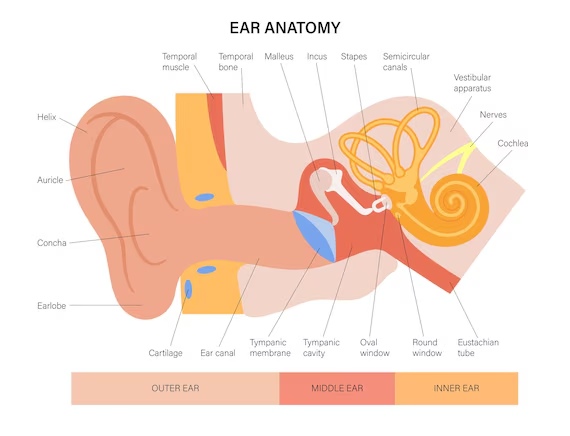
Why Does the Eardrum Behave Like a Drum Skin?
On one side of this membrane, you have the air from the room or environment around you. On the other side, inside the middle ear, sits a tiny pocket of trapped air. As long as both sides share the same pressure, the eardrum stays relaxed and vibrates freely whenever sound waves hit it .
Trouble starts the instant those two pressures stop matching. And that’s exactly what happens whenever we change altitude in a hurry. So now we know the players. Let’s see what happens during the action.
What Happens When We Climb in a Plane or Up a Mountain?
Here’s where physics steps onto the stage. According to the Mayo Clinic, when a plane takes off or when we drive up a high Alpine pass, the outside atmospheric pressure drops as altitude rises . But what’s happening inside the middle ear at the same time? Nothing. The pressure in there is still locked at whatever it was when we were on the ground.
The result: internal pressure now exceeds external pressure, pushing the eardrum outward and making it bulge. A bulging, stretched-tight membrane can’t vibrate the way it should, so we get that classic muffled, plugged-up, slightly deaf sensation .
Let’s visualize the pressure swing with a clean table.
| Situation | Outside Pressure | Middle Ear Pressure | Eardrum Behavior | What You Feel |
|---|---|---|---|---|
| At sea level (rest) | ~1 atm | ~1 atm | Relaxed, neutral | Normal hearing |
| Plane takeoff / climbing a pass | Decreases | Stays high | Bulges outward | Muffled, plugged ears |
| Plane landing / driving downhill | Increases rapidly | Stays low | Pushed inward | Pain, pressure, sometimes a sharp ache |
| Scuba diving (every 10 m down) | +1 atm per 10 m | Lags behind | Pushed inward fast | Strong squeeze; needs active equalization |
Why Does Landing Hurt More Than Takeoff?
Ever noticed landings hurt more than takeoffs? You’re not imagining it. On the way down, external pressure climbs fast and shoves the eardrum inward. This phase tends to be the most uncomfortable, sometimes even painful, because the rising outside pressure tends to slam shut the very mechanism that should be helping us equalize .
Scuba divers know this feeling intimately. Every 10 meters of depth adds about 1 atmosphere of pressure, which is why divers learn to actively “equalize” from their very first lesson .
Who Was Eustachio and What’s His Famous Tube?
Now meet the hero of our story. According to MedlinePlus, the portal run by the U.S. National Library of Medicine, the **Eustachian tube** is a small canal, roughly 3 to 4 centimeters long, connecting the middle ear to the nasopharynx, the area behind the nasal cavities .
The tube was named after Bartolomeo Eustachi, a 16th-century Italian anatomist. Its purpose? Linking the middle ear to the outside world so pressure can balance on both sides of the eardrum. Most of the time, it stays closed. But it pops open briefly every time we swallow, yawn, or sneeze, letting a puff of air through to even things out. That satisfying “pop” we hear is the eardrum snapping back to neutral once it gets the air it was craving .
Which Tricks Really Work to Unblock Our Ears?
Pressure changes during takeoff, landing, or a fast descent from a mountain road happen quicker than our Eustachian tubes can manage on their own. We need to give them a hand.
These aren’t grandma’s old wives’ tales, by the way. They’re strategies documented in medical literature :
- Swallow repeatedly — sipping water in small mouthfuls works like a charm.
- Yawn, even on purpose if you have to fake it.
- Chew gum — the constant jaw movement keeps the tube opening regularly.
- Try the Valsalva maneuver — pinch your nose shut, close your mouth, and gently blow as if clearing your nose. Air gets forced up into the middle ear.
A serious word of caution on that last one. A review published in *AIMS Public Health* warns that blowing too hard during the Valsalva maneuver can damage the inner ear instead of helping it . Gentle is the magic word.
When Should We Worry About Ear Barotrauma?
If none of those tricks work and the Eustachian tube stays stubbornly shut, we might bump into something doctors call ear barotrauma, also known as “airplane ear.” This condition is well documented in medical literature and detailed by both the Mayo Clinic and Cleveland Clinic.
When this happens, the eardrum sits there with unbalanced pressure it can’t release. The result? Muffled hearing and pain that may stick around for hours after landing. Fluid can build up in the middle ear, and in severe cases, the eardrum can actually tear .
Humanitas points out that barotrauma is far more likely when we fly with a cold, sinusitis, allergies, or an ear infection. Inflammation swells the lining of the nasopharynx, exactly where the Eustachian tube opens, and blocks it from doing its job.
Red flags to watch for: if discomfort lingers long after the flight, or if you notice sharp pain, hearing loss, or vertigo, see an ENT specialist .
Wrapping Up: A Tiny Tube That Saves Our Hearing
Here’s what we hope you take with you from today’s read. That annoying plugged-ear sensation isn’t a malfunction. It’s actually your body running a brilliant pressure-equalization system that engineers would envy. A 3-to-4-centimeter canal, a tense membrane stretched like drum skin, and a few well-timed swallows are all that stand between us and serious ear injury at altitude.
Next time you board a plane, drive up a winding mountain road, or zip up to the 80th floor in an elevator, pause for a second. Listen for that little “pop.” It’s physics meeting biology in real time, inside your own head, an everyday miracle most of us walk through without noticing.
Come back to FreeAstroScience whenever you want to sharpen your understanding of the world around you. We’ll keep waking up your curiosity, one article at a time, because the sleep of reason really does breed monsters, and we’d rather feed wonder.
Frequently Asked Questions
1. Why do my ears pop more during landing than during takeoff?
During descent, outside pressure rises fast and pushes the eardrum inward. This actively closes off the Eustachian tube, making it harder to equalize, which is why landings often feel more painful than takeoffs.
2. Is the Valsalva maneuver safe?
Yes, when done gently. Blowing too hard while pinching your nose can hurt the inner ear, so use moderate pressure only .
3. Should I avoid flying with a cold?
If you can postpone the flight, it’s a good idea. A cold inflames the nasopharynx and blocks the Eustachian tube opening, raising your risk of barotrauma significantly .
4. How long should plugged ears last after a flight?
Usually minutes to a few hours. If you still feel muffled hearing, sharp pain, or dizziness a day later, see an ENT specialist .
5. Do divers experience the same problem?
Yes, and worse. Pressure jumps about 1 atmosphere every 10 meters of depth, which is why scuba training devotes serious time to active equalization techniques from day one .