Quantum Computers Are Closer Than Ever to Breaking Encryption — Here’s What You Need to Know
What if the passwords, bank accounts, and encrypted messages you trust today could be cracked open by a machine that doesn’t even exist yet — but almost does?
Welcome to FreeAstroScience, where we break down complex scientific ideas into language that makes sense. We’re Gerd Dani and the FreeAstroScience team, and today we’re tackling one of the most electrifying stories in modern physics: the race to build a quantum computer powerful enough to shatter the encryption that guards our digital lives.
Two separate research teams — one at the California Institute of Technology, the other at Google — just announced breakthroughs that have sent shockwaves through physics and cybersecurity alike. The gap between “theoretical threat” and “real machine” just got a whole lot smaller.

Stick with us to the end. This story touches everything from your cryptocurrency wallet to the nature of space-time itself. And we promise — you don’t need a physics degree to follow along.
📑 Table of Contents
- 1. The Algorithm That Changed Everything
- 2. What Did the Caltech Team Actually Build?
- 3. Why Are Neutral Atoms the Secret Weapon?
- 4. How Do You Fix a Qubit That Keeps Breaking?
- 5. Google’s 10x Efficiency Leap
- 6. Is Your Encryption Still Safe?
- 7. What Do the Skeptics Say?
- 8. Beyond Hacking: What Else Could These Machines Do?
- 9. Where Do We Go From Here?
The Algorithm That Changed Everything
About 30 years ago, mathematician Peter Shor wrote an algorithm that flipped the world of digital security on its head. He showed that a computer running on the strange rules of quantum mechanics could quickly solve two math problems that ordinary computers would need billions of years to crack .
Here’s why that matters: those two math problems are the foundation of nearly every secure website, email inbox, and bank account on the planet .
For three decades, Shor’s algorithm stayed a theoretical ghost. Nobody had a machine powerful enough to run it. Early estimates said you’d need billions of qubits — the basic units of quantum computing — to pull it off. Over time, that number dropped to about a million .
But a million qubits still felt like a distant dream. Today’s quantum computers typically have just a few hundred qubits.
That gap — between what the math demands and what engineers can build — has been our shield. And it just got dramatically thinner.
What Did the Caltech Team Actually Build?
A group of physicists at Caltech, led by Dolev Bluvstein and Madelyn Cain, asked a simple but bold question: What is the smallest quantum computer you could build that could, say, hack a Bitcoin wallet?
They didn’t just ask the question. They designed the answer.
Working with colleagues Qian Xu (an expert in error-correcting codes), Robert Huang (quantum theory and machine learning), Manuel Endres (experimental physics), and legendary theorist John Preskill, the team put together a blueprint for a machine that could break common encryption with only tens of thousands of qubits .
Let those numbers sink in. We went from billions to millions to tens of thousands.
The team then formed a company — Oratomic — to actually build the thing .
The Numbers That Matter
Their simulations showed some eye-opening results:
| Encryption Scheme | Atoms Required | Estimated Time |
|---|---|---|
| RSA (common form) | 10,000 | ~100 years |
| RSA (common form) | 100,000 | ~3 months |
| ECC (widely used) | 10,000 | ~3 years |
| ECC (widely used) | 26,000 | A few days |
Data from the Caltech team’s simulations
A few days to crack elliptic curve cryptography with 26,000 atoms. That’s the kind of number that makes cybersecurity experts lose sleep.
Why Are Neutral Atoms the Secret Weapon?
Not all qubits are created equal. The Caltech team bet on a technology called neutral atom qubits, and it’s easy to see why.
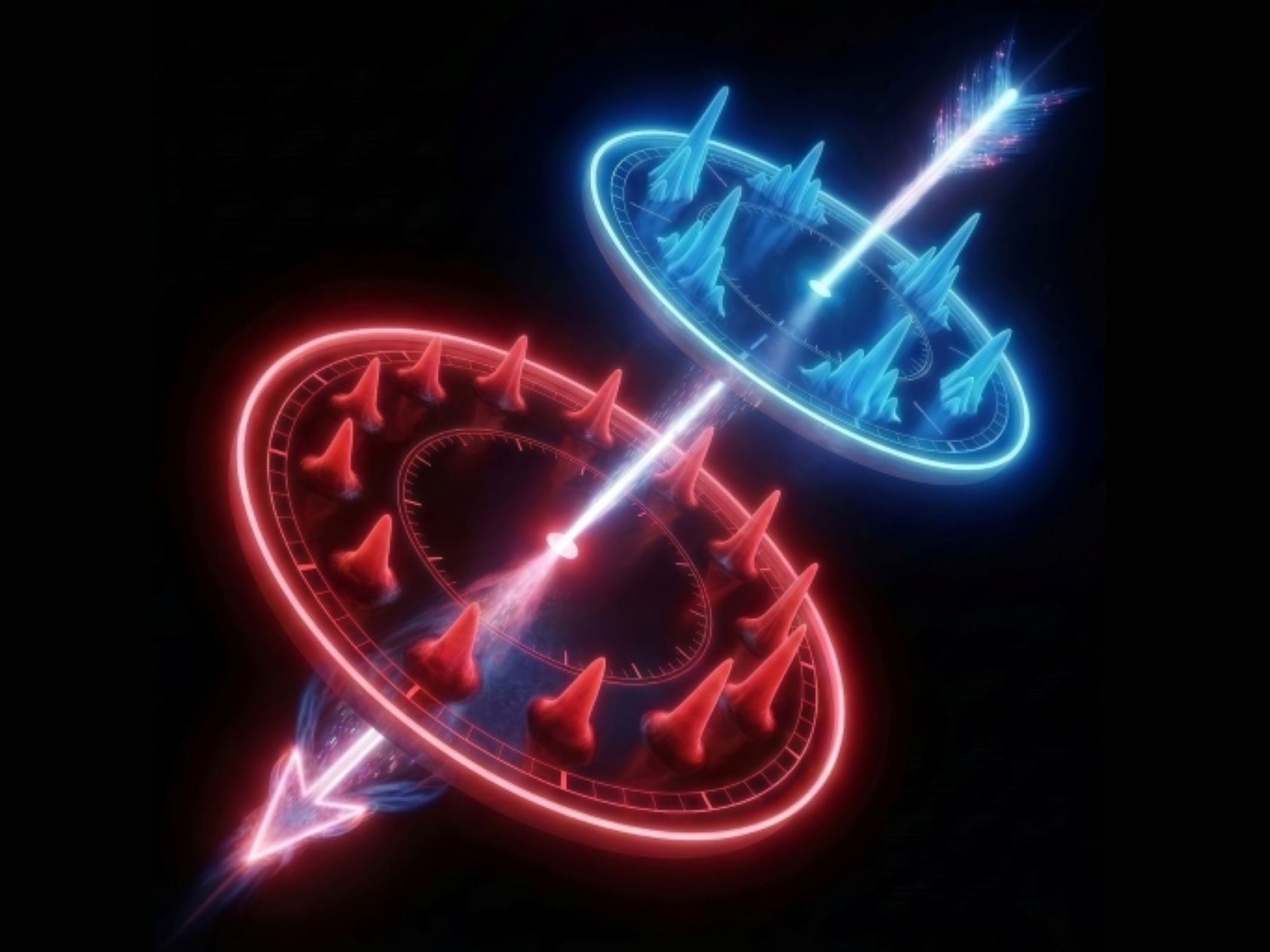
Over the past decade, physicists have learned to suspend individual neutral atoms in laser beams and arrange them however they want. Think of it like holding marbles in mid-air with tweezers made of light — except each “marble” is smaller than anything you can see, and it can store quantum information.
Other qubit types exist. Google and IBM champion superconducting circuits, which operate faster but sit locked in place, like traditional transistors Neutral atoms, by contrast, can be moved around. You can shuffle one atom across an entire array to connect with a distant partner.
That freedom of movement turns out to be a game-changer for error correction, as we’ll see next.
In 2023, Bluvstein and Cain — then at Harvard in Mikhail Lukin’s lab — ran sophisticated quantum algorithms using 280 neutral atoms. Shortly after, Endres’s group at Caltech demonstrated control of an astonishing 6,100 neutral atoms at once. They didn’t perform calculations with that many, but they proved the scale was possible.
How Do You Fix a Qubit That Keeps Breaking?
Here’s the hard truth about quantum computing: qubits are extremely error-prone. They’re not like the transistors in your laptop, which flip reliably between 0 and 1 for years. Qubits are fragile. They lose their quantum state at the slightest disturbance — heat, vibration, even a stray photon.
So you need error correction. Constantly.
The Old Way: Surface Codes
The gold-standard approach is called the surface code. You lay qubits in a rectangular grid, link each one to its neighbors, and use the entire block to represent just one reliable virtual qubit . When real qubits go haywire, the virtual qubit stays safe long enough for you to find and fix the problems.
The surface code works. It’s well understood. But it’s wildly expensive: thousands of real qubits for a single virtual qubit .
The New Way: qLDPC Codes
In recent years, physicists discovered a dramatic shortcut — quantum “low-density parity-check” codes, or qLDPC codes. These codes let you pack far more virtual qubits into a given array.
The trick? qLDPC codes require linking qubits to distant partners, not just neighbors. That’s exactly where neutral atoms shine — because you can physically move them to meet their partners across the array .
The Caltech team went further. Qian Xu identified a promising recipe for a new qLDPC code, and Robert Huang, working with a large language model designed by mathematicians, optimized it.
The result was remarkable:
🔬 The LLM-Optimized Code
Creates 1 virtual qubit from just 4 real atoms and withstands 20–24 catastrophic errors. Compare that to an earlier high-performing qLDPC code that needed 12 real qubits per virtual qubit and handled only 12 errors
That’s a massive improvement. Fewer physical resources, better error tolerance. Nikolas Breuckmann of the University of Bristol compares finding the right code to cooking: “Sometimes a pinch of just the right ingredient can go a long way” .
Google’s 10x Efficiency Leap
While the Caltech group was designing its dream machine, Google’s researchers weren’t sitting idle.
Led by Craig Gidney, Google’s team has spent years making Shor’s algorithm more efficient. In 2019, Gidney detailed a quantum program that could break RSA encryption in eight hours — but it needed 20 million qubits. Last year, he brought that down to fewer than a million qubits.
Now, in a white paper released the same day as the Caltech paper, Gidney and his collaborators announced a new quantum procedure specifically designed for breaking elliptic curve cryptography (ECC). It’s at least 10 times more efficient than any previous method .
Their estimate? Most cryptocurrencies would fall in minutes to a machine with fewer than 500,000 qubits Thompson, a physicist at Princeton University and CEO of neutral atom startup Logiqal, called the tenfold reduction “hugely significant” .
A New Kind of Secrecy
Something else happened that’s never occurred before in this field. For the first time, Google described their work using a “zero knowledge proof” — a cryptographic technique that proves a program works without revealing how it works‘s right. The researchers building quantum computers are now hiding their own methods, aware that sharing too many details could give bad actors a head start.
Is Your Encryption Still Safe?
Let’s be direct: neither Caltech’s Oratomic nor Google has the hardware to break encryption today . No one does. The machines don’t exist yet.
But the trajectory is clear. We’ve gone from “this will take decades” to “this might take years.” As Nikolas Breuckmann put it: “If you care about privacy or you have secrets, then you better start looking for alternatives”
What’s Being Done?
In 2024, the National Institute of Standards and Technology (NIST) published new cryptographic codes designed to resist both classical and quantum attacks . The U.S. government has laid out a plan to switch entirely to these post-quantum codes by 2035 .
Some organizations aren’t waiting. Google, for instance, recently announced it aims to stop relying on RSA and ECC by 2029 .
Jeff Thompson’s message is blunt: “If you were thinking about when you were going to do a post-quantum crypto transition, you should not be waiting any longer. This is the time to do it”.
What Do the Skeptics Say?
We wouldn’t be doing our job at FreeAstroScience if we didn’t give you the full picture. And the full picture includes healthy skepticism.
Harvard’s Mikhail Lukin — himself a founder of neutral atom startup QuEra Computing — says the Caltech projections “are broadly in line with what we and others have estimated,” but adds that “in these resource estimates details matter and it is important to work them out carefully” .
Some key details in the Caltech paper remain vague. External researchers can’t fully evaluate certain claims, especially around error correction steps that drive the team’s most optimistic projections.
Jeff Thompson pointed out that the Caltech group made “aggressive assumptions about the speed of operations they can do” . They claim the machine will complete the entire error correction cycle — check for errors, interpret results, fix problems, replace stray atoms, and reset — once every millisecond
And it would need to maintain that pace for days or even weeks while a computation runs. No group has ever done that .
Mark Saffman, a physicist at the University of Wisconsin-Madison and chief scientist at Infleqtion, wants proof at a smaller scale first: “Show me that you can do a million rounds or something” on 100 or 1,000 qubits Caltech team acknowledges these challenges. They know integration will require a “tremendous engineering and technological effort”. But they don’t see anything impossible standing in the way. As Preskill said simply: “We just have to build these machines and see if they work” .
Beyond Hacking: What Else Could These Machines Do?
Here’s the part of the story that excites us the most.
Most of the researchers building quantum computers are physicists at heart . They’re not really interested in cracking passwords. They’re interested in understanding the universe.
A computer that speaks the language of quantum mechanics could teach us extraordinary things about the quantum world . Imagine discovering materials that become superconductors at room temperature — no extreme cooling needed. That could revolutionize energy transmission, transportation, and medicine.
Preskill, for his part, wants to simulate the quantum nature of space-time itself. Huang said he’d first run Shor’s algorithm to prove the machine works, then pivot to speeding up machine learning .
If this group succeeds, it will mark the end of what Preskill called the “Noisy Intermediate Scale Quantum” (NISQ) era — the pre-error-correction period he named in a 2018 paper — and the beginning of the fault-tolerant era .
That’s a new chapter in computing. A new chapter in physics. Maybe a new chapter in what it means to understand reality.
As Bluvstein said, rushing off to celebrate before his paper went live: “Pick a cooler life quest than building the world’s first quantum computer with your friends!”
Where Do We Go From Here?
Let’s step back and see the full picture.
Thirty years ago, Peter Shor showed us that quantum computers could, in theory, break the locks on our digital world. For decades, that threat stayed safely in the realm of theory — the machines were too primitive, the qubit counts too astronomical.
That comfort zone is shrinking fast. The Caltech team showed that clever codes and neutral atom technology could reduce the required qubits from millions to tens of thousands. Google showed that smarter algorithms can make Shor’s attack ten times more efficient. Neither has a working machine today, but the physics keeps pointing in one direction: forward.
We don’t say this to alarm you. We say it because knowledge is the best preparation. Governments and organizations are already transitioning to post-quantum cryptography. You should be aware of these shifts — as a citizen, as a professional, as someone who lives online.
At FreeAstroScience.com, we believe science explained simply is science that sets you free. We exist to help you never turn off your mind, to keep it active at all times — because, as Goya once warned us, the sleep of reason breeds monsters.
The quantum era isn’t coming someday. It’s coming soon. And the more you understand it, the more ready you’ll be.
Come back to FreeAstroScience.com anytime. We’ll be here, turning the complex into the clear — one story at a time.
📚 References & Sources
- Quanta Magazine — “New Advances Bring the Era of Quantum Computers Closer Than Ever” (April 3, 2026)
- NIST — Post-Quantum Encryption Standards (2024)
Article written for FreeAstroScience.com by Gerd Dani · Published April 2026