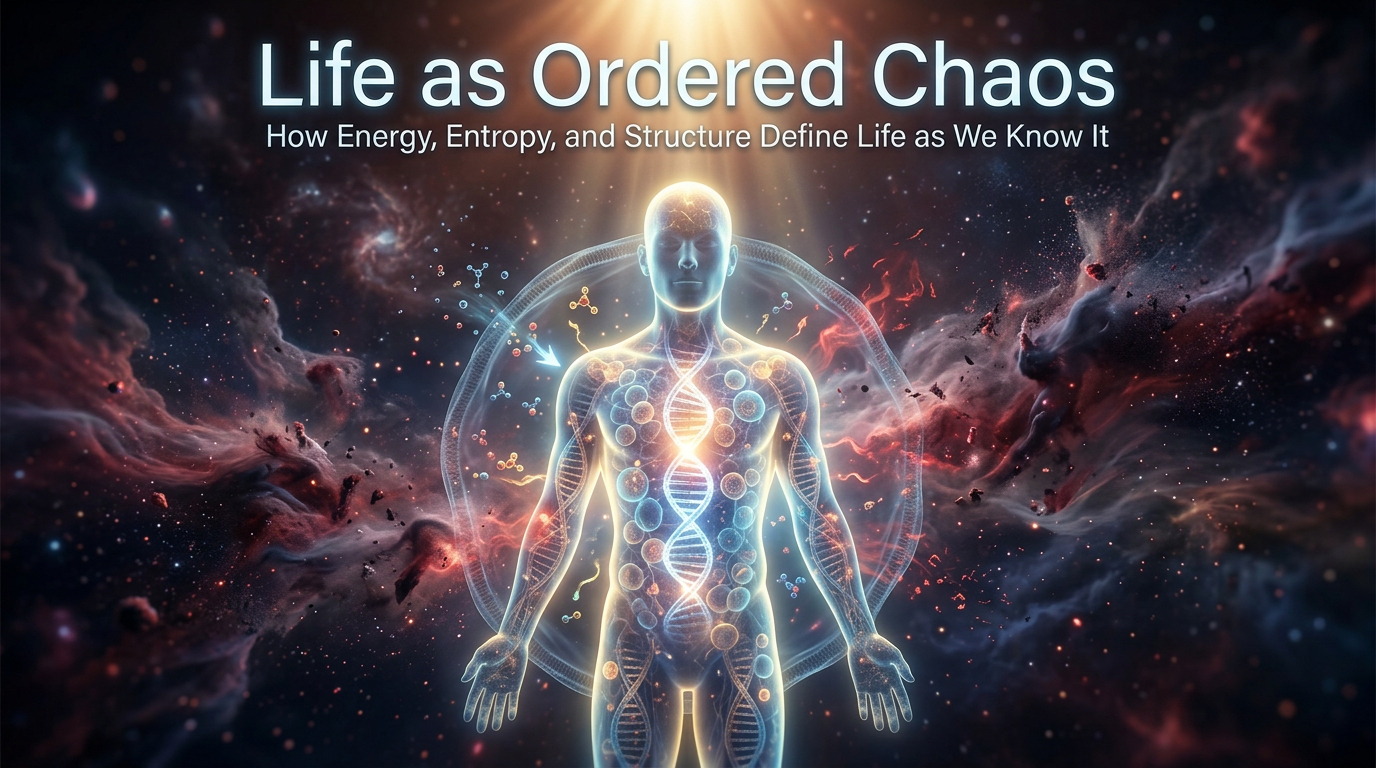
Life as Ordered Chaos: How Energy, Entropy, and Structure Shape Everything Alive
Have you ever stopped to wonder — in a universe that’s slowly falling apart — how you manage to hold yourself together? How does a single cell, a beating heart, a thinking brain exist in a cosmos where disorder always wins?
Welcome to FreeAstroScience.com, where we break down complex scientific ideas into plain, honest language — because we believe your mind deserves to stay awake. We’re the FreeAstroScience team, and today we’re going to walk through one of the most profound questions in all of science: What makes life possible in a universe ruled by entropy?

This isn’t just physics. It’s personal. It’s about you, about every breath you take, every thought you form. It’s about how we’re all — every single one of us — tiny islands of order floating in an ocean of chaos.
Stay with us to the end. We promise it’ll change how you see yourself.
📖 Table of Contents
- 1 What Does the Second Law of Thermodynamics Tell Us About Life?
- 2 How Does Metabolism Keep Us Alive Against Entropy?
- 3 Why Can’t Life Exist in a Closed System?
- 4 How Do Cell Membranes Create the Boundaries of Life?
- 5 Why Is Information the Secret to Life’s Persistence?
- 6 What Did Epictetus Know About the Nature of Change?
- 7 Open vs. Closed Systems: A Side-by-Side Look
- 8 The Mathematics of Entropy: A Quick Guide
1. What Does the Second Law of Thermodynamics Tell Us About Life?
Let’s start with a law that applies everywhere — from your kitchen to the farthest galaxy we can see.
The Second Law of Thermodynamics says that total disorder — what physicists call entropy — always increases over time in an isolated system . Think of it like a room you never clean. Left alone, it gets messier. Never tidier. That’s the universe’s default setting.
So here’s the puzzle. Living things look incredibly organized. Your body contains roughly 37 trillion cells, each one performing thousands of coordinated chemical reactions every second. That doesn’t sound like disorder at all.
And yet, life doesn’t break the Second Law. Not even close.
The key is a simple but powerful distinction: local order versus universal disorder . We — living organisms — create pockets of order here, right where we stand. But we pay for that order by increasing the disorder out there, in our surroundings. The total entropy of the universe still goes up. We just carve out a small, temporary exception for ourselves.
Think of it this way. You’re building a sandcastle on a beach while the tide slowly rises. The castle is beautiful, intricate, organized. But the ocean — vast and relentless — keeps growing. Your castle doesn’t stop the tide. It just holds its shape for a little while.
That’s us. That’s life.
2. How Does Metabolism Keep Us Alive Against Entropy?
If entropy is always rising, how do we stay organized? The answer is energy — and the brilliant chemical machinery we call metabolism.
Life needs a constant supply of energy to persist . On Earth, the original source of almost all biological energy is the Sun. Plants capture sunlight and convert it into chemical energy through photosynthesis. Then, in one way or another, every living thing on the planet gets its energy from plants — whether directly (eating a salad) or indirectly (eating something that ate the salad) .
What Does Metabolism Actually Do?
Metabolism isn’t one single reaction. It’s a network — a web of chemical reactions that build molecules up and break them down . When we eat food, our bodies disassemble complex molecules and reassemble the pieces into forms our cells can use.
Here’s the catch: these reactions aren’t perfectly efficient. They release energy as heat . That heat radiates out into the environment, increasing entropy in the surroundings. So every time you digest a meal, every time your heart beats, you’re paying the universe its entropy tax.
And that’s okay. That’s the deal. We stay ordered because we export disorder.
A Quick Analogy
Imagine a factory. Raw materials come in. Products go out. But the factory also produces waste — exhaust, scrap, heat. The factory stays clean and organized inside. The parking lot? Not so much. That’s metabolism in a nutshell: organized work on the inside, exported disorder on the outside.
3. Why Can’t Life Exist in a Closed System?
This is one of the most important ideas in all of biology and physics — and it’s surprisingly easy to grasp.
Life cannot exist in isolation . Every living system depends on a continuous exchange of energy and matter with its surroundings. Without that exchange, there’s no way to maintain order. No way to keep the sandcastle standing.
Scientists call this an open system — a system that trades both energy and matter with the world around it . Your body is an open system. So is a tree. So is a bacterium.
A closed system, by contrast, moves toward equilibrium — a state where nothing interesting happens anymore . No gradients. No differences. No work being done. In a closed system, everything winds down to a flat, featureless sameness.
And here’s the thing about equilibrium: it’s death . Without energy gradients — differences in chemical concentration, temperature, or electrical charge — there’s no movement, no transformation, and no life.
Life runs on imbalance. On difference. On the gap between what is and what could be. We survive because we’re constantly teetering on the edge, never quite reaching equilibrium. The moment we do, it’s over.
That’s not depressing — it’s extraordinary. We are processes that refuse to settle.
4. How Do Cell Membranes Create the Boundaries of Life?
Every living cell has a boundary. A skin. A wall between “self” and “everything else.”
That boundary is the cell membrane — a thin, selective barrier that controls what comes in and what goes out . It’s not just a wall; it’s a gatekeeper. It lets certain molecules through while blocking others. It manages the flow of energy and matter, keeping the cell’s internal environment stable enough for the chemistry of life to work .
Why Does Compartmentalization Matter?
Without this separation, the delicate organization inside a cell would dissolve into the surrounding environment . Imagine pouring a drop of ink into a glass of water. Without a boundary, the ink spreads everywhere. It reaches equilibrium. The structure — the concentrated drop — disappears.
A cell membrane prevents that from happening. It holds the ink together, so to speak. It maintains the concentration gradients and chemical differences that make life’s reactions possible.
So when we talk about the “boundary” of life, we’re not just speaking in metaphors. There’s a real, physical structure — only about 7 to 8 nanometers thick — that separates you from the chaos outside.
That thin membrane? It’s one of the most important inventions in the history of the universe.
5. Why Is Information the Secret to Life’s Persistence?
Energy keeps us alive from moment to moment. But what keeps life going across generations? What carries the blueprint from parent to child, from one century to the next?
Information.
In all known living organisms, the instructions for building and running a body are stored in DNA (or, in some cases, RNA) . This molecular code tells cells how to grow, when to divide, what proteins to make, and how to respond to the world around them.
The Balancing Act of Stability and Change
Here’s something beautiful about biological information: it has to be stable enough to preserve what works, yet flexible enough to allow change over time . Too rigid, and life can’t adapt. Too loose, and the message falls apart.
Every time a cell copies its DNA, it spends energy doing so — linking information directly to thermodynamic cost . Maintaining and replicating genetic information isn’t free. It’s another piece of the energy budget that keeps us on the right side of entropy.
And without replication — without the ability to pass this information on — life would be temporary . A single flash, then nothing. Replication is what turns a fleeting chemical event into a lineage. A story that stretches across billions of years.
Your DNA connects you to the very first living cells on Earth, roughly 3.8 billion years ago. You carry their legacy in every cell of your body.
If that doesn’t make you feel part of something larger, we don’t know what will.
6. What Did Epictetus Know About the Nature of Change?
Here’s where physics meets philosophy.
In his Discourses (Book 1, Chapter 2), the Stoic philosopher Epictetus wrote: “No great thing is created suddenly” .
He said this nearly 2,000 years ago. And yet, it maps perfectly onto what modern thermodynamics tells us about life.
Life didn’t appear in a single moment. It emerged gradually — through billions of years of chemical experimentation, energy flow, and natural selection. Order wasn’t imposed from the outside. It grew, slowly, from the interplay of energy, matter, and information.
And life doesn’t stay alive all at once, either. It’s a continuous expression of change . A negotiation, moment by moment, between internal structure and external decay. We hold ourselves together, but only for a while. Then we pass the torch — through reproduction, through information — and the process continues.
Life, in this view, is a transient pattern that persists among the total increasing disorder of the universe . Like a whirlpool in a river. The water keeps flowing, but the shape endures.
That’s us. A pattern. A beautiful, temporary, defiant pattern.
7. Open vs. Closed Systems: A Side-by-Side Look
To make all of this clearer, let’s compare the two types of systems we’ve been discussing. The difference between them is the difference between life and death.
| Feature | 🟢 Open System (Life) | 🔴 Closed System (Non-Life) |
|---|---|---|
| Energy Exchange | Continuous input and output of energy | No energy exchange with surroundings |
| Matter Exchange | Imports and exports matter freely | No matter crosses the boundary |
| Entropy Behavior | Local entropy can decrease (order increases) | Entropy always increases toward maximum |
| Equilibrium | Maintained far from equilibrium | Moves inevitably toward equilibrium |
| Example | A living cell, a human body, a tree | A sealed, insulated container |
| Outcome | Life persists ✓ | Stagnation and decay ✗ |
Table: Key differences between open and closed thermodynamic systems as they relate to life. Source: FreeAstroScience.com
The takeaway is straightforward. Life is a process that requires openness. Seal it off, and it dies. Give it a steady flow of energy, and it dances .
8. The Mathematics of Entropy: A Quick Guide
For those of you who enjoy seeing the math behind the ideas, here’s a brief look at the core formula that describes entropy. Don’t worry — we’ll keep it friendly.
🔬 Boltzmann’s Entropy Formula
S = kB · ln(Ω)
| Symbol | Meaning | Value / Unit |
|---|---|---|
| S | Entropy of the system | Joules per Kelvin (J/K) |
| kB | Boltzmann constant | 1.380649 × 10⁻²³ J/K |
| ln | Natural logarithm | — |
| Ω | Number of microstates (possible arrangements) | Dimensionless |
💡 In Plain English: The more ways a system’s particles can be arranged (higher Ω), the greater its entropy (S). A messy room has high entropy — many possible arrangements. A crystal has low entropy — very few. Life keeps Ω locally low by spending energy.
🌍 The Second Law, Stated Simply: For any isolated system, the total entropy change is always ≥ 0.
ΔStotal ≥ 0
This means: the total disorder of the universe never decreases. Life doesn’t violate this rule — it just pushes disorder elsewhere.
That formula — carved into Ludwig Boltzmann’s tombstone in Vienna — is one of the most powerful equations in all of physics. And it applies to you, right now, as you read these words.
Bringing It All Together: The Five Pillars of Life
When we step back and look at the big picture, life rests on a handful of connected principles. Let’s lay them out:
- Energy input — A constant flow of energy from an external source (like the Sun) keeps biological processes running .
- Metabolism — A network of chemical reactions transforms energy into usable forms, releasing heat and increasing entropy in the surroundings .
- Open-system dynamics — Living things exchange energy and matter with their environment, staying far from equilibrium .
- Compartmentalization — Cell membranes create protected internal spaces where the chemistry of life can happen .
- Information replication — DNA and RNA store and transmit the instructions that let life persist across generations .
Take away any one of these, and life as we know it stops.
That’s not a list of dry facts. It’s your operating manual. Right now, inside your body, all five of these principles are at work — keeping you ordered, keeping you alive, keeping you you.
You’re Not Alone in This
Here at FreeAstroScience, we write about science because we believe knowledge is the best kind of company. When you understand why you exist — not just the emotional “why,” but the physical, chemical, thermodynamic how — you start to see yourself as part of something enormous.
You’re not a random accident. You’re the result of 3.8 billion years of information being copied, energy being transformed, and order being maintained against all odds.
You’re an island of order in a vast, expanding universe. And so is every person reading this right now.
We’re all in this together — tiny patterns of defiance, holding our shape against the tide.
Conclusion: The Sleep of Reason Breeds Monsters
Let’s take a breath and gather what we’ve learned.
Life exists at the intersection of order and chaos. The Second Law of Thermodynamics tells us that the universe trends toward disorder — and living things don’t fight that law. Instead, they work with it, importing energy and exporting entropy to maintain their structure . Metabolism provides the engine. Open-system dynamics provide the flow. Cell membranes provide the boundary. And DNA provides the memory that lets the whole process continue beyond a single lifetime .
As Epictetus reminded us nearly two millennia ago, no great thing is created suddenly . Life is gradual. Life is change. Life is a pattern that persists — not by resisting chaos, but by dancing with it.
At FreeAstroScience.com, we exist to explain complex scientific ideas in simple, human terms. We believe that understanding the universe is a kind of self-care — a way of honoring the extraordinary process that made you possible.
Never turn off your mind. Keep it active. Keep it curious. Because as Goya once warned us, the sleep of reason breeds monsters.
Come back to FreeAstroScience.com anytime. There’s always more to discover, and we’ll be here — holding our little island of order, just for you.
📚 References & Sources
- Madden, Isla. “Life as Ordered Chaos: How Energy, Entropy, and Structure Define Life as We Know It.” Medium, April 2026. Read on Medium ↗
- Boltzmann, Ludwig. Lectures on Gas Theory. Originally published 1896–1898. Entropy formula: S = kB ln(Ω).
- Epictetus. Discourses, Book 1, Chapter 2. Translated by W.A. Oldfather. Loeb Classical Library.
- Schrödinger, Erwin. What Is Life? Cambridge University Press, 1944. Wikipedia overview ↗
Article written for FreeAstroScience.com — where complex science becomes simple understanding.
© 2026 FreeAstroScience · Science and Cultural Group