What Makes May 2026 a Month of Rare Lunar Magic?
Have you ever wondered why, once in a while, the calendar hands us two full moons in the same 31 days? Welcome, dear reader. We’re glad you’re here with us at FreeAstroScience, where we break down complex science into words that actually make sense. Stick with us to the end of this article, because May 2026 hides a small handful of sky events that punch far above their weight, and we want you to catch every one of them.
📑 Table of Contents
- Why should we look up in May 2026?
- What is the Flower Microluna of May 1?
- How do we watch the Eta Aquarids from Halley’s Comet?
- What about the quieter Eta Lyrids?
- Why is May 31 a true Blue Moon?
- Your quick-glance sky calendar
- Final thoughts
Why Should We Look Up in May 2026?
Let’s be honest: May 2026 isn’t the busiest astronomical month of the year. But the few events it offers are worth setting an alarm for ]. We’re getting a “microluna” opening night, one of the year’s best meteor showers mid-month, and a calendar quirk so rare it gave English a whole idiom: once in a blue moon.
Our planet doesn’t care about our human schedules. It keeps dancing with the Moon, the dust trails of long-dead comets, and the Sun’s light, regardless of whether we’re watching. That’s why we love pointing these moments out to you, one of our most valued readers.
What Is the Flower Microluna of May 1?
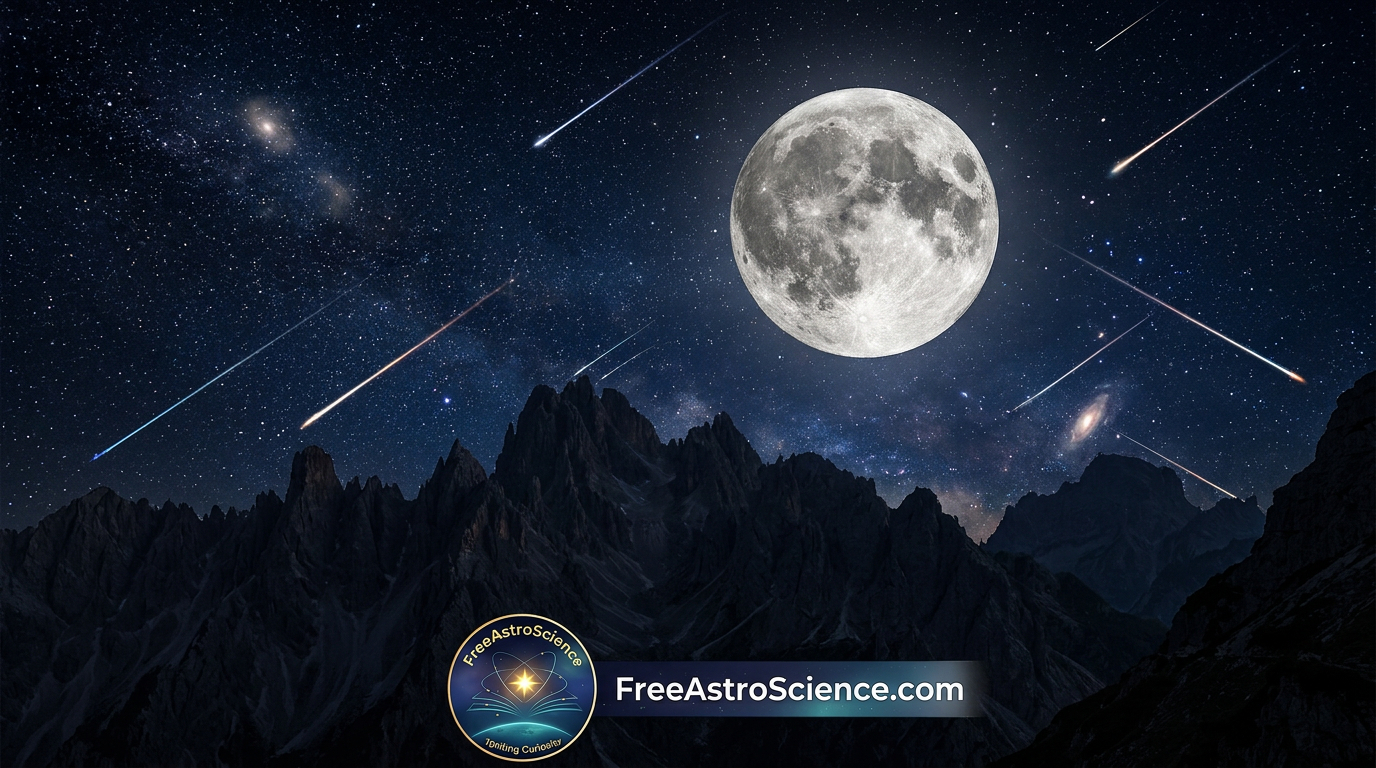
May 1, 2026 opens with a full Moon glowing in the constellation Libra, reaching totality at 19:23 Italian time (17:24 UTC) . Early Native American tribes called it the Flower Moon, because spring blooms explode across the Northern Hemisphere right about now.
Here’s the twist that makes this one special. Just four days later, on May 5, the Moon reaches its apogee at 405,839 km from Earth . Being full so close to that farthest point means it qualifies as a microluna, a journalistic (not strictly astronomical) term for a full Moon near apogee .
How much smaller will it actually look?
Apparent size difference:
The microluna appears 5.9% to 6.9% smaller than an average full Moon, and a striking 30% less bright than a supermoon at perigee .
Angular size ∝ 1 / distance → θapogee / θperigee ≈ 356,500 km / 405,839 km ≈ 0.878
Translation? It won’t jump out at you. But if you’ve been tracking full Moons for a few months, your eye may notice the difference.
How Do We Watch the Eta Aquarids from Halley’s Comet?
Here’s where May 2026 gets truly beautiful. Every year around this time, Earth plows through the debris trail left behind by Comet 1P/Halley . Those grain-of-sand-sized pieces slam into our atmosphere at roughly 65 km/s, burning up as long, persistent streaks of light .
We meet Halley’s dust twice a year actually, once in May as the Eta Aquarids and again in October as the Orionids .
When and how to watch
- Active window: April 15 to May 27, 2026
- Peak night: May 5 (some sources list May 6–7 for the Northern Hemisphere)
- Peak rate: up to 60 meteors per hour in the Southern Hemisphere; around 30/hour in the Northern Hemisphere
- Best viewing time: from about 4 a.m. local time, once the constellation Aquarius has climbed above the eastern horizon
- Moon interference: a waning gibbous Moon will wash out the fainter meteors, but the brighter ones will still punch through
Quick speed calculation: 65 km/s is roughly 234,000 km/h. A single Eta Aquarid meteor could cross Italy (about 1,200 km north to south) in under 20 seconds if it kept going horizontally. Thankfully, the atmosphere vaporizes them in a second or two.
What About the Quieter Eta Lyrids?
The Eta Aquarids get a modest support act this month. The Eta Lyrids come from dust left by Comet C/1983 H1 IRAS-Araki-Alcock, with a radiant in the constellation Lyra .
This is a minor shower. Active from May 6 to May 15, peaking on May 11, forecasts suggest only about 3 meteors per hour on the peak night . The best time to look is from around 10 p.m., when Lyra climbs high enough on the northeastern horizon .
Small numbers, yes, but if you’re already outside for clear skies, why not? Every meteor you catch is a tiny piece of a comet that swung past the Sun decades ago.
Why Is May 31 a True Blue Moon?
We usually get one full Moon per calendar month. But the Moon’s cycle runs 29.5 days, while our months stretch to 30 or 31 . Once in a while, that mismatch lets a second full Moon sneak into the same month. That second one is what we call a Blue Moon .
On May 31, 2026 at 10:45 Italian time (08:46 UTC), the Moon reaches full phase again, making it the month’s second and earning it the Blue Moon title
Will it actually look blue?
No. Despite the name, our satellite will shine its usual silvery grey . The phrase has nothing to do with color and everything to do with rarity. English speakers use “once in a blue moon” the way Italians say “ogni morte di papa” — for something that almost never happens .
Fun math moment: 12 lunar cycles × 29.5 days = 354 days. That’s 11 days short of our 365-day year. Those extra days pile up until, roughly every 2–3 years, a month gets gifted a second full Moon.
Your Quick-Glance Sky Calendar for May 2026
| Date | Event | What to Know | Type |
|---|---|---|---|
| May 1 | Flower Microluna | Full phase 17:24 UTC; appears ~6% smaller than average | Moon |
| May 5–7 | Eta Aquarids peak | Up to 60/hr (S), ~30/hr (N); best from 4 a.m. local | Meteors |
| May 11 | Eta Lyrids peak | ~3/hr; watch from 10 p.m., radiant in Lyra | Meteors |
| May 16 | New Moon | 20:03 UTC — darkest skies of the month for deep-sky viewing | Moon |
| May 31 | Blue Moon | Second full Moon of the month at 08:46 UTC | Rare |
Final Thoughts from Us at FreeAstroScience
May 2026 won’t flood your camera roll with eclipses or planetary oppositions. What it offers is subtler and, in a way, more personal. A full Moon that looks slightly shy. A meteor shower fueled by a comet Edmond Halley tracked three centuries ago. A second full Moon that gave the English language an entire idiom.
We wrote this article specifically for you, here at FreeAstroScience.com, where we take complex scientific principles and turn them into something you can actually use on a Tuesday night with your kids in the backyard. Our mission? To help you never switch off your mind. Because, as Goya warned us, the sleep of reason breeds monsters.
Keep your eyes open. Keep your questions sharper. And come back to FreeAstroScience.com soon — we’ve got more sky to share with you.
Clear skies,
Gerd Dani — President, Free AstroScience
📚 Sources
- Tortorelli, L. — “In arrivo la Luna Blu e le Eta Aquaridi — eventi astronomici di maggio 2026”, Geopop, 29 April 2026.
- SeaSky — Astronomy Calendar of Celestial Events 2026.
- American Meteor Society — 2026 Meteor Shower List.
- TimeandDate — Moon Distances for Rome, Italy.
- U.S. Naval Observatory & The Old Farmer’s Almanac — referenced via SeaSky calendar data.