The evolutionary trajectory of Earth’s atmosphere remains one of the most compelling enigmas in modern geobiology. A groundbreaking discovery by South Korean researchers has provided pivotal insights into this phenomenon, suggesting that impact-generated lakes may have actively fostered the earliest oxygen-producing life forms. By identifying ancient microbial structures within a confirmed asteroid impact site, the scientific community is closer to decoding the precise environmental catalysts that initiated the oxygenation of our planet.
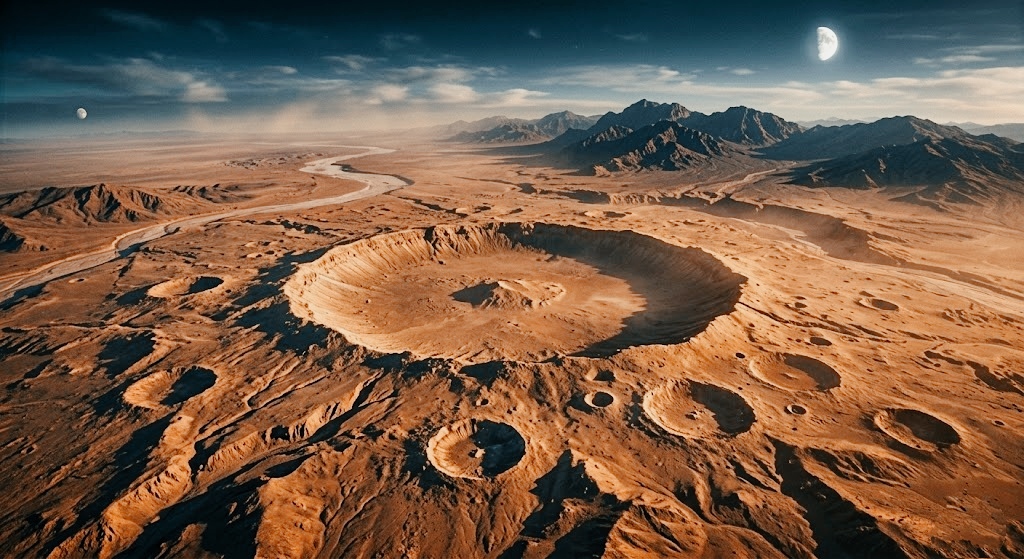
Asteroid impact: discovery of stromatolites within the Hapcheon crater
A dedicated team of scientists from the Korea Institute of Geoscience and Mineral Resources, commonly referred to as KIGAM, recently uncovered remarkable evidence within the Hapcheon impact crater, which stands as the only validated asteroid collision site on the Korean Peninsula. The researchers successfully documented the presence of stromatolites, which are finely layered structures meticulously built by ancient microbial communities over vast geological timescales. These specific specimens, measuring between ten and twenty centimeters in diameter, were identified predominantly in the northwestern sector of the crater, marking an unprecedented biological find for this location.
The physical presence of these structures indicates that a highly specialized lacustrine environment flourished inside the basin long after the initial celestial collision. Stromatolites represent some of the most ancient and enduring records of life on Earth, heavily associated with photosynthetic microorganisms like cyanobacteria. Because fossil evidence elsewhere dates similar structures back at least 3.5 billion years, finding them within the confines of an impact basin suggests a direct and profound link between cosmic bombardments and the proliferation of primitive biological systems.
The surrounding geological matrix further supports the theory that these organisms did not merely survive but actively colonized the basin during its post-impact phase. The discovery strongly implies that asteroid craters did not function solely as agents of mass destruction, but rather as isolated, protective basins where early life could consolidate and evolve. This shift in perspective forces geologists to re-evaluate the ecological aftermath of major impact events during the formative eras of our planet.
Hydrothermal systems and the Great Oxidation Event
Geochemical analyses performed on the newly discovered stromatolites revealed a complex history of high-temperature water alteration, alongside distinct traces of both local terrestrial rock and extraterrestrial materials. The innermost layers of the fossilized structures displayed significantly stronger hydrothermal signatures compared to the outer sections, indicating that the microbes initiated their growth during an earlier, much warmer phase of the lake. This evidence points directly to a post-impact hydrothermal system that gradually cooled over thousands of years, maintaining a stable, mineral-rich habitat.
The thermal energy released by the melting of crustal rock during the asteroid impact effectively transformed the resulting lake into a massive, self-sustaining incubator. This persistent warmth, coupled with a steady supply of dissolved minerals, created an optimal setting for photosynthetic microbes to thrive far away from the harsher, less predictable conditions of the open oceans. The research team postulates that these specialized, impact-generated lakes essentially functioned as localized oxygen oases, concentrated zones where the production of life-supporting gas could accelerate.
Consequently, these localized environments offer a plausible mechanism to help explain the dynamics of the Great Oxidation Event, which occurred roughly 2.4 billion years ago. During this transformative epoch, atmospheric oxygen levels on Earth rose dramatically, permanently altering the global biosphere and paving the way for complex multicellular organisms. The existence of hydrothermal crater lakes suggests that the rise of global oxygen may have been underpinned by numerous regional hotspots driven by the residual energy of cosmic impacts.
Implications for early martian astrobiology
This current body of research significantly expands upon a foundational 2021 study published in Gondwana Research, which originally confirmed the impact origin of the Hapcheon structure. By identifying definitive biological markers within the crater, the KIGAM team, led by principal author Doctor Jaesoo Lim, has successfully demonstrated that impact basins can foster complex microbial ecosystems. Doctor Lim noted that this research provides the first comprehensive evidence proving stromatolites could form in hydrothermal lakes created by asteroid collisions, emphasizing the suitability of such environments for early life.
Beyond its profound implications for terrestrial history, this discovery directly informs the ongoing search for extraterrestrial life, particularly on the planet Mars. Scientists have long established that early Mars possessed an environment rich in water, with a surface heavily scarred by numerous impact craters that once held ancient lakes. If impact-generated hydrothermal systems could successfully sustain oxygen-producing life on Earth, identical geological features on Mars may have hosted parallel biological processes during its damp youth.
As robotic explorers continue to traverse the Martian surface, crater basins remain primary targets for scientific drilling and sample collection. The findings from the Hapcheon crater suggest that astrobiologists should focus their attention precisely on the ancient hydrothermal zones within these planetary scars. By looking for similar layered structures and geochemical signatures in Martian craters, researchers may eventually uncover definitive proof that the red planet once cradled primitive microbial ecosystems.
The study is published in Communications Earth & Environment.