
An Alien Recipe for Water: Why Comet 3I/ATLAS Is Rewriting the Story of Planet Formation
A new study with the ALMA radio telescope has measured something astronomers have never seen before in any comet: water from another star system, carrying a chemical fingerprint that points to an origin in conditions far colder—and far stranger—than anything that produced our own Sun.
A Visitor From Another Star
When astronomers spotted 3I/ATLAS in July 2025, they knew almost immediately that they were looking at something extraordinary. Its trajectory was hyperbolic—too steep, too fast—meaning it was not bound to the Sun. It was just passing through, a fragment of another planetary system slingshotting briefly into our own before disappearing back into interstellar space forever.
It is only the third such object ever confirmed, after 1I/’Oumuamua (2017) and 2I/Borisov (2019). And while it briefly became a tabloid sensation thanks to recycled “alien spacecraft” speculation, the real story has turned out to be far more interesting. Scientifically, 3I/ATLAS is now the most chemically scrutinized interstellar object in history.
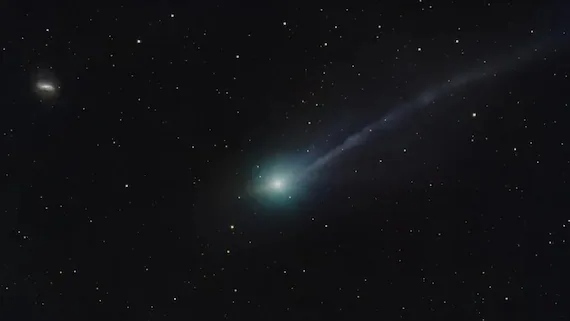
The latest result, published in Nature Astronomy on April 23, 2026, by Luis E. Salazar Manzano, Teresa Paneque-Carreño and an international team, delivers the headline finding to date: the water locked inside this comet is not like ours. Not even close.
The Discovery in One Number
Using the Atacama Large Millimeter/submillimeter Array (ALMA) in Chile, the team observed 3I/ATLAS just six days after its closest approach to the Sun, on November 4, 2025. They were hunting for a specific molecule called HDO—semi-heavy water—and they found it in startling abundance.
The bottom line:
- Earth’s oceans contain roughly 1–2 molecules of HDO for every 10,000 molecules of normal water.
- Comets in our own Solar System contain about 2–5 per 10,000.
- Comet 3I/ATLAS contains at least 66 per 10,000.
That is a deuterium enrichment more than 30 times higher than the average Solar System comet, and more than 40 times higher than Earth’s oceans. No comet ever observed comes close.
What Is “Semi-Heavy” Water, and Why Does It Matter?
Everyone learns the formula for water in school: H₂O—two hydrogen atoms and one oxygen atom. But hydrogen has a heavier cousin called deuterium (often written as D). A deuterium nucleus contains one proton and one neutron, instead of just a proton. Replace one of the hydrogens in water with deuterium and you get HDO: semi-heavy water. Replace both, and you get D₂O: heavy water.
Chemically, semi-heavy water behaves almost identically to ordinary water. But its origin story is very different. Forming HDO efficiently requires extraordinarily cold conditions—colder than about 30 K (–243 °C)—where a chain of low-temperature chemical reactions involving the H₃⁺ ion can dramatically enrich molecules with deuterium.
This is why scientists treat the D/H ratio in water as a sort of cosmic birth certificate. The amount of deuterium baked into a comet’s ice is a faithful record of the temperature, density, and radiation environment of the cloud where its parent star—and its parent water—first formed. Warm those ices later, and the signature partially erases. Keep them frozen for billions of years, and the signature survives.
3I/ATLAS, in other words, is carrying a sample of pristine ice from another planetary system—and that sample is talking.
How the Measurement Was Made
The team targeted two specific frequency windows with ALMA. One was tuned to a rotational transition of HDO at 241.561 GHz; the other was tuned to a transition of normal water (H₂O) at 183.310 GHz. They also captured many transitions of methanol (CH₃OH), which would prove crucial.
Here is where the work becomes elegant. The HDO line was detected clearly. The H₂O line, however, was not—it was lost in the noise. So how do you measure a ratio when the denominator hides?
The answer lies in methanol. The relative populations of methanol’s many quantum energy levels depend sensitively on how often its molecules collide with water molecules in the comet’s coma (the gas envelope around the nucleus). By using state-of-the-art radiative transfer modeling—a code called SUBLIME—and Bayesian statistical inference (the same kind of techniques used to characterize exoplanet atmospheres), the researchers could work backwards from the methanol spectrum to constrain the amount of water that must have been there.
From this they derived a coma kinetic temperature of about 70 K and a water production rate of roughly 1.6 × 10²⁹ molecules per second—values consistent with independent measurements from the SOHO spacecraft and the MAVEN mission orbiting Mars. With the water abundance pinned down, the HDO detection translated directly into a D/H ratio.
The result, depending on which of two analysis approaches is used, is a lower limit of D/H > 4.6 × 10⁻³ or, more conservatively, > 6.6 × 10⁻³. Either way, the conclusion is the same: 3I/ATLAS is wildly enriched in deuterium compared to anything in our own Solar System.
What This Tells Us About 3I/ATLAS’s Birthplace
The deuterium enrichment cannot be explained by simply assuming 3I/ATLAS was born in a different region of the Milky Way. The variation in raw deuterium-to-hydrogen abundance from place to place in our galaxy is far too small to account for what ALMA is seeing. Something more local—something about the actual cloud where this comet’s parent star ignited—must be responsible.
Two complementary explanations are on the table, and they are not mutually exclusive:
1. A colder, more isolated cradle
Most stars are born in clusters, surrounded by other stars whose ultraviolet radiation gently warms the surrounding gas. The Sun is widely thought to have formed in just such a clustered environment—evidence includes traces of short-lived radioactive isotopes that likely came from a nearby supernova. In a cluster, gas in the dense star-forming filaments tends to sit around 20–30 K.
An isolated star, by contrast, can be born in gas closer to 10 K. And because deuterium fractionation is exquisitely temperature-sensitive, those colder conditions produce dramatically more HDO. The simplest reading of the new data, therefore, is that 3I/ATLAS formed around a star born in much greater isolation than our Sun—or in a far quieter, less irradiated corner of its natal cloud.
2. A different protoplanetary disk history
The alternative is that the parent disk—the rotating cloud of gas and dust from which 3I/ATLAS condensed—simply never reprocessed its water as thoroughly as ours did. In our Solar System, radial mixing in the protoplanetary disk likely blended D-rich primordial ices with thermally processed water from warmer inner regions, diluting the original signal. If 3I/ATLAS was ejected from its system early, before such mixing had time to act, its ice would retain a much purer record of the cold prestellar phase.
This idea fits neatly with another recent finding: observations from the James Webb Space Telescope and the SPHEREx mission found that 3I/ATLAS is unusually rich in carbon dioxide compared to water, possibly indicating that it formed beyond the CO₂ “snowline” in its parent disk—farther out, and colder, than our own comets.
The Bigger Picture: Are All Solar Systems Like Ours?
For decades, astronomers have used Solar System comets as a yardstick for understanding how water—and by extension, the ingredients of life—was delivered to young planets. Some comets share Earth’s D/H ratio almost exactly; others differ by a factor of two. That relatively narrow range of variation has fed a comforting picture: planet-forming chemistry might be broadly similar across the galaxy.
3I/ATLAS shatters that comforting picture. With a D/H ratio at least 20–30 times higher than the typical cometary value, it lies far outside any range we have ever measured locally. If this comet is at all representative of the broader population of exocomets drifting through the galaxy, then the chemistry of planet formation may be far more diverse than our limited Solar System sample suggested.
Combined with its independently estimated kinematic age of 3 to 11 billion years—possibly making it the oldest interstellar object ever detected, born in the early Milky Way—3I/ATLAS gives us a glimpse of how planetary systems were being assembled long before our own began to form 4.6 billion years ago.
Why This Matters
A measurement like this could not have been made even a decade ago. It requires a comet from another star, caught while still actively outgassing; a radio telescope sensitive enough to detect a faint isotopic line in a passing visitor; sophisticated non-equilibrium chemistry models; and modern statistical inference to extract a hidden quantity. The convergence of all of these capabilities—around a single object visible for only a few months—is what makes 3I/ATLAS such a once-in-a-generation gift.
Every interstellar comet we catch is a small, frozen letter from another star, and 3I/ATLAS has just delivered its most surprising line yet: the conditions that shape worlds elsewhere can be profoundly different from the ones that shaped our own.
Astronomers are already analyzing additional ALMA observations from later in November 2025, and JWST follow-up has independently confirmed the deuterium enrichment. The full chemical portrait of this remarkable visitor is still being painted. But one conclusion is already secure: somewhere, around some other star—older than our Sun, colder than our cradle—the ingredients for worlds were mixed in a different way. And we now have a sample.
Reference
Salazar Manzano, L. E., Paneque-Carreño, T., Cordiner, M. A., et al. “Water D/H in 3I/ATLAS as a probe of formation conditions in another planetary system.” Nature Astronomy, published online April 23, 2026. DOI: 10.1038/s41550-026-02850-5
Image credit suggestion: Amateur photograph of 3I/ATLAS taken on November 16, 2025 with a Celestron EdgeHD 800 telescope (Satoru Murata, Wikimedia Commons).