Have you already booked your flight this summer and wondered if your plane will actually take off? Welcome, dear reader, to FreeAstroScience.com. We’re glad you stopped by. This article was written for you by us, a team that loves turning complicated science and logistics stories into clear, honest reading. Stay with us to the final line: what’s happening in the skies right now is more than a travel headline. It touches energy security, physics of fuels, and choices that could reshape your holiday plans within weeks.
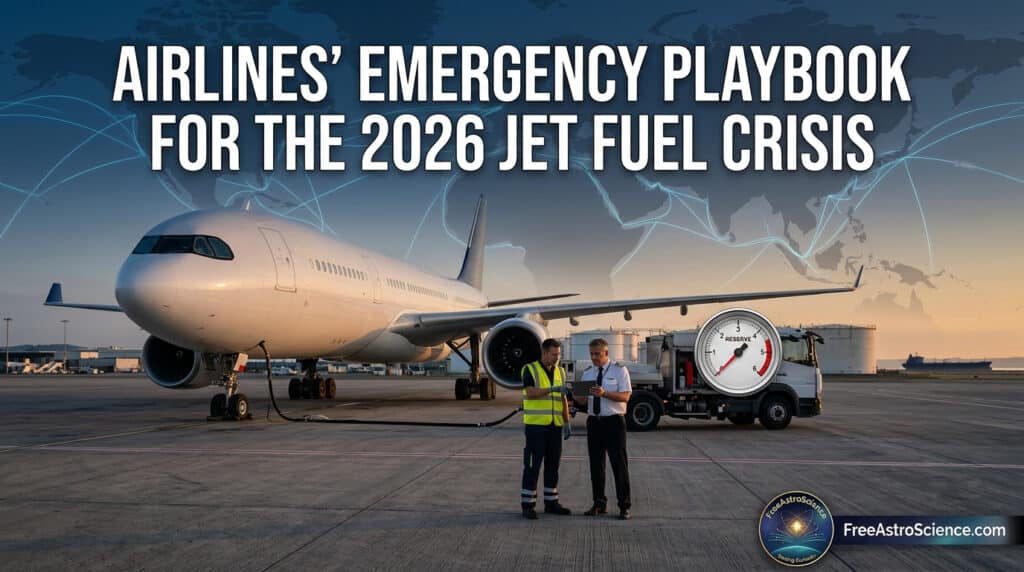
Airlines’ Emergency Playbook for the 2026 Jet Fuel Crisis
Walk onto any runway and you’ll catch that sweet, oily smell of kerosene ]. For the past ten weeks, that smell has become a luxury. Since the Iran war began on 28 February 2026, the Strait of Hormuz has stayed shut, and roughly 40% of Europe’s jet fuel imports used to pass through it . The result? A price shock, a supply squeeze, and a race to save your summer holiday.
Why is jet fuel suddenly so scarce?
The Gulf region normally supplies about 20% of the jet fuel traded on international markets each day . With tankers blocked, that fuel isn’t reaching European tanks. Europe can’t make up the gap at home: five refineries have closed in just over two years, while demand keeps rising.
The UK sits in an exposed spot. We import 65% of the jet fuel we burn, and two of those recently closed refineries were British, leaving just four still running. East Asian refineries, another backup source, depend on Middle Eastern crude, so they’re stretched too.
The Jet A vs Jet A1 puzzle
Here’s a detail many travellers miss. The US aviation market uses Jet A, which has a higher freezing point. Europe and the UK require Jet A1, which has a lower freezing point and works better at cruising altitude . Not every US refinery can make Jet A1, so the extra fuel crossing the Atlantic is limited. British ministers are now looking at whether to temporarily permit Jet A in UK skies.
How bad are the numbers behind the crisis?
| Indicator | Before the War | Now (May 2026) | Source |
|---|---|---|---|
| Jet fuel price (Europe) | $831/tonne (Feb) | ~$1,500/tonne (peaked $1,838) | |
| Price per barrel | $99 | $179 (peak $209) | |
| Europe’s fuel reserve | 37 days | ~30 days (23 = critical) | |
| UK jet-fuel import dependency | 65% | 65% (sources shifting) | |
| Fuel share of airline costs | 25–30% | Rising fast | |
| US jet fuel exports to Europe | ~25,000 barrels/day | ~150,000 barrels/day (6× normal) |
Extra annual cost ≈ Fuel share × % price rise × Airline revenueFor United Airlines, CEO Scott Kirby estimates sustained high prices could add $11 billion in yearly costs — more than double the company’s best-ever profit of under $5 billion .
When the International Energy Agency warned in mid-April that Europe had “maybe six weeks” of jet fuel left, IATA’s Director General Willie Walsh called the assessment “sobering” . Reserves at the Amsterdam-Rotterdam-Antwerp hub are now at their lowest level in six years .
What is the UK’s new contingency plan?
On 2 May 2026, Transport Secretary Heidi Alexander announced a temporary rule change. Carriers can now cancel flights at least two weeks in advance without losing their precious take-off and landing slots .
Why does that matter? Under the Airports Slot Allocation Regulations 2025, airlines must use their slots at least 80% of the time, or a rival can snatch them . In normal years this pushes carriers to fly half-empty planes just to keep the slots. With fuel so tight, that’s wasteful. The new plan lets them hand back unused slots temporarily and keep their rights for next year .
Merging flights: how it would work
Travel journalist Simon Calder gave a clear example. Lufthansa runs 10 daily flights between London Heathrow and Frankfurt. In midsummer, with fewer business travellers, Lufthansa could axe two or three, moving passengers from an 08:30 departure to one at 10:30 . The saved fuel then goes to less frequent routes — say, Manchester to the Greek island of Skiathos — where you can’t simply “get the next one” .
Alexander put it plainly: “The last thing I want is any passenger turning up at the departure gate to receive a text message saying that their flight is cancelled” . Airlines UK, led by chief executive Tim Alderslade, welcomed the move, calling slot alleviation a way to “avoid unnecessary flying” while protecting connectivity .
Which flights will airlines cut first?
Carriers are already trimming schedules before any forced rationing. The list keeps growing :
- Lufthansa: 20,000 flights removed between now and the end of October; feeder airline CityLine shut down early, 27 older jets grounded .
- SAS: “at least a thousand” flights cancelled in April .
- KLM: 160 flights cut next month, about 1% of European routes .
- Air France-KLM, Air Canada: broad summer-schedule reductions .
- Vietnam Airlines: 23 domestic flights cut weekly from April.
- Industry total: around 12,000 cancellations in May alone , and nearly two million airline seats trimmed across the sector.
The pattern: lunchtime, midweek, and short-haul routes
According to reporting from Corriere della Sera, the first victims are likely midday flights, which usually carry fewer passengers . Morning and late-afternoon services — packed with commuters and families — stay protected . Ryanair CEO Michael O’Leary told the Italian daily that while “nothing is concrete yet,” with Hormuz shut “the supply problem becomes more serious week after week” .
Other likely cuts target Tuesdays, Wednesdays, and Saturdays — historically quieter days — and short domestic routes that high-speed trains can replace . Flights to islands stay sheltered, since ferries rarely offer a proper alternative .
Hedging: who’s protected and who isn’t?
European and Asian airlines typically hedge fuel, buying it at fixed prices months ahead. EasyJet hedged 80% of its first-half supply at $717/tonne, yet the other 20% cost an extra £25 million in March alone . Most US carriers don’t hedge, so they’re taking the full hit . John Strickland of JLS Consulting says this gives well-hedged low-cost carriers a rare chance to pressure weaker rivals .
Will your ticket cost more?
Short answer: yes, especially long-haul. A London–Melbourne ticket in June now costs 76% more than last year, according to Teneo . Virgin Atlantic added surcharges of £50 on economy returns and £360 on business fares . Cathay Pacific raised fuel surcharges by roughly 34% across all routes . Air India tacked on up to $280 on some flights .
Short-haul inside Europe is a different story. Wizz Air CEO József Váradi actually reported prices falling in late April, because nervous customers need coaxing back: “That level of hesitancy can be overcome through price stimulation” . United’s Scott Kirby took the opposite line, promising investors the airline would do “whatever it takes to recover 100% of the increase in jet fuel prices” .
What are your rights if flights are cancelled?
Under current UK law, if your flight is cancelled you’re entitled to a full refund or rerouting on a comparable service . Delays of two hours (short-haul), three hours (medium), or four hours (long-haul) trigger rights to care and assistance — food vouchers, phone refunds, accommodation if needed .
Here’s the fight brewing behind the scenes. Airlines want fuel shortages labelled “extraordinary circumstances,” which would let them dodge compensation payouts . The UK hasn’t agreed. The European Commission has hinted carriers may be excused from compensation only if they can prove the disruption came directly from the fuel shortage and that all reasonable measures were taken .
Consumer group Which? isn’t happy. Rory Boland, editor of Which? Travel, warned: “It’s not fair for the rules to now be bent in favour of airlines and potentially leave passengers holding the bill” . Shadow transport secretary Richard Holden said families could be “herded on to a different plane, at a time of the airline’s choosing” .
What comes next for European skies?
European Transport Commissioner Apostolos Tzitzikostas says there’s no proof yet of an actual supply shortage, but the situation is “quite critical, and we must be ready — and we are — for all scenarios” . Amaar Khan of Argus Media thinks the risk is “huge,” with large airports likely to be prioritised over smaller ones .
Prime Minister Keir Starmer has gone further than his own government’s line, suggesting Britons may need to rethink “where they go on holiday this year” . Meanwhile US carriers like Delta — which owns a Philadelphia refinery precisely to hedge against crises like this — report no near-term impact on their operations .
Even if Hormuz reopens tomorrow, recovery won’t be instant. Pavel Molchanov of Raymond James warns it “could take until the end of the year” to bring all released strategic reserves to market . Europe’s deficit currently sits at 250,000 barrels a day .
Our Take: The Summer We Learn to Fly Lighter
We’ve walked you through the prices, the politics, and the plans. The picture is messy but not hopeless. Airlines are trying something sensible: fewer, fuller planes instead of half-empty flights burning scarce kerosene. Governments are adjusting decades-old slot rules to stop wasteful flying. Passengers keep most of their rights — though the compensation battle is far from settled.
This episode reminds us that modern aviation rests on a thin chemical thread called Jet A1, shipped across contested waters, refined by a shrinking pool of plants. One closed strait, and the whole engine coughs. That’s a lesson worth carrying beyond the holiday season.
At FreeAstroScience.com we wrote this for you because we believe complex scientific and technical stories deserve simple, honest explanations. Our mission is to keep your mind active and never let it switch off — because, as Goya warned, the sleep of reason breeds monsters. Come back soon to keep sharpening your curiosity with us. Safe travels, whatever your June looks like. 🛫