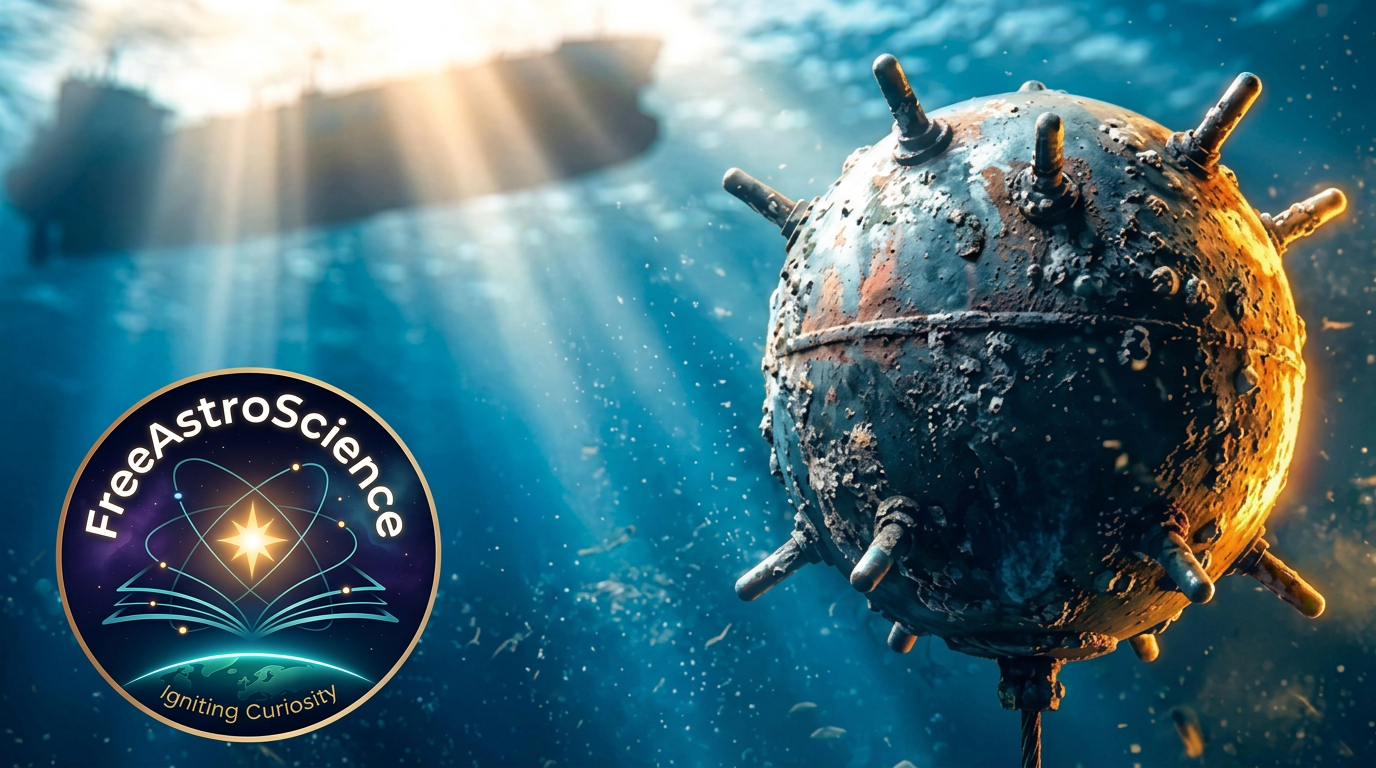
What if a single underwater bomb could choke a fifth of the planet’s energy supply?
Welcome, dear reader. We’re glad you stopped by FreeAstroScience.com, where we break down the toughest scientific and geopolitical puzzles into language anyone can grasp. Today we’re taking you under the murky waters of the Strait of Hormuz, where small metal spheres packed with explosives have done what diplomats spent decades trying to prevent: they’ve shut down the busiest oil corridor on Earth.
Stay with us until the very end. By the last paragraph, you’ll understand the science of naval mines, the psychology of fear they exploit, and the painstaking work of the brave crews trying to clear them. We promise it’s worth the read.
📑 What You’ll Find Inside
- Why does a 39-km strait matter to your gas pump?
- Which three mine families is Iran using?
- How does the seabed help and hurt minelayers?
- Why is fear the deadliest weapon of all?
- How do navies actually clear a minefield?
- What is the “mine gap” and why should you care?
- What happens after the ceasefire ends on April 22?
The Quiet War Beneath the Waves of Hormuz
Picture a stretch of sea no wider than the distance between two small towns. Now picture a fifth of the world’s oil and liquefied natural gas squeezing through it every single day. That’s the Strait of Hormuz on a normal Tuesday.
Today, more than forty days into the war between the United States, Israel, and Iran, that same strip of water sits eerily quiet. Tankers wait in harbors. Insurance brokers refuse new policies. And somewhere below the surface, between 2,000 and 6,000 metal eggs filled with high explosive sit patiently, waiting.
We wrote this article specifically for you, our FreeAstroScience reader, because we believe that knowing how things work is the best defense against fear and propaganda. Our mission has never changed: keep your mind awake, because the sleep of reason breeds monsters.
Why Does a 39-km Strait Matter to Your Gas Pump?
Look at a map of the Persian Gulf. The only way out is a narrow neck of water between Iran and Oman. That’s the Strait of Hormuz.
The numbers tell the story:
- Length: about 167 km
- Width at the narrowest point: 39 km (24 miles), per Al Jazeera’s reporting
- Width at the widest point: over 100 km
- Two shipping lanes: each roughly 3 km wide
- Buffer zone between lanes: another 3 km
- Average depth on the navigable channel: 40 to 60 metres
- Depth near the Iranian coast: drops to 15 to 30 metres
Before the war broke out on February 28, this single waterway carried one-fifth of the world’s oil and LNG supplies. Every barrel from Saudi Arabia, Kuwait, Iraq, Qatar, and the UAE that reaches an open ocean has to thread this needle.
So when Iran’s Islamic Revolutionary Guard Corps (the Pasdaran) seeded those waters with mines in the opening days of the conflict, they didn’t just block ships. They squeezed the energy artery of the planet.
Which Three Mine Families Is Iran Using?
Naval mines have been called the most cost-effective weapons in modern warfare, and for good reason. According to the Foreign Policy Research Institute, sophisticated modern mines can cost tens of thousands of dollars to build, yet they impose strategic costs orders of magnitude higher.
Iran’s arsenal, estimated at 2,000 to 6,000 units largely produced at home, falls into three families. We’ve put them side by side so you can see the differences at a glance.
| Mine Type | Example Model | How It Triggers | Typical Depth | Threat Level |
|---|---|---|---|---|
| Contact | M-08 (design from WWI) | Direct physical hit on the ship’s hull | Anchored to shallow seabed or floated on a sphere | Moderate – visible to sonar, easier to spot |
| Bottom (Influence) | Maham-2 | Magnetic, acoustic, or pressure sensors detect the ship | Rests on the seafloor | High – no contact needed, hard to detect |
| Smart / Rocket | Chinese EM-52 (reportedly) | Detects ship overhead, fires rocket upward | Up to 200 m (656 ft) | Very High – strikes from below, deep-water capable |
Let’s slow down on each one, because the science is fascinating.
Contact Mines: The WWI Classic Still Doing Damage
The simplest design also happens to be the oldest. A contact mine is essentially a hollow steel sphere stuffed with explosive. The lower half holds the warhead. The upper half traps an air pocket that gives the mine buoyancy. A cable ties it to a concrete weight on the seabed, leaving the sphere floating just below the surface.
When a ship’s hull touches one of those metal horns sticking out, a glass tube inside breaks, an electrical circuit closes, and the mine detonates. The M-08 design dates back to the First World War. Brutal, simple, and still effective in 2026.
Bottom Mines: Listening for Your Footsteps
Bottom mines are smarter cousins. They sit on the seafloor and wait, sensors awake. They don’t need a ship to bump into them.
Three signatures give a passing vessel away:
- Magnetic signature: the steel hull warps Earth’s magnetic field as it moves overhead.
- Acoustic signature: propeller and engine noise.
- Pressure signature: the displacement of water as the ship glides past.
When the right combination is detected, the mine fires. The Maham-2, Iran’s domestic model, belongs to this family. We can model the hydrostatic pressure these mines must survive (and detect) using a simple physics formula.
Hydrostatic pressure on a bottom mine
P = ρ · g · h
- P = pressure on the mine casing (Pascals)
- ρ = seawater density ≈ 1025 kg/m³
- g = gravitational acceleration ≈ 9.81 m/s²
- h = depth in metres
At a typical Hormuz depth of 50 m: P ≈ 1025 × 9.81 × 50 ≈ 502,762 Pa, or roughly 5 atmospheres. At the EM-52’s maximum 200 m depth, that climbs to about 20 atmospheres – manageable for hardened steel casings, ruinous for an unarmored ship hull above.
That sensitivity to pressure changes is exactly why minesweepers must move silently and with as little magnetic disturbance as possible. We’ll get to that in a moment.
Smart Mines: The Sniper of the Seabed
The third family is where things get unsettling. Smart mines (like the reportedly imported Chinese EM-52) sit anchored on the seabed at depths up to 200 metres. They wait. When sensors confirm a ship is passing overhead, the mine fires a rocket-propelled warhead straight up at the ship’s belly.
A vessel’s hull is its weakest point. A rocket strike from below can break a tanker’s keel in a single blow. And because the mine itself stays on the seafloor, divers and sonar teams can’t easily neutralize the threat without first finding the launcher in dark, deep water.
How Does the Seabed Help and Hurt Minelayers?
Geography did Iran a favor. The Strait’s shallow floor (40–60 m on the main channels, 15–30 m near the Iranian coast) makes mine-laying easy and cheap. Iran’s islands of Qeshm, Hormuz, and Larak narrow the navigable corridors even further, forcing international traffic into channels barely a few kilometres wide.
Analysts at the Washington Institute for Near East Policy point out that any mine placement was almost certainly chosen to exploit these natural pinch points. The map released by the IRGC last week confirms it: Iran is steering shipping much closer to its own coast, away from the traditional route hugging Oman.
Why? Because mines are easier to plant and harder to find in shallow water. And shipping that hugs the Iranian coast also stays under the watchful eye of Iranian shore batteries.
Why Is Fear the Deadliest Weapon of All?
Here’s the part that surprised us most as we read through the sources. Iran has never publicly disclosed the exact location of the mines. The fact that US warships are still searching tells you Washington doesn’t know either.
That’s not a flaw in the strategy. That is the strategy.
A retired Romanian naval officer, Alexandru Cristian Hudisteanu, put it perfectly when speaking to Al Jazeera. He explained that when planning a strait blockade, you don’t have to mine every square metre. You just need ship captains and insurance underwriters to believe mines could be anywhere.
His exact phrasing stuck with us: the mined area doesn’t have to be everywhere to feel like it’s everywhere in the minds of those who must transit it.
A single mine is enough to invalidate an insurance policy. One unconfirmed sighting freezes commerce for weeks. The cheapest weapon in modern war isn’t the explosive itself; it’s the doubt it plants in your head. That’s psychological warfare written in salt water.
How Do Navies Actually Clear a Minefield?
The technical name for this work is MCM, short for Mine Countermeasures. Two complementary techniques do the job.
Mine hunting uses high-resolution sonar to find and identify each mine, one by one. Think of it as scanning the seafloor with a flashlight, except the flashlight is sound and the room is pitch-black and freezing.
Minesweeping is the more aggressive cousin. Crews drag mechanical cutters or magnetic generators behind small boats. The cutters slice mooring cables so contact mines drift to the surface and get destroyed by gunfire. The magnetic loops simulate a passing ship’s signature, fooling influence mines into detonating in empty water.
Both methods share the same painful reality: they’re slow, methodical, and high-risk. The boats doing the work are, in Hudisteanu’s blunt phrase, “virtually sitting ducks” for coastal missiles or fast attack craft. They need a screen of destroyers and aircraft just to survive long enough to do their job.
That’s why three qualities matter most for any minesweeping vessel:
- Silence underwater (so acoustic sensors don’t trigger)
- Low magnetic signature (so magnetic sensors don’t trigger either)
- Long underwater autonomy (the work takes days, not hours)
Italy’s Marina Militare has decades of experience here, and Italian crews are part of the Paris summit planning the post-war clearance mission.
What Is the “Mine Gap” and Why Should You Care?
This is where the story takes an awkward turn for the United States.
The US Navy decommissioned its last four Avenger-class MCM ships based in Bahrain in September 2025. Just weeks later, in August, it retired the MH-53E Sea Dragon helicopters that had been the backbone of airborne minesweeping for decades.
By the time the war started on February 28, 2026, the Pentagon had almost no dedicated mine-clearing assets left in the region. Analysts at FPRI call this the “mine gap,” and they argue it was the result of years of institutional neglect.
The current strategy leans on small Littoral Combat Ships fitted with MCM mission modules. The catch? Only one of these, the USS Canberra, is currently in the area. Two more, USS Tulsa and USS Santa Barbara, are still steaming toward the Middle East.
In the meantime, the guided-missile destroyers USS Frank E. Peterson and USS Michael Murphy began clearing operations on April 11, hoping to carve a safe corridor through the strait. President Trump has asserted US forces destroyed all 28 Iranian mine-laying boats. CENTCOM has only confirmed strikes on 16 vessels, with the full destruction unverified by independent observers.
Trump has also publicly asked NATO allies, including Italy, for help. The Paris summit is the diplomatic answer to that request. Any allied mission, however, will only launch after hostilities formally end (to keep EU countries from being dragged directly into the war) and after minimum safety conditions are confirmed for the crews.
What Happens After the Ceasefire Ends on April 22?
The two-week ceasefire announced after the failed Islamabad negotiations is set to expire on April 22. Three scenarios are possible: a renewed truce, a frozen conflict with the strait still mined, or a full return to combat.
Whichever path the diplomats choose, the mines will remain on the seabed long after the politicians stop talking. Naval mines have a habit of outliving the wars they were laid in. Some of the mines from the 1980s Iran-Iraq Tanker War are still being cleared from the Gulf today.
That’s the brutal arithmetic of underwater warfare. A weapon that costs a few thousand dollars to build can sit silently for decades, waiting for a fishing boat, a tanker, or a passenger ferry to pass overhead. The cost of its presence is measured not just in lives, but in the price of your heating bill, your morning commute, and the food on your supermarket shelf.
A Final Thought from Us
We’ve walked you through the geography, the chemistry, the physics, and the psychology of the Hormuz mine crisis. If one idea sticks with you, let it be this: the most powerful weapon in this whole story isn’t an explosive. It’s uncertainty.
A single mine, real or rumored, can do what entire fleets cannot: shut down global commerce without firing a shot. That’s both a warning and an invitation to think harder about how we measure power in the 21st century. Brute force still matters, of course. But fear, well-placed and well-timed, can move oil markets faster than any missile.
We wrote this piece for you because the team at FreeAstroScience.com believes complex science and geopolitics shouldn’t be locked behind paywalls or jargon. You deserve clear answers, and you deserve to keep your reasoning sharp. The sleep of reason breeds monsters – Goya was right two centuries ago, and the truth has only sharpened since.
Come back to us soon. There’s a whole sky and a whole ocean of stories left to share, and we’d rather walk them with you than alone.
📚 Sources & Further Reading
- Brugnoni, S. (15 April 2026). Mine nello Stretto di Hormuz: come si disinnescano e quali sono i tipi, a contatto e di fondo. Geopop – GeopolitiX, Episode 63. Video by Stefano Gandelli, geologist and science communicator.
- Mansour, M. (13 April 2026). What do we know about sea mines in and around the Strait of Hormuz? Al Jazeera, US-Israel war on Iran.
- Foreign Policy Research Institute (FPRI), Philadelphia – Analysis on naval MCM capabilities and the “mine gap” cited by Al Jazeera (April 2026).
- Washington Institute for Near East Policy – Strategic assessment on Iranian mine placement, cited by Al Jazeera (April 2026).
- Statement by US Central Command (CENTCOM) on operations of USS Frank E. Peterson and USS Michael Murphy, April 11, 2026.
This article was written for you by Gerd Dani, President of Free Astroscience – Science and Cultural Group, exclusively for FreeAstroScience.com, where complex scientific principles are explained in simple terms. Keep your mind awake, always. The sleep of reason breeds monsters.