Have you ever wondered why, on one single spring day, booksellers from Barcelona to Buenos Aires hand out roses to anyone who buys a novel?
Welcome to FreeAstroScience, dear reader. We’re glad you’re here with us today. On April 23rd, something quietly magical happens across the world. Books and flowers swap hands. Strangers smile at each other on street corners. A 1,500-year-old dragon-slaying legend comes alive again. If you’ve ever sat alone with a book in your lap and felt less lonely for it, this story belongs to you. Stay with us until the last line. We promise you’ll close this page with a warmer heart than when you opened it.
📖 Table of Contents
What Happens Every April 23rd Around the World?
Every April 23rd, UNESCO celebrates World Book and Copyright Day. The date isn’t random at all. It grew from Catalonia, the Spanish region that turned reading into a love letter.
Picture Barcelona on that morning. The streets fill with wooden stalls. Books stack up like friendly bricks. Roses line the sidewalks in red and yellow waves. Couples walk hand in hand, swapping paperbacks for petals. Old friends hug over poetry collections. Booksellers grin behind cash registers that ring nonstop.
This isn’t a marketing gimmick. It’s a tradition with deep roots, born from a saint, a dragon, and two writers who happened to die on the same day.
Who Was Sant Jordi and Why Does His Legend Still Move Us?
Sant Jordi is the Catalan name for Saint George, the Christian martyr. He serves as patron saint of both Catalonia and the city of Barcelona. On April 23rd, called the Diada de Sant Jordi, the whole region throws a party.
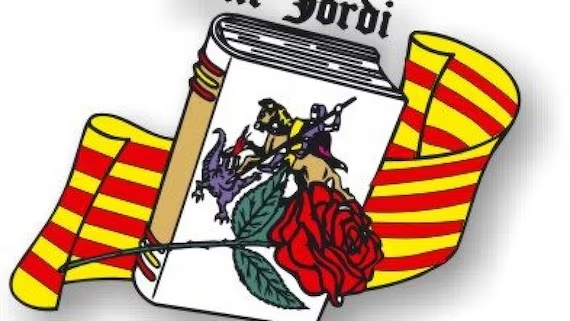
Here’s how the Spanish version of the legend goes. A dragon once terrorized the Catalan town of Montblanc. Sant Jordi rode in, slayed the beast, and saved the princess held captive. Where the dragon fell, a rose bush sprouted from the blood-soaked earth. The princess, moved by his courage, wrote him a poem in thanks.
Notice the detail. She didn’t give him gold. She gave him words.
Other versions of the tale place the dragon in Libya. Some versions put it in different countries entirely. But Catalans kept the story close to home, rooted in their own soil.
In 1456, Sant Jordi officially became the patron saint of Catalonia. To honor him, Barcelona filled with rose stalls each April 23rd. Engaged couples planning weddings flocked to the flower fair. Over the centuries, the day became a quiet festival of love.
You can already see the pattern forming. A saint. A rose. A poem of gratitude. Now we just need books.
How Did Cervantes and Shakespeare End Up Sharing This Date?
Here’s where the story takes a literary turn worth savoring.
April 23rd also marks the death of two giants of world literature: Miguel de Cervantes, who gave us Don Quixote in 1605, and William Shakespeare, whose plays reshaped theatre at the turn of the 17th century.
Think about that coincidence for a second. The man who invented the modern novel and the man who redefined drama share a single day on the calendar.
In the 1920s, a Catalan writer named Vincent Clavel i Andrés had a bright idea. He ran the Cervantes publishing house. He pitched the Barcelona Book Chamber and the Booksellers’ Corporation a simple plan. Let’s throw a party for reading. Let’s celebrate our language, our literature, our culture.
The very first Book Festival took place on October 7, 1927. Then, in 1929, Barcelona hosted the Universal Exposition. Booksellers spilled onto the streets with their stalls. The energy was electric. People couldn’t get enough.
Someone then had a better thought. Why not move the festival to April 23rd? That date already honored Sant Jordi. It also marked the death of Cervantes and Shakespeare. Three reasons, one day.
So in 1931, Catalonia celebrated its first April 23rd Book Day. A beautiful tradition took shape overnight. Give a book to the person you love. In return, receive a rose. Booksellers joined the custom, handing a rose to every customer who bought a book on that date.
| Year | What Happened |
|---|---|
| 1456 | Sant Jordi becomes the official patron of Catalonia |
| 1605 | Cervantes publishes Don Quixote for the first time |
| 1616 | Cervantes and Shakespeare both die around April 23rd |
| 1927 | First Catalan Book Festival held on October 7th |
| 1929 | Barcelona’s Universal Exposition sparks a new idea |
| 1931 | First Book Day celebrated on April 23rd in Catalonia |
| 1996 | UNESCO declares April 23 as World Book and Copyright Day |
| 2026 | Rabat, Morocco is named UNESCO World Book Capital |
When Did UNESCO Make It a Global Celebration?}
For sixty-five years, this beautiful exchange stayed mostly within Catalan borders. Then UNESCO stepped in with a gift for the world.
Starting in 1996, the United Nations Educational, Scientific and Cultural Organization officially declared April 23rd as World Book and Copyright Day. They picked the date by blending the Catalan tradition with the Cervantes-Shakespeare coincidence. That’s why many people call it “The Day of Books and Roses.”
The goals are simple but ambitious:
- Encourage people of every age to read more
- Support publishers, booksellers, and living authors
- Protect intellectual property through strong copyright laws
Every year, UNESCO picks a World Book Capital. In 2026, that honor belongs to Rabat, Morocco. Each year, a different city steps up to host events, debates, reading marathons, and author visits.
Why Does This Matter to Us in 2026?
We’ll speak from the heart here.
At FreeAstroScience, we spend our days writing about stars, black holes, and the physics of distant galaxies. But books? Books are another kind of universe. Each one is a small cosmos you can hold in your hands.
As a young man who navigates the world from a wheelchair, we know what books mean in a way that’s hard to put into words. A page can take you places your body can’t go. A novel can lend you legs when your own won’t carry you across a mountain. A poem can place a rose in your palm even when you’re sitting alone in a quiet room on a gray afternoon.
That’s not small. That’s everything.
The simplest equation ever written in Catalonia.
When you give a book to someone you love, you’re not just handing over paper and glue. You’re giving them a door. When you receive a rose in return, you’re holding the echo of an ancient legend where courage beat fear and beauty grew from the battleground.
How Can You Celebrate Sant Jordi Wherever You Live?
You don’t need a plane ticket to Barcelona. You can start right where you are, today.
Pick one book that changed you. Give it to someone you love. Write a short note on the inside cover. Tell them why the story mattered. Three sentences are enough. Sometimes three sentences mean more than three hundred.
If you can, tuck a rose between the pages. A real one. Or a paper one you fold yourself. Small gestures carry heavy weight across long years.
Live alone? Give yourself a book. We mean it. Buy something you’ve wanted to read for months. Light a candle. Make tea. Open page one. That counts too. Self-love is still love, and Sant Jordi would approve.
A Final Thought Before You Close This Page
So there you have it, our friend. April 23rd isn’t just a date on the calendar. It’s a ribbon that ties together a Catalan dragon, a Spanish novelist, an English playwright, a brave princess with a poem, and every single person who has ever turned a page and felt a little less alone in the world.
This article was written just for you by FreeAstroScience, where we break down complicated science and human stories into plain, warm words. Our mission is to keep your mind awake. Never switch it off. Never stop asking why. Remember Goya’s warning: the sleep of reason breeds monsters. The best defense against those monsters is a book in your hands and honest curiosity in your chest.
Come back and see us soon. We’ll be here, explaining the universe, one page at a time. Bring a friend. Bring a rose. Bring your questions. We’ve got answers waiting.
📚 Sources & Further Reading
*Written with care by Gerd Dani for FreeAstroScience.com — where science, stories, and a stubborn love of reading all live under one roof.*