When Knowledge Becomes a Form of Care
Every language we learn is a quiet act of tenderness toward another human being.
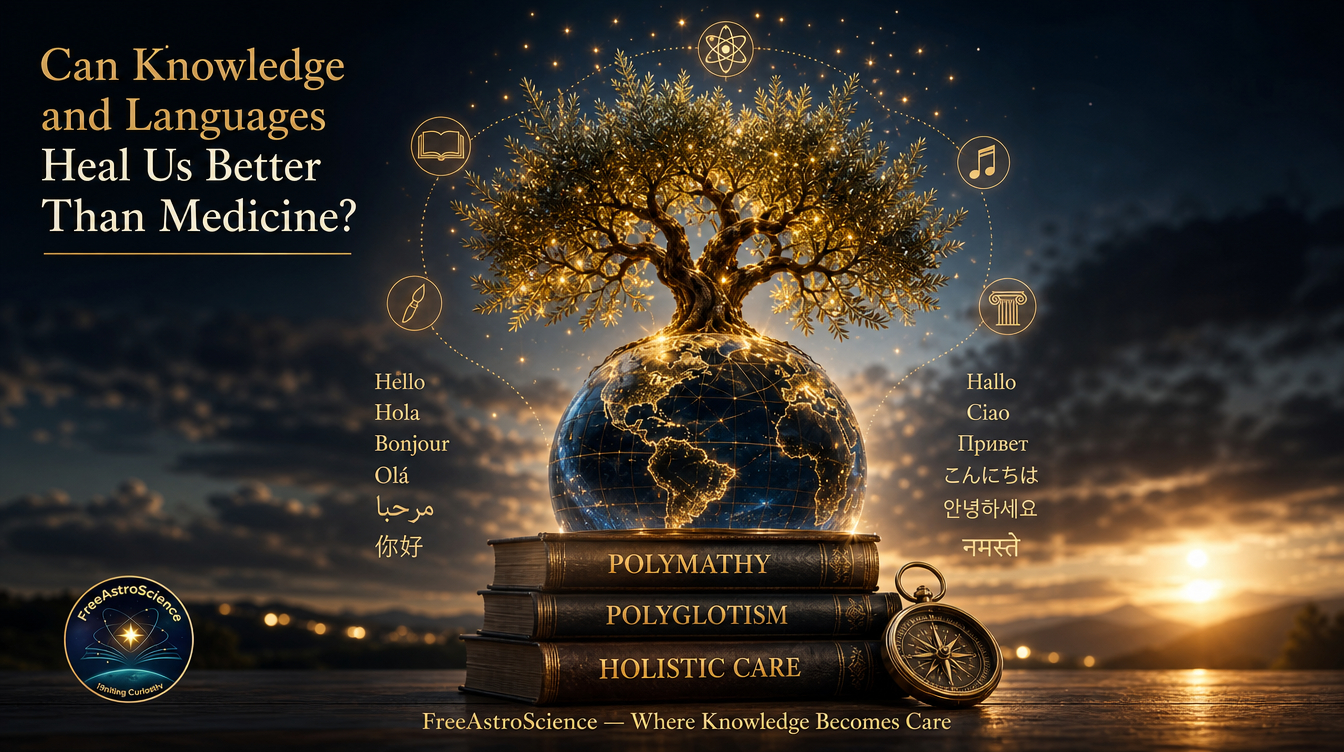
I sat with that image for a long time.
A glowing tree rising from a globe, books stacked like roots beneath it, and greetings scattered in twelve languages — the Arabic **مرحبا**, the Indian **नमस्ते**, the Russian **Привет**, our warm Italian **Ciao**. At its heart, a sentence in Portuguese stopped me cold: “Na minha visão, a assistência policármica encontra maior amplitude e profundidade quando articulada com a polimatia e o poliglotismo.”
In my own translation: care that touches every dimension of a human being grows wider and deeper when paired with interdisciplinary knowledge and with the languages of the world.
A truth I feel on my skin.
The Word You Won’t Find in Any Dictionary
“Policarmica” isn’t in your dictionary. It’s a Portuguese neologism, likely born in nursing or pedagogy circles, describing a kind of care that holds body, mind, spirit, culture, and relationships together. All at once. Without slicing the person into organs and diagnoses.
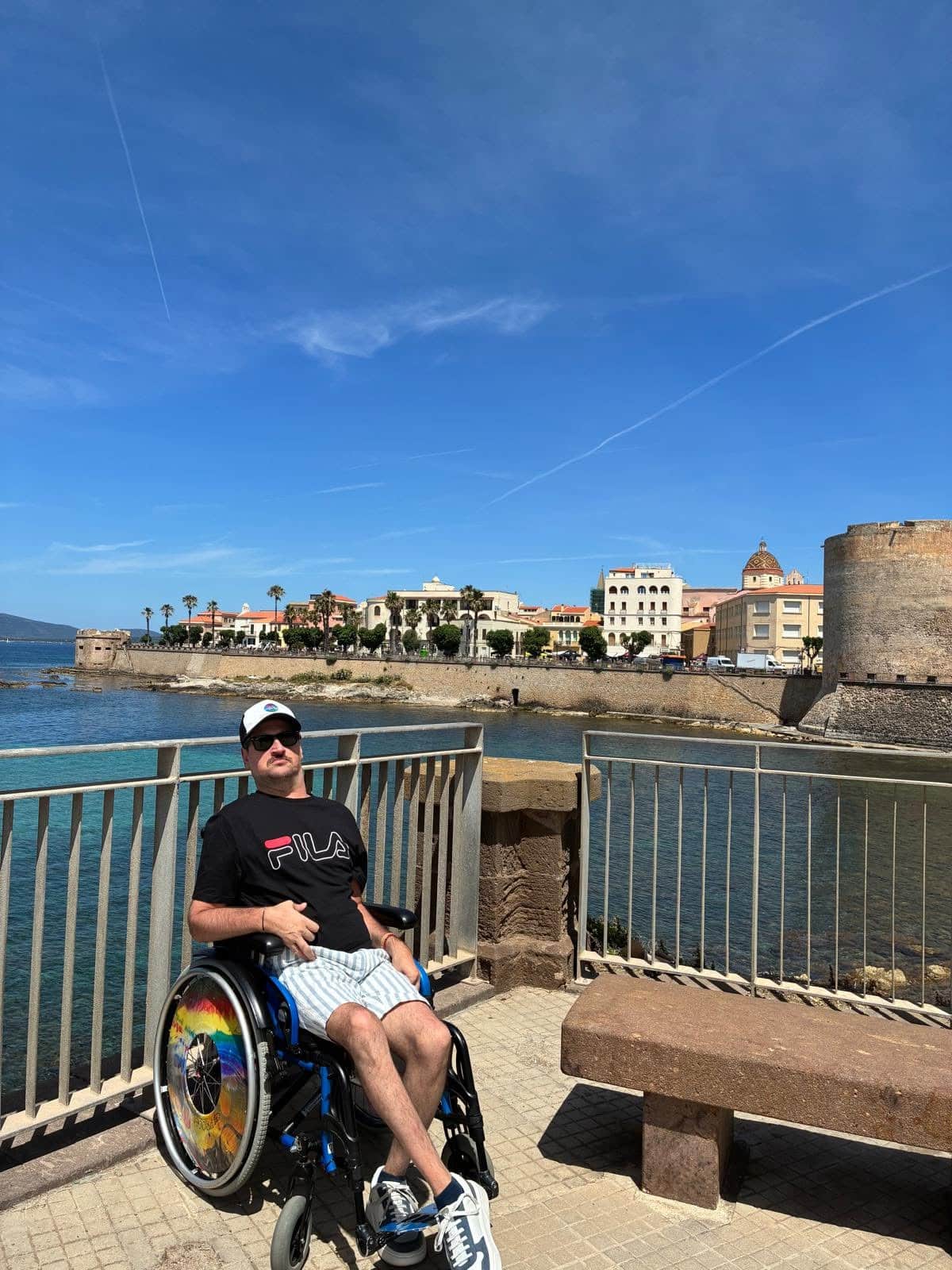
As a young man in a wheelchair, raised between Italian hospitals and Albanian memories, I can tell you the difference between technical assistance and policarmic care at first glance. The first one measures you. The second one sees you.
And seeing a person takes tools no clinical manual hands you on its own.
Polymathy: When Different Knowledges Hold Hands
Back at the University of Bologna, during my astronomy years, I noticed something strange. Physicists spoke one language, philosophers another, doctors yet another. Each one locked inside their own little garden.
Yet the real questions — *what is consciousness? why do we suffer? how do you truly heal someone?* — don’t respect academic borders. They demand bridges between worlds.
Polymathy means exactly this: cultivating several fields of knowledge that talk to each other. Not to show off at dinner parties, but because someone trained only in medicine cares poorly for a patient with a migration story behind them. Someone trained only in astronomy misses why showing the stars to a sick child brings the smile back. Someone trained only in literature can’t hear the poetry inside an equation.
Knowledge in sealed compartments is limping knowledge. (And someone in a wheelchair knows a thing or two about limping: occasional stumbling is fine; standing still, never.)
Polyglotism: Every Language Is a Doorway
When I arrived in Italy from Albania in 1991, I was five years old and spoke a mother tongue nobody around me understood. Italian became my second skin. Then English came. Then a bit of Turkish during my Erasmus at Sabancı University in Istanbul. Then fragments of other languages picked up while travelling across Europe and the United States.
And I promise you: each new language doesn’t just add words. It adds a way of feeling.
Turkish has *hüzün*, a collective, almost sweet melancholy that English struggles to name precisely. Portuguese has *saudade*. Albanian has *mall*, a close cousin of *saudade*. Translation is always a small betrayal, but it’s also the kindest gesture there is — saying, *”I want to understand you in your tongue, not force you into mine.”*
That’s why, in a hospital room, in a classroom, on a science blog like FreeAstroScience, speaking many languages isn’t a fancy hobby. It’s a quiet political act of respect.
The Kind of Care That Actually Changes Things
Bring those three together — policarmic care, polymathy, polyglotism — and you get something genuinely revolutionary. Care that doesn’t reduce, doesn’t oversimplify, doesn’t standardise human beings into protocols.
Care that, faced with an elderly Ukrainian fleeing war, doesn’t see merely “patient with post-traumatic stress” but a person carrying a history, a language, a culture, a private cosmology. (And here, as a European hoping for peace in Ukraine right now, I get openly emotional: care also means this — putting down weapons and starting to listen.)
Care that, faced with a child with a disability, doesn’t see a “diagnosis” but an expanding universe.
Care, in short, that looks more like a tree — roots in books, leaves reaching for the sky — than a checklist.
What We Take Home Tonight
The image spoke clearly with three verbs under its small icons: **assist, understand, connect**. Then a promise: *know diversity, communicate without borders, transform realities.*
This isn’t motivational-poster talk. It’s a programme for living.
Study things that don’t seem to belong together. Learn the language of the person sitting beside you, even just ten words. Care for people the way you’d care for a garden: with patience, with seasons, with curiosity. And remember always — I’ve been telling myself this since I was five and nobody around me understood my Albanian — that **you must never give up**.
The future will be written by those who can hold a microscope, a dictionary, and a heart, all at once.
*(A note for FreeAstroScience readers: I’ve simplified some complex ideas about interdisciplinarity, applied linguistics, and the science of care to keep this piece accessible. If you want to go deeper, write to me. The doors — and the languages — are open.)
A hug from Rimini, Gerd