Why Do Blue Auroras Glow Now? The Hidden Spring Secret
Have you ever closed your eyes and pictured the northern lights? Chances are you saw green ribbons, maybe a streak of ruby red. But what if we told you the sky can also burn a deep, electric blue — and that right now, in late April, is one of the rarest windows to catch them?
Welcome to FreeAstroScience.com, dear reader. We’re glad you’re here. We wrote this piece for you, because we believe complex science shouldn’t live behind thick walls. Our mission is simple: keep your mind switched on, always. Because, as Goya warned, the sleep of reason breeds monsters. So stay with us until the last line — there’s a beautiful piece of atmospheric physics waiting, and you’ll never look at the polar sky the same way again.
📑 Table of Contents
- What Paints the Aurora Its Colors?
- Why Does Nitrogen Usually Hide Its Blue?
- What Is Resonance Scattering?
- Why Is Late April the Magic Window?
- What Did the Norwegian Sky Reveal?
- How Can You Spot a Blue Aurora?
- Final Thoughts
What Paints the Aurora Its Colors?
Let’s start with the basics. The aurora is born when the Sun spits out a stream of charged particles — mostly electrons and protons — called the solar wind. Earth’s magnetic field grabs these particles and funnels them toward the poles. When they smash into gas atoms high in our atmosphere, they transfer energy. The atoms light up, then release that energy as photons.
Think of it like a cosmic neon sign. Different gases, different colors .
| Color | Gas Involved | Altitude |
|---|---|---|
| 🟢 Green | Atomic oxygen | 100–240 km |
| 🔴 Red | Atomic oxygen | 300–400 km |
| 🌸 Pink | Neutral nitrogen | Below 100 km |
| 🔵 Blue | Ionized nitrogen (N₂⁺) | ~100–200 km |
Green rules because our eyes are most sensitive to it, and because oxygen glows green easily at those altitudes . Red joins the party higher up, where oxygen is thin and excited at a longer wavelength . But blue? Blue is the shy one.
Why Does Nitrogen Usually Hide Its Blue?
Here’s a puzzle worth chewing on. Earth’s atmosphere is about 78% nitrogen and only 21% oxygen . So why aren’t blue auroras everywhere?
Dr. Elizabeth MacDonald, a space physicist at NASA Goddard, explains it clearly: at auroral altitudes — around 100 km and above — the air isn’t mixed like we’re used to down here. Gravity has sorted the atmosphere into layers, and the nitrogen-rich layer sits above the oxygen-rich one .
There’s a second catch. Blue auroras come from ionized molecular nitrogen (N₂⁺) in the upper atmosphere . That ionized nitrogen exists in low concentrations compared with oxygen, and the blue light it gives off is usually too faint for our eyes to pick up against the night sky .
So blue is rare not because nitrogen is scarce, but because its glow is dim. Something has to boost it.
What Is Resonance Scattering?
Here comes the physics that makes this story click.
When ionized nitrogen molecules high above us get bathed in direct sunlight — while we, down on the ground, stand in darkness — they absorb and re-emit that sunlight at specific wavelengths. This process is called resonance scattering, and it acts like a natural amplifier for the blue emission .
Without sunlight hitting that high nitrogen layer, the blue photons are few and feeble. With sunlight? The N₂⁺ ions become a broadcasting tower. As the U.S. National Park Service notes, ionized molecules can get pulled upward by electric fields in the aurora, reach altitudes where sunlight still touches them, and light up with a deep blue glow .
In simple terms: the Sun isn’t lighting the aurora directly. It’s charging up the rare blue molecules so they can finally be seen.
Why Is Late April the Magic Window?
Now we get to the seasonal twist — and why we’re writing this today.
For resonance scattering to work, you need a very specific geometry. The ground must be dark enough for your eyes to adapt, but the upper atmosphere — the layer at roughly 200 km altitude — must still be bathed in sunlight .
That happens when the Sun sits low enough below the horizon to darken the sky at ground level, but not so low that Earth’s shadow swallows the high atmosphere too. At Geir T. Birkeland Øye’s latitude in Ørsta, Norway, this sweet spot opens up around late April, when the Sun doesn’t sink more than about –13° below the horizon .
💡 The seasonal recipe for blue auroras (at high latitudes):
- Ground-level sky: dark enough to see stars
- Upper atmosphere (~200 km): still sunlit
- Active aurora producing N₂⁺ ions
- Solar depression around –13° or shallower
This window closes fast. A few weeks later, the Arctic summer floods the sky with twilight, and aurora hunting goes on pause until August .
What Did the Norwegian Sky Reveal?
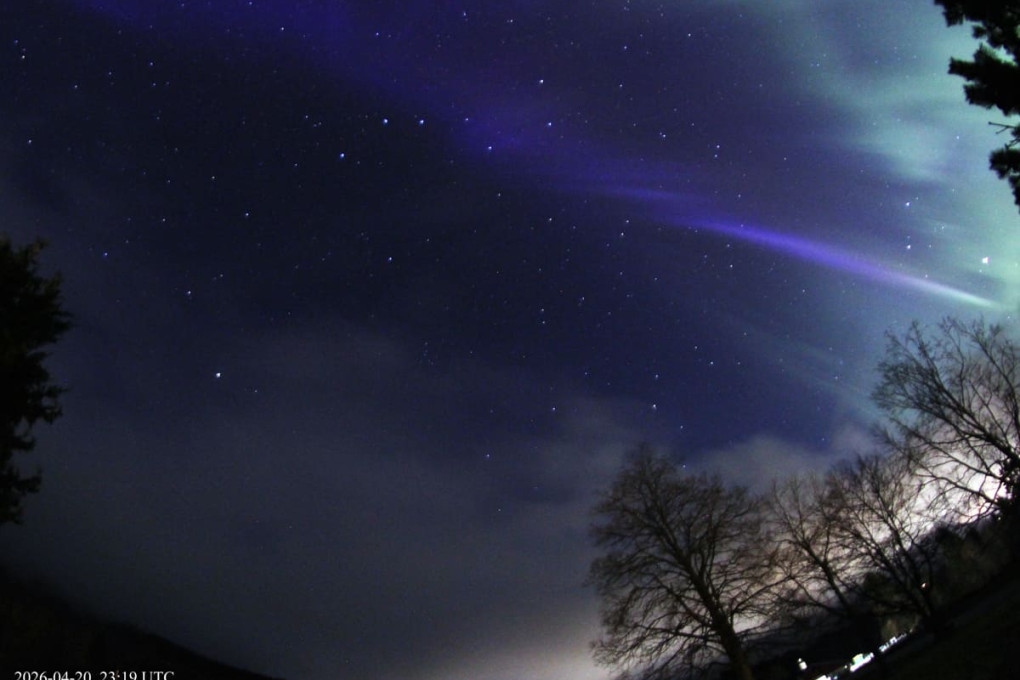
The photograph that sparked this whole conversation came from Ørsta, a quiet town on Norway’s western coast. Geir T. Birkeland Øye, an experienced sky photographer, captured something few people ever see: a Corona Borealis — an aurora shaped like a crown, forming at the zenith right above the observer’s head — glowing blue .
He told Focus.it that he photographs the sky every clear evening, so he’s used to reading subtle shifts in auroral behavior. That night, the forecast was nothing special. Then the aurora suddenly flared up, and the amplified N₂⁺ emission became bright enough to stand out with the naked eye and the camera alike .
His words say it best: “a rare and completely unexpected observation.”
How Can You Spot a Blue Aurora?
If you’re already planning a northern lights trip, or you live at a good latitude, here’s what we’d suggest:
- Timing matters more than luck. Late April and late August offer those twilight-plus-dark-ground conditions at places like Fairbanks, northern Scandinavia, and Iceland .
- Check the Sun’s angle. Aim for nights when the Sun dips between about –8° and –14° below the horizon for part of the evening.
- Watch for storm intensifications. The blue emission pops when the aurora suddenly brightens .
- Use your camera. Digital sensors pick up blue and violet hues our eyes miss. Long exposures often reveal colors the naked eye never caught.
- Look up, not just out. Corona-type auroras form at the zenith, directly overhead — people miss them by staring at the horizon.
And a gentle reminder: during the current Solar Cycle 25 maximum, solar activity is running hot, which means richer colors and more frequent displays . The Sun is on our side for the next year or two.
Final Thoughts
Blue auroras are more than a pretty rarity. They’re a reminder that what we see in the sky depends on geometry, chemistry, and timing working together in silence above our heads. A single molecule of ionized nitrogen, sitting 200 km up, catches the last rays of a Sun we can no longer see — and hands us a photon our eyes can just barely register.
That’s physics doing poetry.
We wrote this piece for you, right here at FreeAstroScience.com, because we believe curiosity is a muscle. The more you stretch it, the stronger it gets. The night sky isn’t a backdrop — it’s a working laboratory, and you’ve got a front-row seat whenever you choose to look up.
Come back to us soon. There’s always another layer to peel back, another question worth asking. Keep your mind awake — the universe rewards those who do.
🔗 Sources & Further Reading
- Explore Fairbanks — Northern Lights Colors: What Do They Mean?
- Space.com — Aurora colors: What causes them and why do they vary?
- Canadian Space Agency — The colours of the northern lights
- WebExhibits — What causes the colors of the aurora?
- Perlan — The Colours of the Northern Lights
- Natural History Museum — The aurora borealis explained
- Focus.it — *Aurore boreali blu: come si formano?* (Elisabetta Intini, 23 April 2026)