
Researchers at Tulane University School of Medicine have discovered an unexpected outcome for cells with extra chromosomes. Instead of merely surviving, they become more aggressive, mobile, and predatory in a game-changing finding that enhances understanding of cancer behavior.
Now, polyploidy is well known in the plant world but relatively rare in our kind of cell, and this study, published on April 21 in the Journal of Cell Biology, shows that such cells trigger a stress response that makes them highly aggressive, enabling them to invade tissues and eat other cells. These findings could be a new weapon in the battle against therapy-resistant cancers.
Animal cells are diploid in the normal condition; each cell inherits one set of chromosomes from each parent. However, occasionally cells replicate their DNA and fail to separate, leading to polyploid cells. In some tissues, such as the liver, it is harmless or even beneficial.
But in cancer, polyploidy seems to play the part of a deadly booster shot.
“Extra chromosomes can supercharge cells,” the researchers explain, enabling them to withstand stress and grow more robustly. But this resilience comes at a cost: tumors containing polyploid cells are often more aggressive and harder to treat.
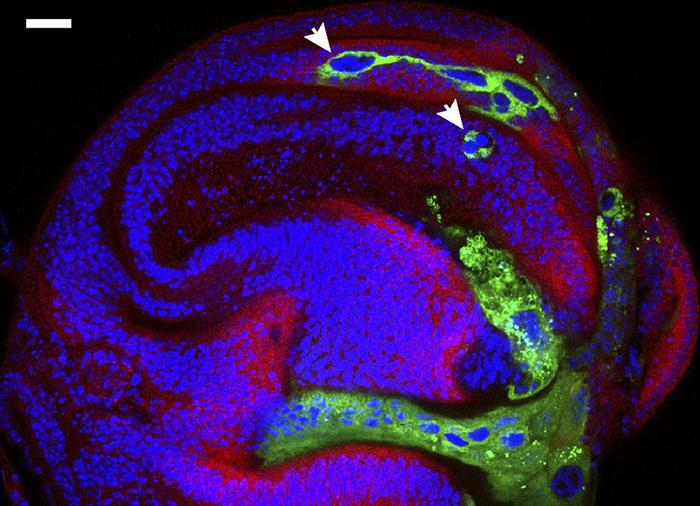
Credit: ©2026 Zhou et al. Originally published in Journal of Cell Biology
To gain insight into how polyploidy alters cell behavior, the Tulane team induced that status in fruit flies, a classic experimental model for cellular biology. What they observed was striking.
Unlike normal cells that stay put, polyploid cells roam freely through tissues. Even more striking, they started swallowing nearby diploid cells, 5especially ones already weak or dying.
This behavior is akin to cellular “survival of the fittest,” in which stronger cancer cells eliminate more vulnerable counterparts, possibly influencing tumor evolution.
Traits like these, if present in real tumors, could assist tumor progression and cause them to overwhelm nearby tissue, making treatment all the more challenging.
At the core of those hostile actions, scientists tracked a cellular stress response.
Polyploid cells have more chromosomes than diploid cells, which forces them to produce an unusually high number of proteins. This overload puts pressure on the cell’s internal machinery and sets off an alarm chain by communicating that something has gone wrong through reactive oxygen species, very electron-hungry molecules.
These molecules trigger a signaling cascade that leads to activation of c-Jun N-terminal kinase (JNK pathway, an evolutionarily conserved stress-response system. Upon activation, this pathway seems to reprogram the cells to enhance mobility and invasion.
Treating the cells with antioxidants or inhibiting the JNK pathway led to a dramatic decrease in their aggressive behavior.
The scientists next reproduced the polyploidy in human lung cancer cells to apply the same mechanism for humans. Just like the fruit flies, polyploid cells became more motile, but that excess movement could be halted by inhibiting identical stress pathways.
The consistency suggests that this discovery is not restricted to model organisms but indicates a common aspect of cancer biology.
The implications are significant. Polyploidy is common in therapy-resistant advanced tumors. By pinpointing which stress pathways compel their behavior, the scientists may have discovered a new weak spot.
“Our findings suggest that elevated reactive oxygen species and JNK activation may underlie the enhanced motility of polyploid cancer cells,” said the study’s lead researcher. “Targeting these stress-sensing pathways could represent a new therapeutic strategy to limit tumor invasion.”
Rather than inactive byproducts of cancer, this paper characterizes polyploid cells as active mediators of its deadliest qualities: motility, survival, and insurgency.
Now, scientists are a step closer to disarming them after uncovering the internal stress signals that fortify these cells against immune cell elimination.
As cancer evolves to evade attack, understanding how cells adapt and exploit their genomic redundancy may be important for preventing this disease at its most malignant stage.