What Is the Square Kilometre Array (SKA) Really Like? The Giant Radio Telescope That’s Changing Astronomy Forever
Have you ever wondered how far we can stretch our senses to listen to the universe?
Welcome to FreeAstroScience.com, where we break down the biggest ideas in science so everyone can understand. Today, we’re diving into the Square Kilometre Array (SKA)—the world’s largest radio telescope, stretching across South Africa and Australia.We’re here to keep your mind awake, because the sleep of reason breeds monsters. Stay with us to the end for a journey that will change how you see the cosmos—and maybe yourself.
Table of Contents
- What Is a Radio Telescope and Why Is SKA Different?
- How Does the SKA Work? Two Sites, One Giant Ear
- SKA-Low vs SKA-Mid: The Heart of the Array
- How Big Is the SKA and Why Does It Matter?
- How Does the SKA See the Universe? Interferometry Explained
- Data Mountains and Supercomputers: The SKA Brain
- What Will the SKA Discover? Scientific Goals
- Precursor Telescopes: MeerKAT and ASKAP
- Timeline, Budget, and Global Team
- Socio-Economic Impact and Why It Matters
- SKA Specifications Table
- Conclusion: Why the SKA Matters for All of Us
- FAQ: Your SKA Questions Answered
- References
The Square Kilometre Array: Humanity’s Biggest Ear to the Universe
What Is a Radio Telescope and Why Is SKA Different?
Let’s start simple. A radio telescope is like a giant ear, tuned to the whispers of the universe. Instead of catching visible light, it listens for radio waves—signals that travel across billions of years and tell us stories about the birth of stars, galaxies, and maybe even life itself.
But the SKA isn’t just another radio telescope. It’s the most ambitious project of its kind, aiming to create a collecting area of one square kilometre. That’s a million square meters—about 140 soccer fields. It’s split between two of the quietest places on Earth: the Karoo desert in South Africa and the Murchison region in Western Australia. These places are so remote, you’re more likely to meet a kangaroo or a springbok than another person .
SKA is about 50 times more sensitive than the best radio telescopes we have today. It can map the sky 10,000 times faster than anything else. That’s not just a step forward—it’s a leap.
How Does the SKA Work? Two Sites, One Giant Ear
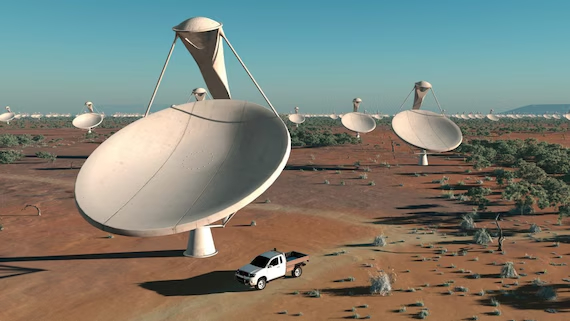
Why split the SKA across two continents? The answer is science and engineering. No single antenna can cover the whole range of radio frequencies we want to study. So, the SKA uses two different types of arrays:
- SKA-Low in Western Australia, for low frequencies (50–350 MHz)
- SKA-Mid in South Africa, for mid to high frequencies (350 MHz–15.4 GHz, with plans to go even higher)
Both sites are far from cities and cell towers. That’s on purpose. Radio telescopes need silence—no Wi-Fi, no phones, no microwave ovens. Just the universe, whispering in the dark .
SKA-Low vs SKA-Mid: The Heart of the Array
Let’s break down the two main parts of the SKA.
SKA-Low (Western Australia)
- Location: Inyarrimanha Ilgari Bundara, Murchison region
- Antennas: 131,072 log-periodic dipole antennas
- Stations: 512, each with 256 antennas
- Frequency Range: 50–350 MHz
- Core: About 50% of stations packed into a 1 km diameter
- Arms: Three spiral arms stretch out to a maximum baseline of 74 km
- Collecting Area: ~419,000 m²
These antennas look like metal Christmas trees. They don’t move. Instead, they use digital tricks—beamforming—to “look” in different directions. It’s like having thousands of ears, all listening together .
SKA-Mid (South Africa)
- Location: Karoo desert
- Dishes: 197 parabolic dishes (133 new SKA + 64 MeerKAT)
- Dish Size: 15 meters across, offset Gregorian design
- Frequency Range: 350 MHz–15.4 GHz (future: up to 20 GHz)
- Core: About half the dishes in a 2 km core
- Arms: Three spiral arms, max baseline 150 km
- Collecting Area: ~33,000 m²
These dishes are fully steerable. They can point anywhere in the sky, hunting for everything from pulsars to galaxies .
How Big Is the SKA and Why Does It Matter?
The SKA’s name says it all: Square Kilometre Array. When you add up all the antennas and dishes, you get a collecting area close to one square kilometre. That’s what gives the SKA its super-hearing.
- Sensitivity: About 50 times better than the best current radio telescopes
- Speed: Can map the sky 10,000 times faster
- Resolution: Can see details as small as a few thousandths of a degree
This isn’t just about breaking records. It’s about seeing things we’ve never seen before—like the first stars lighting up the universe, or the faint signals from distant galaxies .
How Does the SKA See the Universe? Interferometry Explained
Here’s the magic trick: the SKA doesn’t work like a single giant dish. Instead, it combines signals from all its antennas and dishes using a technique called interferometry.
Imagine a choir, where each singer is an antenna. Alone, each voice is nice. Together, they create harmonies you can’t get any other way. By combining signals, the SKA acts like a telescope as big as the distance between its farthest antennas—up to 150 km apart. That’s how it gets such sharp vision .
Data Mountains and Supercomputers: The SKA Brain
Listening to the universe at this scale means drowning in data. The SKA will generate millions of terabytes every day. To handle this, it uses a supercomputer called the Science Data Processor (SDP).
- Data Rate: 8 terabits per second
- Annual Output: ~710 petabytes of scientific data
- Fiber Optics: Thousands of kilometers—enough to circle the Earth twice
This isn’t just a telescope. It’s a data factory, pushing the limits of computing and networking .
What Will the SKA Discover? Scientific Goals
The SKA isn’t just about building something big. It’s about answering the biggest questions in science.
1. Epoch of Reionization and the First Stars
SKA-Low will map the 21-cm hydrogen line from the universe’s “dark ages”—when the first stars and galaxies formed. It can see signals from as early as 100 million years after the Big Bang (redshift z~27). We’ll finally see how the universe lit up .
2. Pulsar Timing Arrays and Gravitational Waves
SKA-Mid will find and time thousands of pulsars—nature’s most precise clocks. By watching for tiny changes in their signals, we can detect gravitational waves from supermassive black hole pairs, in a frequency range no other detector can reach (nanohertz regime) .
3. Testing General Relativity
By studying pulsars in extreme systems—like those orbiting black holes—we can test Einstein’s theories in ways never possible before. We might even check the “no-hair” theorem, which says black holes are simple objects defined only by mass, spin, and charge .
4. Searching for Extraterrestrial Intelligence (SETI)
The SKA will boost our sensitivity to artificial signals by up to 400 times over previous surveys. If there’s anyone out there sending radio messages, we’ll have the best shot yet at hearing them .
5. Cosmic Magnetism
By measuring how radio waves twist as they travel through space (Faraday rotation), the SKA will map magnetic fields in galaxies out to redshift z~2. We’ll finally understand how magnetism shapes the cosmos .
6. Dark Energy and Dark Matter
By mapping millions of galaxies and their hydrogen, the SKA will help us figure out what’s driving the universe’s expansion and how dark matter shapes galaxies .
7. Fast Radio Bursts and Transients
The SKA will catch thousands of fast radio bursts (FRBs)—mysterious, millisecond-long flashes from deep space. We don’t know what causes them yet, but the SKA will help us find out .
Precursor Telescopes: MeerKAT and ASKAP
The SKA stands on the shoulders of giants. Two world-class telescopes paved the way:
- MeerKAT (South Africa): 64 dishes, already making discoveries about the Milky Way’s center and new pulsars. It’s now part of SKA-Mid .
- ASKAP (Australia): 36 dishes with special phased array feeds. In just 300 hours, it mapped 3 million galaxies—a taste of what SKA will do .
Timeline, Budget, and Global Team
Building the SKA is a marathon, not a sprint.
- 2021: SKAO treaty comes into force, creating the intergovernmental organization
- December 2022: Groundbreaking ceremonies in South Africa and Australia
- 2024: First milestone—4 dishes and 6 stations working together as a basic telescope
- 2028: SKA1 (first phase) expected to be fully operational, with nearly 500,000 m² collecting area
- Budget: About €2 billion for the first phase; 80% of spending returns to member countries through contracts
The SKA Observatory (SKAO) is run from Jodrell Bank in the UK. Members include South Africa, Australia, UK, China, Italy, Netherlands, Portugal, and Switzerland. France, Spain, and Germany are joining soon. Over 500 engineers and 1,000 scientists from 20+ countries are involved .
Socio-Economic Impact and Why It Matters
The SKA isn’t just about science. It’s about people.
- Jobs: Thousands created, both directly and indirectly
- Broadband: The fiber optic network boosts internet access in remote areas
- Industry: High-tech contracts drive innovation and growth
- Education: Inspires new generations of scientists and engineers
About 80% of the construction budget goes back to member countries, making sure the benefits are shared .
SKA Specifications Table
Below is a responsive, accessible, and SEO-optimized table comparing SKA-Low and SKA-Mid. You can copy and paste this directly into your WordPress site.
| Feature | SKA-Low (Australia) | SKA-Mid (South Africa) |
|---|---|---|
| Location | Inyarrimanha Ilgari Bundara, Murchison | Karoo desert |
| Type | Log-periodic dipole antennas | Parabolic dishes (offset Gregorian) |
| Number of Elements | 131,072 antennas (512 stations × 256) | 197 dishes (133 SKA + 64 MeerKAT) |
| Frequency Range | 50–350 MHz | 350 MHz–15.4 GHz (future: up to 20 GHz) |
| Max Baseline | 74 km | 150 km |
| Core Diameter | 1 km | 2 km |
| Collecting Area | ~419,000 m² | ~33,000 m² |
| Data Rate | 8 terabits/second (combined) | |
| Annual Data Output | ~710 petabytes | |
Conclusion: Why the SKA Matters for All of Us
The Square Kilometre Array is more than a telescope. It’s a symbol of what we can do when we work together, across borders and cultures, to answer the biggest questions. It’s about listening—to the universe, to each other, to the unknown.
We’re building the SKA not just to see farther, but to understand deeper. To keep our minds awake, to never stop asking, “What’s out there?” That’s the spirit of FreeAstroScience.com. Stay curious, keep your mind active, and remember: the sleep of reason breeds monsters.
Come back soon to FreeAstroScience.com. There’s always more to learn.
FAQ: Your SKA Questions Answered
Q1: What makes the SKA different from other radio telescopes?
A1: The SKA is the largest and most sensitive radio telescope ever built, with a collecting area close to one square kilometre. It’s split between Australia and South Africa, using two types of antennas to cover a huge range of frequencies. It can map the sky 10,000 times faster than current telescopes.
Q2: What are the main scientific goals of the SKA?
A2: The SKA will study the universe’s first stars, search for gravitational waves, test Einstein’s theories, hunt for signs of extraterrestrial life, map cosmic magnetism, and explore dark matter and dark energy. It will also catch fast radio bursts and other cosmic surprises.
Q3: How much data does the SKA produce?
A3: The SKA will generate about 8 terabits of data every second, adding up to around 710 petabytes of scientific data each year. That’s more than all the internet traffic in many countries.
Q4: Who is building and running the SKA?
A4: The SKA Observatory (SKAO) is an intergovernmental organization with members from over 20 countries. The headquarters is at Jodrell Bank in the UK. The project involves more than 500 engineers and 1,000 scientists worldwide.
Q5: When will the SKA be fully operational?
A5: Construction started in 2021, with the first phase (SKA1) expected to be fully operational by around 2028.
References
- Come è fatto SKA, il gigantesto radiotelescopio tra Sud Africa ed Australia (Geopop, Italian)
- SKA Observatory Official Website
- Nature News: SKA Construction Milestones
- BBC Science: SKA Telescope
- Scientific American: The Square Kilometre Array
Written for you by FreeAstroScience.com—where we keep science simple, minds asking questions.