
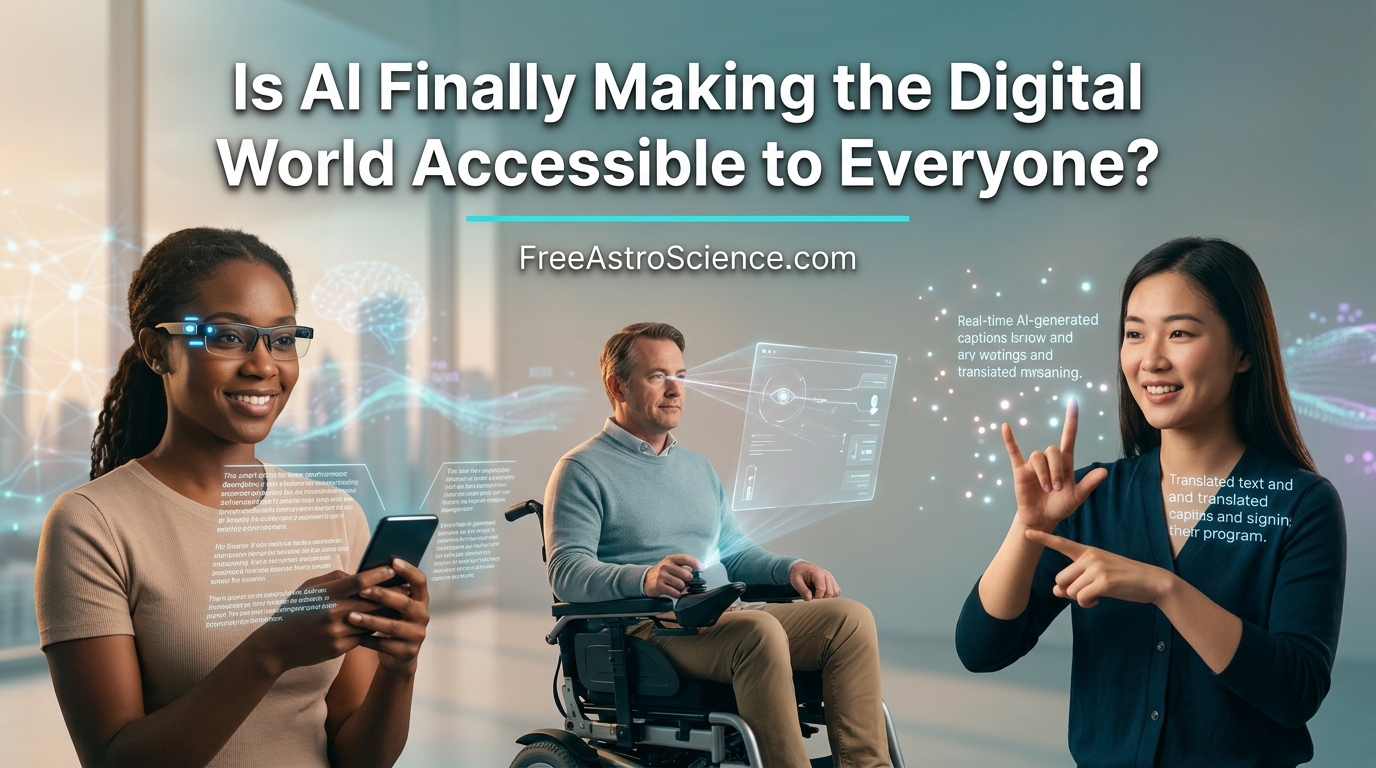
Have you ever wondered if technology really makes life easier for everyone—or if, sometimes, it leaves some of us behind? Welcome to FreeAstroScience.com, where we break down the science shaping our world and ask the questions that matter. Today, we’re diving into the heart of a digital revolution: how artificial intelligence is changing what it means to belong, to participate, and to be seen in our society. Whether you’re a tech enthusiast, someone living with a disability, or just curious about the future, this story is for you. Stick with us to the end, and you’ll see why accessibility isn’t just a feature—it’s a right, a responsibility, and a challenge we all share.
Table of Contents
- When Technology Opens Doors — And Sometimes Slams Them Shut
- What Does “Accessibility” Really Mean in 2025?
- How Is AI Already Changing Lives? Real Tools, Real People
- What’s Holding AI Accessibility Back? The Hard Truths
- What Does the Law Say? Policies Catching Up to Technology
- Where Are We Headed? The Future of Inclusive AI
- Conclusion — A Digital World Where Everyone Belongs
- FAQ: AI Accessibility
- References
When Technology Opens Doors — And Sometimes Slams Them Shut
What Does “Accessibility” Really Mean in 2025?
When we hear “accessibility,” most of us picture ramps, elevators, or maybe Braille signs. But in 2025, accessibility is so much more. It’s about whether you can read a website, understand a video, or even afford a smartphone. It’s about language, memory, attention, and the way we all process the world.
Alice Ruggeri, writing for MagIA, puts it plainly: accessibility isn’t just a technical fix—it’s a cultural, political, and ethical issue. If you can’t access digital tools, you’re shut out of jobs, education, and even friendships. That’s not just unfair. It’s a threat to democracy itself.
Let’s look at the numbers. The World Health Organization says 1.5 billion people worldwide live with disabilities. That’s nearly one in five of us. And yet, as of 2024, 2.6 billion people are still offline—most in low-income countries, but plenty in wealthy ones too. The digital divide is real, and it’s growing.
How Is AI Already Changing Lives? Real Tools, Real People
Seeing the World Through AI Eyes
For millions who are blind or have low vision, AI is a game-changer. Microsoft Seeing AI—launched in 2017 and now on iOS, Android, and Meta Ray-Ban smart glasses—reads text, recognizes faces, and describes scenes out loud. In 2025, it celebrated its tenth anniversary, marking a decade of independence for users.
Google Lookout does much the same, now in 34 languages. Its 2024 update lets you ask questions about images—“What’s in this photo?”—and get answers, thanks to advanced AI. Be My Eyes connects 700,000 blind users with 8 million volunteers in 150+ countries. In late 2023, it added “Be My AI,” powered by GPT-4 Vision, for detailed, conversational image descriptions. Microsoft joined the effort in 2024, using real-world video data to make AI more accurate for blind users.
Wearables like OrCam MyEye ($4,500, fully offline) and Envision Glasses ($3,499) offer instant reading and scene description—no internet needed, which is vital in places with poor connectivity. The impact? The WHO says 2.2 billion people have some form of vision impairment, and 43 million are completely blind. In good conditions, AI text recognition now hits 95–98% accuracy.
Hearing Every Word — AI Captioning and Transcription
If you’re deaf or hard of hearing, AI-driven captions are a lifeline. Otter.ai’s OtterPilot, launched in 2023, saves users an average of four hours a week by automating meeting notes. Michigan State University uses Otter for live transcripts in Zoom classes. Google Live Caption and Live Transcribe (80+ languages) are built into Android, while Apple Live Captions (free, iPhone 11+) work across all apps.
Ava boasts 99% accuracy, and it’s not just for deaf users—71% of hearing students use captions regularly. Arizona State University cut transcription costs by 70% after switching to automated captioning. For broadcast and legal work, Verbit and Rev combine AI with human editors for up to 99% accuracy.
Moving Differently — AI and Motor Disabilities
AI isn’t just about screens. It’s about moving through the world. Apple’s 2025 accessibility updates brought eye and head tracking to iOS, iPadOS, and visionOS. Now, you can control your device with just a glance or a nod.
Brain-computer interfaces (BCIs) are no longer science fiction. In 2025, Apple added Switch Control support for BCIs, letting people with ALS operate devices using brain signals. Clinical studies show BCIs can restore communication for those who’ve lost speech.
Smart wheelchairs like the HOOBOX Wheelie 7 use facial recognition to move—no hands needed. AI-powered prosthetics adapt to your movement, mimicking a natural gait. And Apple’s Personal Voice (iOS 17) lets people with progressive illnesses record and clone their own voice, keeping their identity alive.
The Language of Hands — Sign Language AI Tools
Communication isn’t just about words. Silence Speaks, a British startup, built an avatar that translates text into British and American Sign Language, complete with emotion and intent. Transport for London is piloting it on trains. SignAll Chat offers real-time sign language translation by subscription.
For the deaf-blind, Tatum Robotics is developing robotic hands that translate speech or text into tactile sign language. A 2025 study found real-time ASL recognition systems can hit 98.2% accuracy using deep learning. StorySign (Huawei) uses AR to translate children’s books into sign language. Still, true two-way sign language conversation and facial expression recognition remain tough nuts to crack.
Supporting Minds — AI for Cognitive and Neurodivergent Users
AI isn’t just for physical disabilities. Microsoft Copilot helps break down complex info and create personalized schedules—85% of users in a recent study said it made their workplace more inclusive. Voiceitt and Apple Personal Voice help people with atypical speech (like cerebral palsy or Parkinson’s) communicate more easily.
ChatGPT and other generative AI tools simplify complex texts, making them easier for people with ADHD or autism to follow. In a 2024 Randstad survey, 55% of employees with disabilities used AI for problem-solving, compared to 39% of non-disabled peers. In India and Brazil, the impact is even bigger: 68% and 65% of workers with disabilities report positive effects, compared to 43% in the US and 37% in Germany.
Microsoft Immersive Reader and Apple Accessibility Reader adapt content for dyslexia and low vision. AI chatbots like Polly (Parrots Inc.) help with routine planning, medication reminders, and emotional support.
What’s Holding AI Accessibility Back? The Hard Truths
The Digital Divide Is Not a Metaphor
Let’s face it: not everyone gets to use these tools. 2.6 billion people are still offline. The WHO and UNICEF say nearly 1 billion people who need assistive tech are denied access, with coverage as low as 3% in some places. In the UK, only 9% of disabled people surveyed in 2024 said they actively use AI; 63% knew little or nothing about it.
In the US, AI adoption is highest in wealthy, urban, college-educated areas. Devices like Envision Glasses ($3,499) and OrCam MyEye ($4,500) are out of reach for many, and insurance rarely helps. The digital divide isn’t just about internet—it’s about money, education, and where you live.
When the Algorithm Doesn’t See You
AI isn’t perfect. Speech recognition often fails for people with accents, stutters, or slurred speech. Image recognition can misread mobility aids or facial differences. Disability data is often left out of training sets as “outliers,” making AI less accurate for those who need it most.
Hiring algorithms penalize gaps in employment or non-standard communication. Healthcare AI can miss diagnoses for people with facial differences, and in-home monitoring raises privacy worries. In education, e-proctoring systems can disadvantage neurodivergent students. The “black box” problem—where no one really knows how the AI makes decisions—makes it hard to spot or fix bias.
Designed for Us, Not With Us
Too often, accessibility is an afterthought—bolted on at the end, not built in from the start. Many AI tools are made for people with disabilities, not with them. That’s a problem. Privacy is another worry: AI collects sensitive data (health info, speech, behavior) without always asking clearly.
The answer? Participatory design—co-creating with the people who’ll actually use the tech. It’s not just ethical. It’s smart.
What Does the Law Say? Policies Catching Up to Technology
The rules are changing fast. The EU Accessibility Act (EAA) became enforceable across all 27 EU countries on June 28, 2025. It covers computers, smartphones, banking, e-commerce, and transport, and requires compliance with WCAG 2.1 AA standards. The EU AI Act (full effect August 2026) says high-risk AI must follow accessibility laws and bans systems that exploit disability vulnerabilities.
In the US, the Department of Justice clarified that the ADA covers websites and apps, with new rules expected in 2025 to match WCAG 2.1 AA. ADA lawsuits in California jumped 37% in 2024, with small businesses making up 77% of cases. The first EAA lawsuits landed in France in November 2025.
But the law is still catching up. WCAG 2.2 is gaining ground, but it wasn’t designed for generative AI or real-time decisions. Experts are calling for new standards: accuracy benchmarks, bias audits, and explainability requirements.
Where Are We Headed? The Future of Inclusive AI
The next wave of AI accessibility is already on the horizon. Generative AI tools can now write alt text for images, predict accessibility barriers before they happen, and adapt to your needs in real time.
Edge AI—processing on your device, not in the cloud—means better privacy and faster performance, especially where internet is spotty. Multimodal AI combines vision, speech, and text for support that’s truly personalized.
Accessibility audits are moving from one-time checklists to continuous monitoring. Soon, we’ll see AI accessibility certifications that cover not just technical specs, but ethical and social impact.
The global assistive tech market is set to top $30 billion by 2027. Open data projects like Mozilla Common Voice and Project Euphonia are collecting diverse speech samples to make AI less biased. Tech giants like Microsoft, Google, and IBM are investing in inclusive design, but the real power lies in community feedback and open-source innovation.
The big question isn’t just what AI can do. It’s who decides how it’s built—and for whom.
Conclusion — A Digital World Where Everyone Belongs
Artificial intelligence can open doors, but it can also slam them shut. For every story of newfound independence, there’s another of someone left out—by cost, by bias, or by design. The choices we make now—political, cultural, ethical—will decide who gets to participate in the digital society of tomorrow.
Accessibility isn’t a feature. It’s a right. It’s not just about ramps or captions. It’s about dignity, agency, and belonging. At FreeAstroScience, we believe that the sleep of reason breeds monsters. So let’s keep our minds awake, our hearts open, and our tech human.
Come back soon to FreeAstroScience.com. Keep learning. Keep questioning. And remember: a digital world where everyone belongs is a world worth building—together.
FAQ: AI Accessibility
What is AI accessibility and why does it matter? AI accessibility means designing artificial intelligence tools and digital technology so everyone—including people with disabilities—can use them. It matters because access to information, jobs, and social life increasingly depends on digital tools. Excluding anyone is not just unfair—it’s a threat to democracy and human rights. What are the best AI tools for people with visual impairments? Top tools include Microsoft Seeing AI (iOS, Android, Meta Ray-Ban smart glasses), Google Lookout (34 languages), Be My Eyes with “Be My AI” (GPT-4 Vision), OrCam MyEye (fully offline), and Envision Glasses. These tools read text, describe scenes, and help users navigate the world independently. How does algorithmic bias affect people with disabilities? Algorithmic bias happens when AI systems are trained on data that doesn’t include enough examples from people with disabilities. This can make speech recognition, image recognition, and hiring tools less accurate or even discriminatory, reinforcing exclusion instead of reducing it. What laws protect digital accessibility rights in 2025? The EU Accessibility Act (EAA) is enforceable across all 27 EU countries from June 28, 2025. The EU AI Act (August 2026) requires high-risk AI to comply with accessibility laws. In the US, the ADA covers websites and apps, with new rules expected in 2025. WCAG 2.1 AA is the main technical standard. What is the future of AI and accessibility? The future is moving toward personalized, adaptive AI that works for everyone—on any device, in any language, and in any setting. Expect more on-device processing, continuous accessibility monitoring, and stronger legal protections. But the real future depends on us: demanding, designing, and building tech that includes everyone.
References
- Alice Ruggeri, MagIA: “Accessibilità e intelligenza artificiale: la sfida dell’inclusione nella società digitale”
- World Health Organization: Disability and Health Statistics
- Be My Eyes / Microsoft partnership announcement
- Randstad 2024 AI Equity Survey
- EU Accessibility Act (EAA) Enforcement Details
- Ava Captioning Accuracy Study
- Arizona State University Captioning Cost Reduction
- Silence Speaks / Wired Article
- Forbes: AI and Disability (Cornelia Walther, 2025)
- Harvard Gazette: AI Fairness and Disability (2024)
- UNICEF Global Report on Assistive Technology
- CACM: AI Must Be Anti-Ableist
This article was written for you by FreeAstroScience.com, where we believe that the sleep of reason breeds monsters. Keep your mind awak everyone belongs.