Phoebe: Did a Primordial Black Hole or a Rogue Planet Cause the Mysterious 2019 Flash?
What if a single hour of starlight, captured on a December night in 2019, held the fingerprint of an object older than the first stars themselves? Welcome, dear reader. We’re glad you stopped by FreeAstroScience.com, where we break down the toughest scientific ideas into language anyone can follow. Stick with us until the last line — because what astronomers from Melbourne just announced about a tiny, invisible visitor named Phoebe could rewrite what we know about dark matter, planets without stars, and the very first instants after the Big Bang.
📑 Table of Contents
- What exactly happened on December 18, 2019?
- Why does microlensing act like a cosmic magnifying glass?
- Who are the three suspects behind Phoebe?
- How do we weigh something we can’t even see?
- Could Phoebe be a piece of dark matter?
- Why should you care about a one-hour flash?
- FAQ
A Mystery Hidden Inside the Large Magellanic Cloud
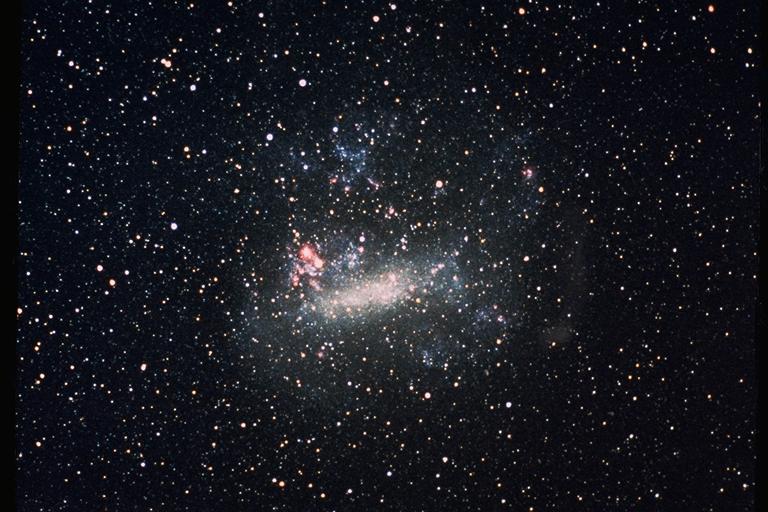
Phoebe is the nickname astronomers gave to an invisible something that briefly bent the light of a distant star . The star sits in the Large Magellanic Cloud, a satellite galaxy of our Milky Way, about 50 kiloparsecs away . On the night of December 18, 2019, that star slowly brightened, peaked, and dimmed back to normal. The whole show lasted about one hour.
No bang. No flare-up. Just a smooth, symmetric rise and fall in light.
That signature is exactly what physicists call gravitational microlensing — a prediction baked into Einstein’s general relativity over a century ago.
What exactly happened on December 18, 2019?
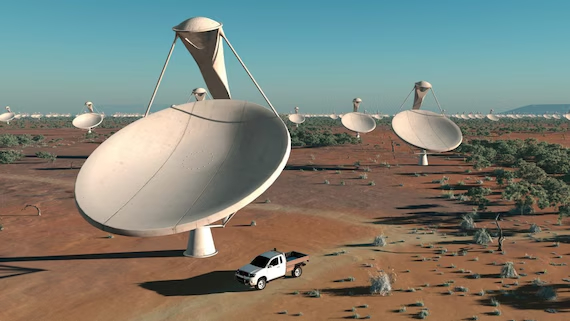
A team led by Renee Key at the Swinburne University of Technology in Melbourne ran a five-night, fast-cadence survey of the Large Magellanic Cloud using the Dark Energy Camera (DECam) on the 4-meter Blanco telescope at Cerro Tololo, Chile . They snapped 20-second exposures back-to-back, getting a new image roughly every 50 seconds . Out of millions of stars, one — and only one — flashed in a way that looked just like microlensing.
They called it Phoebe, a phonetic nod to two possible culprits: a Free-Floating Planet (FFP) and a Primordial Black Hole (PBH) .
The light curve climbed gently for hours and faded just as gently. Stars near Phoebe stayed perfectly stable that night, ruling out atmospheric tricks or camera glitches . Two independent photometry pipelines — DoPHOT and Astrophot — agreed: the brightening was real, and it wasn’t caused by a noisy neighbor leaking light into the source .
Why does microlensing act like a cosmic magnifying glass?
Picture this. A faint, dense object drifts between us and a distant star. Its gravity bends spacetime, and that warped space curves the path of the star’s light toward our telescopes. For a brief moment, the star looks brighter — not because it changed, but because something invisible focused its rays right at us .
The math is elegant. The object’s Einstein radius depends on its mass and distances:
rE = √[ (4GM · DL(DS − DL)) / (c² DS) ]
where M is the lens mass, DL is the lens distance, DS is the source distance, c is the speed of light, and G is Newton’s gravitational constant.
A smaller mass means a smaller Einstein radius — and a much shorter event. That’s the key to figuring out what Phoebe really is .
Who are the three suspects behind Phoebe?
The Australian team modeled three plausible identities for our mystery object :
| Hypothesis | What it would mean | Where it lives |
|---|---|---|
| Rogue planet (Milky Way) | A planet kicked out of its home system, drifting alone | Inside our galaxy |
| Rogue planet (LMC) | First extragalactic free-floating planet ever found | Large Magellanic Cloud |
| Primordial black hole | A relic from inflation, born seconds after the Big Bang | Dark matter halo |
The first two suspects are familiar, in a sense. We already know rogue planets exist around our galactic bulge . Catching one inside the Large Magellanic Cloud would still be a first, though — and a strong hint that planet ejection works the same way in other galaxies .
The third suspect is wilder. Primordial black holes are not the corpses of dead stars. They didn’t form when a giant collapsed. Instead, they would have condensed from extreme density spikes in the first fractions of a second after the Big Bang, long before any star existed . They were proposed back in the 1970s by Carr and Hawking, and they remain a serious candidate for cold, compact dark matter .
How do we weigh something we can’t even see?
Here’s the trick: the duration of the event tells us the mass. Lighter lenses zip across our line of sight faster, producing shorter blips. Heavier ones linger .
Phoebe’s full event lasted around 60 minutes — sitting right at the lower edge of what current telescopes can detect . Plugging the timing into the standard equations, the Melbourne team got a stunning answer:
Estimated mass of Phoebe
≈ 0.032 M⊕
about three lunar masses
That’s roughly 3% of Earth’s mass . Tiny by planetary standards. And here’s the kicker: a stellar-collapse black hole can’t weigh less than about 5 solar masses . Phoebe sits several orders of magnitude below that floor. So it can’t be the ghost of a dead supergiant.
A planet? Possibly. A primordial black hole? Also possible — and at three lunar masses, that fits one of the most theoretically exciting mass windows for dark matter .
Could Phoebe be a piece of dark matter?
This is where the math gets goosebump-worthy.
Using Bayesian modeling, the team compared three population priors: stars in the Milky Way disk and halo, stars in the LMC, and the joint dark matter halo of both galaxies . They asked a simple question: given Phoebe’s behavior, which population is most likely to have produced it?
The answer hit hard. The dark matter halo hypothesis beats the stellar hypotheses by five orders of magnitude — that’s a factor of 100,000 .
In plain English: Phoebe is 100,000 times more likely to be a non-baryonic, dark, compact relic than a regular planet wandering through our galaxy or its neighbor.
If that reading holds up under follow-up observations, we’re looking at one of the oldest objects humans have ever detected. A fossil from before the first stars existed. A whisper from the inflationary epoch — the moment when the universe stretched faster than light and quantum ripples got frozen into reality .
For more than 13 billion years, this little black mass would have drifted in silence, never colliding with anything, never emitting a photon. And then, on one cold December night, its gravity bent the light of a single star just enough for us to notice .
Why should you care about a one-hour flash?
We get it. Astronomy headlines come and go. So why does Phoebe matter to you?
Because dark matter is 85% of all the matter in the universe, and we still don’t know what it’s made of. If primordial black holes account for even a fraction of it, we’d have a brand-new tool to probe inflation — the very birth of space and time .
Phoebe is the second candidate of its kind in 2026. Earlier this year, the Sugiyama team using Japan’s Subaru-HSC telescope reported 12 lunar-mass PBH candidates toward the Andromeda galaxy . Two independent surveys, two different galaxies, the same mass scale. That’s not noise — that starts to look like a population.
We’re not declaring victory yet. Microlensing only gives us geometry, motion, and mass. It can’t tell us a black hole apart from a tiny dark planet just by looking . The Phoebe paper itself is careful about this. The team plans high-resolution spectroscopy of the source star and continued monitoring to test for repeat flares — anything that would betray a stellar origin .
But the door is open. And we love living in a moment when the door is open.
A Final Thought from FreeAstroScience
We wrote this piece for you, here at FreeAstroScience.com, where we translate hard science into clear ideas — because we believe the sleep of reason breeds monsters. Keep your mind awake. Keep questioning. Keep wondering what’s out there in the dark between the stars.
Phoebe might turn out to be a lonely planet adrift in our galaxy. It might be the first planet ever spotted in another galaxy. Or it might be a fragment of the early universe, finally caught in the act of bending starlight after 13 billion years of silence. Whichever answer turns out true, this one-hour flash teaches us something profound: the universe is still hiding ancient secrets in plain sight, and human curiosity — paired with a 4-meter telescope and clever software — is enough to catch them.
Come back to FreeAstroScience.com soon. There’s always more sky to read together.
❓ Frequently Asked Questions
**Q1: What is Phoebe in simple terms?** Phoebe is the nickname for an invisible object that briefly bent the light of a distant star in the Large Magellanic Cloud on December 18, 2019. It’s roughly three times the mass of our Moon and could be a free-floating planet or a primordial black hole . **Q2: How long did the Phoebe event last?** About 60 minutes, with an Einstein timescale near one hour. That makes it one of the fastest and lowest-mass microlensing events ever recorded . **Q3: Why can’t Phoebe be a regular black hole from a dead star?** Because stellar-collapse black holes can’t form below roughly 5 solar masses. Phoebe weighs only about three lunar masses — tens of millions of times lighter than that floor . **Q4: How likely is it that Phoebe is dark matter?** Statistical modeling shows Phoebe is 100,000 times more likely to belong to the joint Milky Way + LMC dark matter halo than to the stellar populations of either galaxy . **Q5: Where can I read the original study?** The paper, titled *AMPM II — A Lunar-Mass Primordial Black Hole Microlensing Candidate in the Milky Way Halo*, was posted on arXiv on May 19, 2026 (preprint ID 2605.19375) and submitted to MNRAS .
📚 References & Sources
- Meloni, D. (2026). Phoebe: Un buco nero primordiale o un pianeta errante dietro l’anomalia del 2019? reccom.org. Read article
- Key, R., Taylor, E. N., Freeman, K. C., Mould, J., Saha, A., Möller, A., Abbott, T. M. C., & Duffy, A. R. (2026). AMPM II — A Lunar-Mass Primordial Black Hole Microlensing Candidate in the Milky Way Halo. MNRAS preprint, arXiv:2605.19375. Read preprint
- Carr, B. J., & Hawking, S. W. (1974). Black holes in the early universe. MNRAS, 168, 399–415.
- Sugiyama et al. (2026). Twelve lunar-mass PBH candidates toward M31 with Subaru-HSC.
- Paczyński, B. (1986). Gravitational microlensing by the Galactic halo. ApJ, 304, 1–5.
Written for you by Gerd Dani — FreeAstroScience.com — where we keep reason awake, one starlit story at a time. 🌌