Article written exclusively for you by FreeAstroScience.com — where complex science becomes a story you can actually follow.
The 85-Solar-Mass Black Hole That Broke Physics: How GW190521 Rewrote the Cosmic Rulebook
What happens when the universe builds something that shouldn’t exist? Welcome, friend. We’re Gerd Dani, writing from FreeAstroScience.com, and today we want to walk you through one of the most jaw-dropping discoveries in modern astrophysics. A black hole sitting right inside a “forbidden zone.” A signal lasting just one-tenth of a second that traveled 17 billion light-years to reach us. Stick with us until the end — you’ll come away seeing the cosmos as a recycling machine, not a graveyard.
Why Are Some Black Holes Considered “Impossible”?
For years, astrophysicists worked with a clean two-tier picture. On one side, stellar black holes — born from dying massive stars, weighing roughly 5 to 50 solar masses. On the other, supermassive monsters at galaxy centers, tipping the scale at millions or billions of solar masses. Between those two worlds? A puzzling silence.
The Pair-Instability Mass Gap
Here’s the catch. When a star’s helium core falls between roughly 32 and 64 solar masses, it suffers what physicists call pulsational pair instability. The core pulses violently, sheds material, and leaves behind a remnant smaller than about 65 solar masses. Push that helium core into the 64–135 solar-mass range, and pair instability blows the star apart entirely. No remnant. No black hole. Nothing left but expanding gas .
That creates a forbidden zone — a band of black hole masses, roughly 65 to 135 solar masses, where stellar evolution simply isn’t supposed to deliver a remnant . If a black hole shows up in that gap, something unusual must have happened. Something the textbooks didn’t predict.
What Did LIGO and Virgo Catch in May 2019?
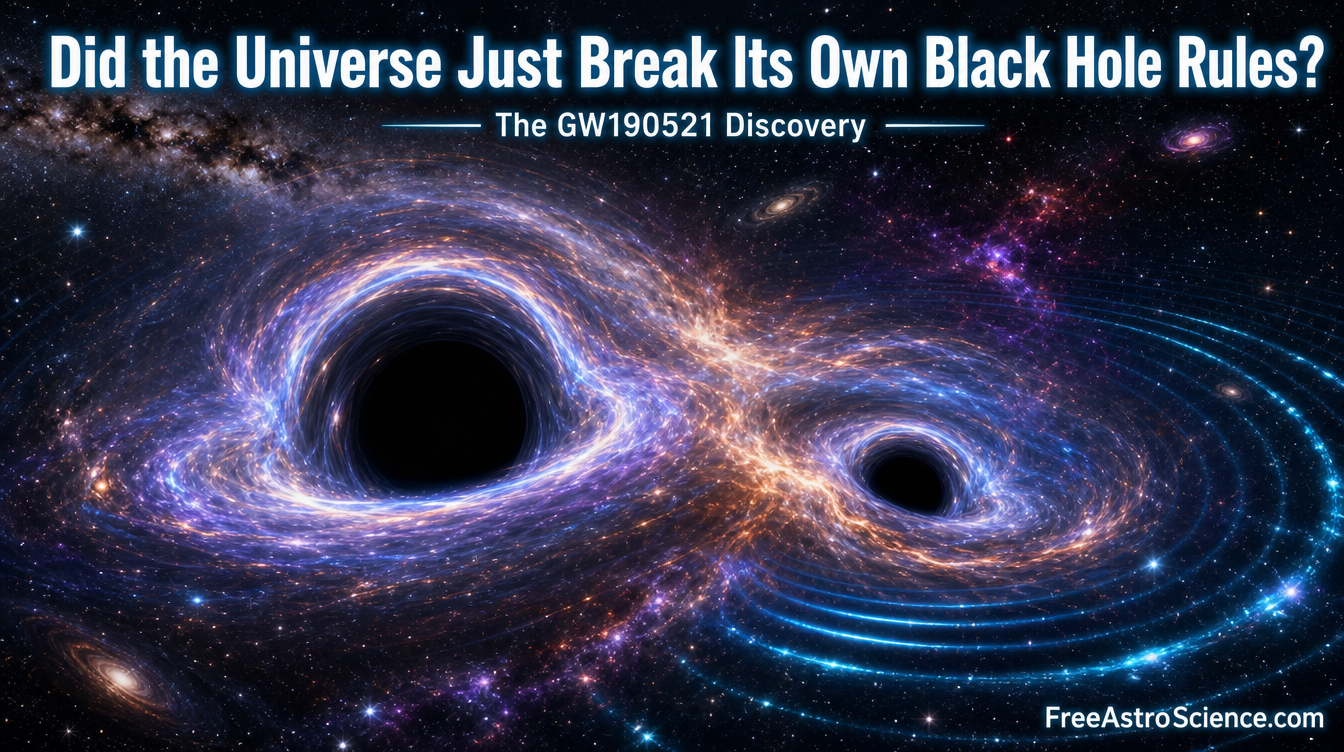
On May 21, 2019, at 03:02:29 UTC, three detectors lit up almost simultaneously: LIGO Hanford, LIGO Livingston, and Virgo. The signal lasted around 0.1 seconds. Just four cycles, mostly in the 30–80 Hz frequency band . Blink and you’d miss it.
But the numbers told a powerful story. The combined signal-to-noise ratio across the three-detector network reached 14.7. The false-alarm rate? One in 4,900 years . Translation: this wasn’t instrument noise. It wasn’t a glitch. It was real.
What Are We Actually Hearing?
Gravitational waves are tiny ripples in spacetime, generated by the most violent events in the cosmos. When two black holes spiral together and merge, they shake the fabric of reality itself. Almost a century after Einstein predicted them, our instruments now feel those tremors.
The signal got the official name GW190521. And what it revealed shook the astrophysics community.
What Do the Numbers Really Say?
The LIGO-Virgo team analyzed the signal using the NRSur7dq4 numerical relativity surrogate model. Here’s what they found.
| Parameter | Value (90% credible interval) |
|---|---|
| Primary black hole mass | 85+21−14 M☉ |
| Secondary black hole mass | 66+17−18 M☉ |
| Total binary mass | 150+29−17 M☉ |
| Mass ratio (m₂/m₁) | 0.79+0.19−0.29 |
| Final remnant mass | 142+28−16 M☉ |
| Final spin (dimensionless) | 0.72+0.09−0.12 |
| Effective precession spin (χp) | 0.68+0.25−0.37 |
| Luminosity distance | 5.3+2.4−2.6 Gpc |
| Redshift | 0.82+0.28−0.34 |
| Probability primary < 65 M☉ | 0.32% |
| Inferred merger rate | 0.13+0.30−0.11 Gpc−3 yr−1 |
Why the Primary Mass Stunned Everyone
Look at that primary black hole: 85 solar masses. Smack inside the pair-instability forbidden zone . The probability it sat below the 65-solar-mass threshold? Just 0.32%. Statistically speaking, the universe gave us a black hole that, by stellar physics alone, simply shouldn’t be there.
The remnant is even more dramatic. At 142 solar masses, it qualifies as an intermediate-mass black hole (IMBH) — a class of objects astronomers had hunted for decades without ever landing one definitively . GW190521 gave us the first clean catch.
How Far Did the Signal Travel?
The merger happened roughly 5.3 gigaparsecs away — about 17 billion light-years in co-moving distance. The corresponding redshift, 0.82, means we’re listening to an event from when the universe was about half its current age . Old light. Old violence. Brand-new physics.
How Does the Universe Recycle Black Holes?
If a single dying star can’t make an 85-solar-mass black hole, where did it come from? The cleanest answer is also the most poetic: it was already a black hole — twice over.
In dense stellar environments — globular clusters, nuclear star clusters, gas-rich disks around active galactic nuclei — black holes don’t lead quiet lives. They jostle, pair up, merge. Then the merged remnant pairs up again. Generation after generation. Astrophysicists call this hierarchical coalescence, and GW190521 is currently the strongest evidence we have that it really happens .
The Spin Fingerprint
How can we tell GW190521’s progenitors were “second-generation” black holes? The spin pattern. The Bayesian analysis showed a log₁₀ Bayes factor of 1.06 favoring a precessing orbital plane and 0.92 favoring nonzero spins . High spins, large tilt angles between the spin axes and the orbital angular momentum — that’s exactly what you’d expect from black holes born of earlier mergers.
Dense stellar systems and AGN disks can act as factories of gravitational monsters, where matter is recycled past the limits of ordinary stellar physics .
Could This Explain Supermassive Black Holes?
This is where the story opens up. If small black holes can climb a ladder to become intermediate-mass ones, the same staircase might keep going. The supermassive giants anchoring galaxy centers — millions to billions of solar masses — may have grown the same way. Merger after merger. Generation after generation.
GW190521 might be the missing link astronomers have been chasing — the first concrete proof that the gulf between stellar and supermassive isn’t a wall, but a bridge built from collisions .
What Comes Next?
Future detectors will catch many more events like GW190521. Third-generation ground-based instruments like the Einstein Telescope and Cosmic Explorer, plus the space-based LISA mission, will widen our reach dramatically . Some signals may be heard by both space and ground detectors at once, letting us follow a single merger across years of inspiral . We’re at the beginning of a new observational era.
Final Thoughts: A Universe That Recycles Itself
This article was put together for you by FreeAstroScience.com, where we work hard to translate dense scientific principles into stories anyone can follow. Our mission is simple: help you keep your mind awake. As Goya warned us in his famous etching, the sleep of reason breeds monsters. Curiosity is the antidote.
GW190521 isn’t just a data point. It’s proof that the cosmos doesn’t waste anything. Black holes once labeled “impossible” turned out to be steps on a longer ladder, and we caught one mid-climb. The next time someone tells you a thing can’t exist because the rules forbid it, remember that 85-solar-mass black hole, sitting calmly inside the forbidden zone, daring us to look closer.
Come back to FreeAstroScience.com soon. There’s always another piece of the cosmic puzzle waiting, and we’d love to walk through it with you.
Frequently Asked Questions
What exactly is GW190521?
GW190521 is a gravitational-wave signal detected on May 21, 2019, at 03:02:29 UTC by LIGO Hanford, LIGO Livingston, and Virgo. It came from the merger of two black holes — 85 and 66 solar masses — producing a remnant of about 142 solar masses .
Why is an 85-solar-mass black hole considered “impossible”?
Stellar evolution predicts a forbidden mass band roughly between 65 and 135 solar masses, caused by pair-instability supernovae. Stars there either lose mass dramatically or blow themselves apart entirely, leaving no remnant in that range .
What is hierarchical merging?
It’s the idea that black holes pair up and merge, and the resulting larger black holes then pair up again. In dense star clusters and AGN disks, this recycling builds bigger and bigger black holes, step by step .
Does this discovery explain supermassive black holes?
It opens the door. If intermediate-mass black holes form through repeated mergers, the same mechanism could help build the supermassive giants at galaxy centers. More observations are needed to confirm this pathway.
Where was the original study published?
The discovery paper appeared in Physical Review Letters, vol. 125, article 101102 (2020), authored by the LIGO Scientific Collaboration and the Virgo Collaboration .
References
style> .fas-refs{background:#0b1d3a;color:#e8f1ff;padding:1.25rem 1.5rem;border-radius:12px;font-family:system-ui,-apple-system,sans-serif;margin:1.25rem 0} .fas-refs h3{color:#ffd166;margin-top:0} .fas-refs ol{padding-left:1.2rem;line-height:1.7} .fas-refs a{color:#9bd1ff;text-decoration:none;border-bottom:1px dotted #6aa3ff;word-break:break-word} .fas-refs a:hover{color:#ffd166;border-bottom-color:#ffd166}📚 Sources
- Abbott, R. et al. (LIGO Scientific Collaboration & Virgo Collaboration). (2020). GW190521: A Binary Black Hole Merger with a Total Mass of 150 M☉. Physical Review Letters, 125, 101102. https://doi.org/10.1103/PhysRevLett.125.101102
- Meloni, D. (2026). Il segreto dei buchi neri impossibili e il meccanismo di riciclo cosmico. reccom.org. https://reccom.org/buchi-neri-impossibili-l-meccanismo-di-riciclo-cosmico/
- Gravitational Wave Open Science Center. Strain Data Release for GW190521. https://doi.org/10.7935/1502-844wj52
/