When Paper Balloons Flew Over Milan: The Forgotten Aerial Story of the Cinque Giornate
Did you know that Italy’s first experiment with airmail happened during a revolution, launched by seminarians and a future famous naturalist? Welcome, dear reader, to another deep-cut from FreeAstroScience.com, where we pull dusty pages out of history and shine a light on the science hiding inside them. Stick with us until the very last line, because this little-known chapter of 1848 mixes physics, patriotism, and paper craft in a way you’ll want to share at dinner tonight.
📑 Table of Contents
- What Were the Five Days of Milan?
- Who Came Up With the Paper Balloon Idea?
- How Did These Paper Mongolfiere Actually Work?
- Where Did the Balloons Land?
- Why Does This Story Still Matter Today?
- FAQ
A Revolution Written in the Sky Above Milan
Picture the scene. March 1848. Milan smells of gunpowder and burning wood. Barricades clog every street. Austrian soldiers fire from rooftops. And up above? A small paper balloon drifts past the smoke, carrying a folded piece of paper. No bombs. No bullets. Just words.
That’s not Hollywood. That actually happened.
What Were the Five Days of Milan?
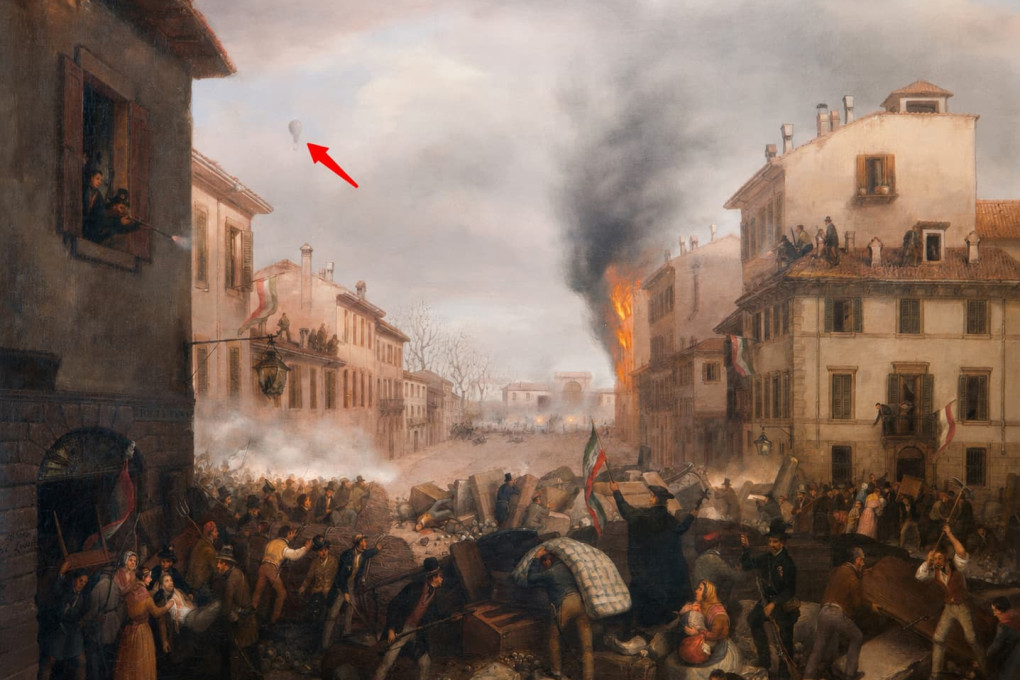
The Cinque Giornate di Milano (March 18–22, 1848) were five intense days when Milanese citizens rose up and pushed the Austrian army out of the city. It’s one of the founding moments of the Italian Risorgimento. And in a painting by Carlo Canella (1800–1879) titled Porta Tosa, you can spot something strange floating above the chaos: a small balloon.
That balloon wasn’t decoration. It was a real weapon of communication.
Who Came Up With the Paper Balloon Idea?
The brain behind this aerial experiment belonged to two unlikely revolutionaries:
- Antonio Stoppani, an abbot who would later become a celebrated naturalist (yes, the same Stoppani who inspired generations of Italian geologists)
- Cesare Maggioni, a young theology student
They worked together with patriots and seminarians from the Seminario Maggiore, which back then sat at Corso Venezia 11 in Milan . While others built barricades from cobblestones and overturned carts, these guys were folding paper.
Their goal? Send proclamations, official bulletins, and instructions from the Provisional Government past Austrian lines and into the surrounding countryside . They needed to call patriots from the villages to come help liberate Milan. And the regular post wasn’t going to cut it with enemy soldiers blocking every road.
So they looked up. Literally.
How Did These Paper Mongolfiere Actually Work?
Let’s talk physics for a moment, because this is where it gets beautiful.
A mongolfiera is a hot-air balloon, named after the Montgolfier brothers who pioneered the design in 1783. The balloons used during the Five Days were modest things: about two meters tall, built entirely from paper, crafted by hand inside the seminary .
The principle is simple. Hot air weighs less than cold air. Heat the air inside a sealed envelope, and the envelope rises. Here’s the math behind why it floats:
| Concept | Formula | What It Means |
|---|---|---|
| Buoyant Force | F = (ρ_cold − ρ_hot) · V · g | Lift comes from the difference between cold outside air and hot inside air |
| Ideal Gas Law | PV = nRT | Heating air at constant pressure makes it expand and lighten |
| Density of Air | ρ ≈ P · M / (R · T) | Higher temperature T means lower density ρ — that’s the magic |
A small fire or burning wick at the base heated the air, and off the balloon went, drifting wherever the wind sent it. Inside? No warheads. No bombs. Just folded proclamations and bulletins waiting to be read by farmers, shepherds, and townspeople kilometers away .
This was, as far as records show, the first airmail experiment in Italy .
Where Did the Balloons Land?
Here’s the part that still gives us goosebumps. Dozens of these paper messengers were launched, not only from the seminary courtyard but also from:
- The Pantheon at Porta Tosa
- The Galleria De Cristoforis
- Several other rooftops across Milan
And they traveled. Far. Some landed in Calvairate. Others in Treviglio, Gorgonzola, the Piacentino, the Comasco, and even reached the Canton Ticino in Switzerland and Piedmont .
Think about that for a second. A paper balloon, two meters tall, built by a theology student, carrying a handwritten call to arms, crossed an international border in 1848.
| Launch Site | Landing Zones | Approx. Distance from Milan |
|---|---|---|
| Seminario Maggiore | Calvairate | ~3 km |
| Pantheon di Porta Tosa | Gorgonzola, Treviglio | ~20–40 km |
| Galleria De Cristoforis | Piacentino, Comasco | ~50–70 km |
| Multiple rooftops | Canton Ticino, Piemonte | 100+ km (across borders!) |
The result? Patriots from the countryside started pouring into Milan to support the uprising . The balloons worked. They actually shaped the outcome of the rebellion.
That’s why painters like Carlo Canella included them in their canvases. If you look closely at Porta Tosa, you’ll see a tiny dot floating in the smoke-filled sky — a quiet hero of the Risorgimento .
Why Does This Story Still Matter Today?
We at FreeAstroScience love this story because it sits at the meeting point of three disciplines we adore: physics, history, and human ingenuity.
Stoppani and Maggioni didn’t have drones. They didn’t have radio. They had paper, fire, and a working knowledge of Archimedes’ principle. And they used those things to coordinate a revolution.
Compare that to today, when we sometimes can’t be bothered to send a text message. The lesson here isn’t just historical trivia. It’s a reminder that clever minds with limited tools can change the course of events. A two-meter paper balloon helped free a city of 200,000 people from imperial occupation. Not bad for a craft project.
There’s also something deeply human about this episode. Picture young seminarians, hands smudged with glue, working through the night in candle-lit rooms while gunfire echoed outside. They weren’t soldiers. They were students who decided that words, lifted by hot air, could fly farther than bullets.
A Final Thought from Us
This article was written specifically for you by FreeAstroScience.com, where we explain complex scientific principles in simple terms. Our mission is to keep you from ever switching off your mind — because, as Goya warned us, the sleep of reason breeds monsters.
The Five Days of Milan teach us something physics teachers rarely cover: that buoyancy, heat transfer, and the ideal gas law aren’t abstract equations. They can be tools of liberation. They can be the difference between isolation and connection. Between silence and a roar of voices joining yours.
Next time you see a hot-air balloon drifting peacefully over a summer field, remember Antonio Stoppani. Remember Cesare Maggioni. Remember that the same physics keeping that balloon aloft once helped a city break its chains.
Come back to FreeAstroScience.com soon. We’ve got more forgotten science stories waiting for you, and we promise — your curiosity is safe with us.
❓ Frequently Asked Questions
1. Were aircraft really used during the Five Days of Milan?
No. No actual airplanes flew over Milan in 1848. What flew were paper hot-air balloons (mongolfiere) about two meters tall, built by hand by patriots and seminarians.
2. Who invented the idea of using balloons during the uprising?
The idea came from abbot Antonio Stoppani — later a famous naturalist — and theology student Cesare Maggioni, both linked to the Seminario Maggiore in Milan.
3. What did the balloons carry?
They carried no weapons. Only proclamations, bulletins, and instructions from the Provisional Government, intended to reach patriots beyond Austrian lines.
4. How far did the balloons travel?
Surprisingly far. They reached Calvairate, Treviglio, Gorgonzola, the Piacenza and Como areas, and even Canton Ticino in Switzerland and Piedmont.
5. Was this really the first airmail in Italy?
Yes. According to the source, the Milan balloon launches of March 1848 represent the first airmail experiment in Italian history.
📚 Sources & References
- Focus.it — “Durante le Cinque giornate di Milano ci fu una battaglia aerea?”
- Carlo Canella (1800–1879), painting Porta Tosa, depicting the Five Days of Milan with a balloon visible in the sky.