
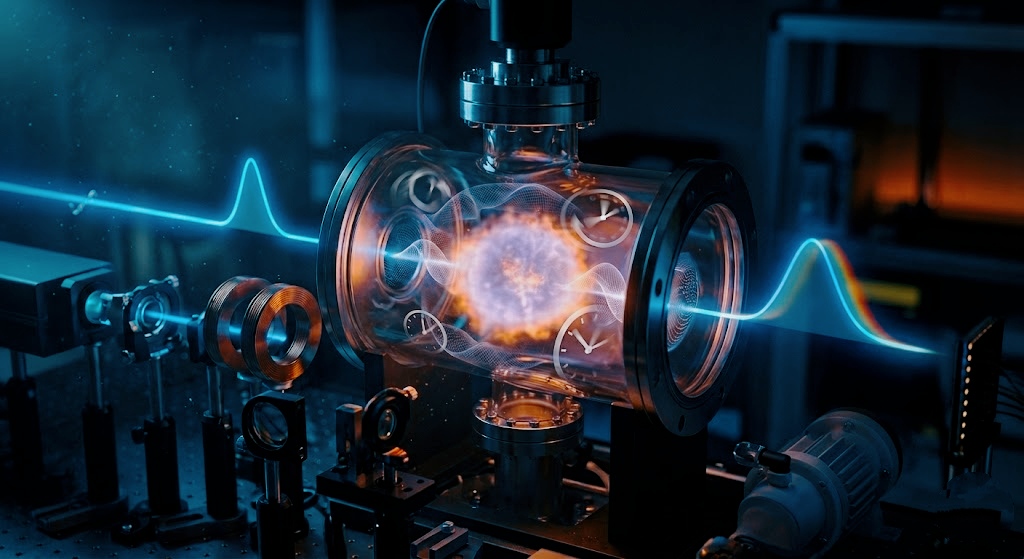
The study of light and matter interaction frequently reveals behaviors that challenge classical intuition. Recent experimental research has focused on the transit of photons through a cloud of rubidium atoms, focusing specifically on the duration these particles spend within the medium. This investigation utilizes the concept of atomic resonance, where a photon may be temporarily absorbed as excitation energy before being re-emitted.
The phenomenon of negative residence time in quantum systems
However, the application of quantum principles to this process suggests that the time elapsed during this interaction may defy standard chronological expectations. When a photon enters the atomic cloud, it interacts with the rubidium atoms in a way that allows its energy to be stored momentarily. This process of excitation and subsequent release provides a window into the peculiar temporal nature of particles at the subatomic scale.
Ultimately, the goal of such research is to quantify the “residence time” or the duration of this energy transfer. By analyzing how long a photon remains within the atomic structure, scientists can better understand the fundamental limits of speed and causality. The results of these experiments suggest that our traditional understanding of a linear, forward-moving timeline may not fully capture the complexity of quantum events.
Quantum uncertainty and the mechanism of atomic resonance
In the experimental setup, rubidium atoms serve as a medium that exhibits resonance with incoming photons. This resonance facilitates a temporary transfer of energy from the light particle to the atom, resulting in a state of atomic excitation. To achieve this effect, the photon must possess a precisely defined energy level that matches the transition requirements of the rubidium.
According to a variation of the Heisenberg uncertainty principle, a high degree of precision in energy necessitates an inherent uncertainty in time. Consequently, the light pulse associated with the photon must have a significant temporal duration rather than being a sharp, instantaneous point. This means that while the average entry time into the cloud is known, the exact moment of individual entry remains fundamentally blurred.
Most photons interacting with the cloud are scattered in random directions, meaning they never reach the intended detector at the far end of the experiment. However, those few photons that traverse the medium successfully and maintain their original path exhibit anomalous arrival times. This behavior sets the stage for a deeper investigation into how these particles manage to navigate the atomic cloud so efficiently.
Experimental observation of apparent temporal paradoxes
Data collected from the transit of successful photons indicate that these particles arrive at their destination much earlier than a constant speed of light would suggest. Indeed, the calculated average suggests that the photons exit the cloud before they have even entered it. This phenomenon has been historically categorized as negative residence time, a concept that seems to violate the basic flow of cause and effect.
While this effect was observed in the early 1990s, many physicists initially dismissed it as a statistical artifact of the measurement process. They argued that only the leading edge of the long, uncertain light pulse moved through the cloud while the rest of the pulse was lost to scattering. In this view, the “early” arrival was simply a result of seeing the very front of a very long train of light.
However, researchers in Toronto decided to test this dismissal by looking directly at the atoms themselves during the interaction. By interrogating the rubidium atoms, they sought to determine how long the excitation energy actually persisted within the medium. This shifted the focus from the arrival time of the light to the internal state of the matter, providing a more direct way to measure the passage of time.
Weak measurement and the validation of negative occupancy
To measure the duration of atomic excitation without triggering the quantum Zeno effect, which would halt the interaction through the act of observation, a technique known as weak measurement was employed. This involved passing a secondary, low-intensity laser beam through the cloud to monitor phase shifts. Because the measurement was deliberately imprecise, it allowed the system to evolve without the heavy perturbation of a standard observation.
Although individual measurements provided only rough data, the mathematical average of millions of experimental trials yielded a highly accurate residence time. Surprisingly, the result of this weak measurement perfectly matched the negative values suggested by the photons’ arrival times. This correlation proved that the negative time was not a byproduct of pulse shape, but a real physical consequence of the interaction.
These findings demonstrate that negative residence time is a measurable physical impact on the atomic cloud, rather than a mere mathematical curiosity. While these results do not imply the invention of a functional time machine, they reveal that the quantum world contains undiscovered territories regarding how time is spent and recorded. This experiment serves as a reminder that the odyssey of quantum research continues to challenge the boundaries of physical reality.
The study is published in the journal Physical Review Letters.


Great article, i really enjoy reading it, i hope you post more, keep up the good wok , is gona come follow you for more , nice reading it.