Chinese astronomers have recently announced the identification of a significant celestial object designated as DESI-HVS1, which is believed to be an ancient, metal-poor hypervelocity star. This discovery was made possible through a comprehensive analysis of spectroscopic data from the Dark Energy Spectroscopic Instrument and precise astrometric measurements from the European Space Agency’s Gaia satellite. Hypervelocity stars are characterized by extraordinary speeds that often exceed 500 kilometers per second, granting them the energy required to escape the gravitational pull of their host galaxy.
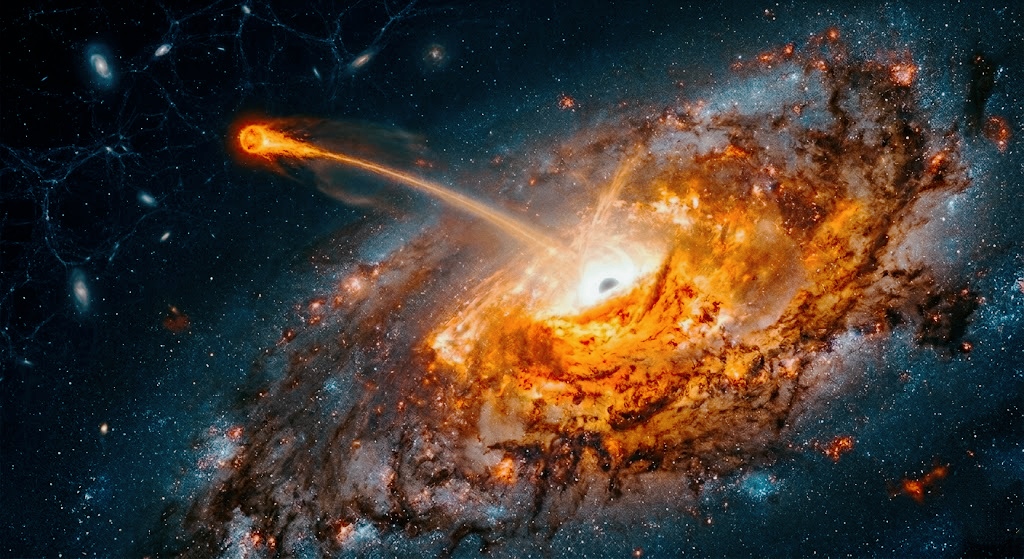
DESI-HVS1: discovery of an ancient hypervelocity star originating from the galactic center
Hypervelocity stars are typically generated through the Hills mechanism, a process wherein a binary star system is disrupted by the immense gravitational forces of a supermassive black hole. As one star in the pair is captured by the black hole, the other is violently ejected into space at extreme velocities. The galactic center serves as the primary environment for such events within the Milky Way due to the presence of a central supermassive black hole and a highly dynamic stellar population.
Despite the theoretical prevalence of these events, linking specific distant stars back to the galactic center remains a significant challenge for modern astronomy. Uncertainties regarding exact distances and proper motions often limit the precision of backward orbital integrations, making it difficult to confirm a star’s point of origin. Consequently, only a small number of known hypervelocity stars have been definitively traced back to the extreme environment of the inner Milky Way.
The identification of DESI-HVS1 by a team led by Shunhong Deng represents a potential breakthrough in this field of study. By utilizing the latest data releases from both the DESI and Gaia missions, the researchers were able to perform a detailed analysis of this candidate. This star stands out among the known population because it is an old, low-mass F-type star, whereas most previously identified hypervelocity stars have been young and massive.
Orbital characteristics and galactic trajectory
DESI-HVS1 is currently situated approximately 12,300 light-years away from Earth and maintains a total galactocentric velocity of roughly 523 kilometers per second. This speed is comparable to the escape velocity at its specific location, suggesting it is on a path to eventually leave the galaxy. The current position and velocity vector of the star indicate a trajectory that is moving away from the galactic disk and outward from the inner regions of the Milky Way.
Orbital reconstructions based on collected data suggest that the star passed within 1,300 light-years of the galactic center approximately 12.9 million years ago. During this close encounter, it reached an estimated ejection velocity of 682 kilometers per second, a speed consistent with the energy levels expected from a supermassive black hole interaction. Its orbit appears strongly ballistic, featuring a clear turning point near the perigalacticon and only a single crossing of the galactic plane.
The consistency of this orbital path reinforces the hypothesis that the star was propelled by the Hills mechanism. Unlike many other stellar objects that wander through the galaxy due to multiple gravitational interactions, the directness of this star’s exit suggests a singular, high-energy event. This clear trajectory provides astronomers with a rare opportunity to study the long-term effects of galactic ejection on ancient stellar bodies.
Physical properties and scientific significance
The physical analysis of DESI-HVS1 reveals that it has a mass of approximately 0.76 solar masses and an effective temperature of 6,198 K. One of its most striking features is its low metallicity, recorded at -1,64 dex, which indicates that it formed from gas clouds that had not yet been heavily enriched by previous generations of stars. Furthermore, the age of the star is estimated to be approximately 14.1 billion years, marking it as a remnant from the very early stages of the universe.
These findings led the research team to conclude that DESI-HVS1 is the first old, low-mass, and metal-poor candidate for a hypervelocity star compatible with a galactic center origin. Prior to this discovery, the known population of hypervelocity stars ejected from the center consisted almost exclusively of young, massive stars. The existence of an ancient star in this category suggests that the ejection processes in the galactic center have been active and consistent across various epochs of galactic history.
If the nature of DESI-HVS1 is confirmed, it will significantly expand the diversity of the known hypervelocity star population. This discovery allows scientists to probe the dynamics of the galactic center using a different class of stellar tracers, potentially offering new insights into the history of our galaxy’s supermassive black hole. The study underscores the importance of combining large-scale spectroscopic surveys with precision astrometry to uncover the most elusive residents of the Milky Way.
The study has been published on arXiv.