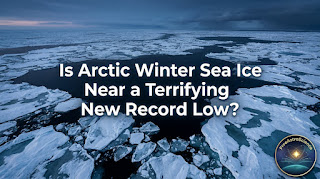

What if the Arctic is telling us something we can no longer afford to ignore?
Welcome to FreeAstroScience.com — the place where we break down
complex science so that everyone, from curious teenagers to seasoned researchers,
can grasp what’s really happening on our planet. We’re glad you’re here.
Right now, in March 2026, the Arctic Ocean is running out of ice — and not just
a little bit. We’re watching history unfold in real time. Satellite data shows
Arctic sea ice extent at nearly 14.22 million km² as of March 10,
and that number is still falling. If you’ve ever wondered what climate change looks
like in action, this is it: cold, hard, and measurable.
We invite you to read this article all the way to the end. Not just to understand
the numbers — but to feel why they matter. Because the Arctic isn’t just some
distant, frozen corner of the world. It’s the planet’s air conditioner. And it’s
struggling.
The Arctic Is Running Out of Ice — And the 2026 Data Should Alarm Every One of Us
We live in an era of satellite eyes. Instruments orbiting hundreds of kilometres
above Earth have been watching the Arctic since 1978. Every day, they send back
images of that vast white expanse — or, lately, the troubling absence of it.
On March 10, 2026, the Arctic sea ice extent sat at roughly 14.22 million
square kilometres. That might sound like a lot. But it’s far below where
it should be for this time of year, and the season isn’t over yet.
We’re watching a record potentially collapse right in front of us. The previous
all-time low winter maximum was set just one year ago, in 2025. We could break it
before March is out.
What’s Happening to Arctic Sea Ice Right Now in 2026?
Sea ice in the Arctic grows through autumn and winter, reaching its peak — called
the winter maximum — usually in late February or March. Then it shrinks
through spring and summer. That rhythm, like a slow breath of the planet, has been
running for millions of years.
But that breath is getting shallower every decade. In 2026, we haven’t even reached
the maximum yet, and the extent is already among the lowest ever observed at this
point in the year. The National Snow and Ice Data Center (NSIDC)
in Boulder, Colorado, tracks this daily — and their numbers are stark.
On February 27, 2026, Arctic sea ice volume hit a record daily low.
One day later, on February 28, it was still at record territory. And the
Copernicus Climate Change Service confirmed that February 2026 saw
the third-lowest sea ice extent for that month on record — sitting 5%
below the 1991–2020 average. These aren’t blips. They’re a pattern.
How Low Can It Go? The Numbers Behind the Crisis
A record that keeps getting broken
On March 22, 2025, Arctic sea ice peaked at 14.33 million km².
That single data point rewrote the record books — the lowest winter maximum in
47 years of continuous satellite monitoring. It knocked the previous record of
14.41 million km² (set in 2017) off the shelf.
Now, in 2026, we’re tracking below even that historic low. The four previous
lowest winter maximums have all happened in the last decade. Think about that for
a moment. The Arctic has never — in the entire satellite era — lost this much
winter ice this consistently.
| Year | Winter Maximum Extent | Date of Maximum | Record Status |
|---|---|---|---|
| 2026 | ≤ 14.22 million km² (tracking) | Expected late March | ⚠️ Potentially new all-time low |
| 2025 | 14.33 million km² | March 22, 2025 | Previous all-time low (47-year record) |
| 2017 | 14.41 million km² | March 7, 2017 | Former record (broken in 2025) |
| 1981–2010 avg. | ~15.64 million km² | — | Long-term baseline average |
The long-term trend doesn’t lie
March sea ice extent has been declining at roughly 2.5% per decade
relative to the 1981–2010 average. Nearly every March since 2004 has fallen well
below the historical average. This isn’t a bad year in isolation — it’s a
long-term trajectory that bends consistently in the wrong direction.
📐 Sea Ice Extent Trend (Simplified Linear Model)
E(t) ≈ E₀ − r · (t − t₀)
Where E(t) = extent in year t (million km²), E₀ = baseline extent (~15.64 million km² for 1981–2010 average),
r = mean decline rate (~0.39 million km²/decade for March), t₀ = baseline year (1995.5, midpoint of 1981–2010).
This linear approximation illustrates the overall trend; actual year-to-year values fluctuate significantly.
Why Is the Arctic Warming So Much Faster Than the Rest of the Planet?
Here’s something that surprises most people: the Arctic is warming at
3 to 4 times the global average rate. Scientists call this
“Arctic amplification,” and it’s one of the most well-documented phenomena
in modern climate science.
Why so fast? Several feedback loops are at work — each one feeding into the next.
The most powerful is called the ice-albedo feedback. White ice reflects
sunlight back into space. Open dark ocean absorbs it. When ice melts, more heat
gets absorbed. More heat melts more ice. It’s a loop that runs faster and faster.
In 2025, the water year from October 2024 to September 2025 logged the
highest Arctic air temperatures since 1900 — a 125-year record.
In August 2025, ocean surface temperatures in parts of the Atlantic sector of the
Arctic Ocean reached up to 7.2°C (13°F) above the 1991–2020 average.
The last 10 years, taken together, are the 10 warmest in Arctic history.
“Given that the Arctic is warming at 3–4 times the global average rate, we are
likely to continue to observe continued Arctic warming, loss of multi-year ice.”— Samantha Burgess, Strategic Lead for Climate, European Centre for Medium-Range Weather Forecasts (ECMWF)
The old ice is disappearing
Not all sea ice is equal. First-year ice — frozen just last winter — is thin
and fragile. Multi-year ice, which survives multiple melt seasons, is thick
and tough. The Arctic used to be dominated by multi-year ice. Now, that old,
resilient ice is almost gone. What we’re left with is younger, thinner ice that melts
faster and freezes later.
What Does Losing Sea Ice Actually Mean for the Planet?
This is where the numbers stop being abstract. Sea ice loss doesn’t just affect
polar bears — though it does affect polar bears. It changes weather patterns for
billions of people. It accelerates sea level rise. It reshapes entire ecosystems.
Ecosystems under pressure
Species like ringed seals, harp seals, and polar bears depend on sea ice for
feeding, breeding, and resting. As ice disappears, their populations decline
and their behavior shifts. Meanwhile, boreal species — Atlantic cod, walleye pollock
— are pushing into Arctic waters they never inhabited before, competing with native
species that evolved for a very different world.
At the base of the food web, the story is equally complex. Sea ice loss brings
more sunlight into polar waters, boosting phytoplankton blooms in some areas while
disrupting nutrient cycles in others. A study published in Nature Communications
in 2025 found that light availability in Arctic marine ecosystems has increased by
75–160% in some regions. That sounds good on the surface. But it’s
reshaping food chains that took millions of years to stabilise.
Weather, permafrost, and coastal communities
A warming Arctic destabilises the jet stream — the high-altitude wind current that
steers weather systems across the Northern Hemisphere. That’s linked to the extreme
weather events, heat domes, and unusual cold snaps that have become more frequent
across Europe and North America.
⚠️ Did you know? Thawing permafrost is releasing iron and other metals
into Arctic rivers, causing them to run orange and rust-coloured — a phenomenon scientists
are calling “river rusting.” Drinking water for Arctic communities is directly affected.
This was highlighted in the Arctic Report Card 2025, authored by 112 scientists
from 13 countries.
Coastal erosion is accelerating too. Without sea ice acting as a natural buffer,
waves batter Arctic shorelines that were previously protected. Entire communities
are facing relocation. The Arctic, in short, is not just changing for Arctic people —
it’s changing for all of us.
Who Is Watching, and What Are the Scientists Saying?
Three institutions are central to monitoring this crisis: the
National Snow and Ice Data Center (NSIDC) in Boulder, Colorado;
the Copernicus Climate Change Service (part of the European
Centre for Medium-Range Weather Forecasts); and Mercator Ocean,
the French oceanographic research centre in Toulouse.
Seamus McAfee, a spokesperson for the NSIDC, told AFP in early March 2026 that
conditions are looking serious: “It is looking like it could be a very
significant extent, perhaps one of, if not the lowest, in the record.”
The NSIDC has not yet issued its formal determination for 2026 — that will come
after the maximum is officially confirmed later this month.
Gilles Garric, a polar oceanographer at Mercator Ocean, put it more bluntly:
the current winter already ranks among the “top three” lowest
levels ever observed. And Samantha Burgess of ECMWF confirmed that 2026 is
on track to fall within the five lowest years on record for winter sea ice extent.
| Expert | Institution | Assessment for 2026 |
|---|---|---|
| Seamus McAfee | NSIDC Spokesperson | “Perhaps one of, if not the lowest, in the record” |
| Samantha Burgess | ECMWF Strategic Climate Lead | Likely within five lowest years on record |
| Gilles Garric | Mercator Ocean, Toulouse | “Top three” lowest levels observed |
| Walt Meier | NSIDC Senior Research Scientist | “Arctic sea ice has fundamentally changed from earlier decades” (2025 statement) |
Is There Any Chance of Recovery?
Technically, yes — a little. McAfee noted that “there is still a chance for recovery”
before the maximum is reached. A sudden cold snap, an unusual shift in wind patterns —
these could push the numbers up slightly before the season peaks.
But let’s be honest about what that means. Even if ice extent ticks up a bit before
the maximum, we’re still looking at one of the lowest winter peaks ever recorded.
And year-to-year fluctuations don’t change the long-term trend. The direction of
travel is unambiguous: downward, decade after decade.
The last three years have been the hottest globally on record. Greenhouse gas
concentrations keep rising. The feedbacks keep accelerating. Recovery, in the
sense of returning to 1980s levels of Arctic sea ice, would require a transformation
in energy systems that we haven’t yet managed to deliver.
📐 Ice-Albedo Feedback (Conceptual)
ΔT_Arctic ≈ α · ΔT_global, where α ≈ 3–4
α = Arctic amplification factor (~3–4× global mean warming). As sea ice area (A_ice) decreases,
surface albedo drops from ~0.6–0.8 (ice) to ~0.06 (open ocean), increasing absorbed solar radiation
and further driving ΔT_Arctic. This positive feedback loop is a key driver of accelerated polar warming.
What Can We — Ordinary People — Actually Do?
We won’t pretend that switching off a light bulb will save the Arctic. The scale
of change needed is systemic and political. But that doesn’t mean individuals
are powerless — and it certainly doesn’t mean we should stop paying attention.
Informed citizens vote. They talk. They question. They demand accountability from
governments, corporations, and institutions. Science communicators like us at
FreeAstroScience believe that knowledge is the first and most essential act of
resistance against indifference. When you understand what’s actually happening
in the Arctic, you can’t un-know it.
At FreeAstroScience, we have always stood by one principle: never turn off
your mind. Keep it active. Keep asking questions. Because, as the great
Francisco Goya once wrote: el sueño de la razón produce monstruos —
the sleep of reason breeds monsters. The data is out there. The scientists are
speaking clearly. We owe it to ourselves, and to every generation that comes after
us, to listen.
So, Where Does This Leave Us?
The Arctic Winter Sea Ice story of 2026 is not just a climate bulletin.
It’s a dispatch from a planet under stress. We’ve watched the 47-year satellite
record get rewritten in 2025 with a winter maximum of just 14.33 million
km². Now, in March 2026, we’re potentially watching that record fall
again — before it’s even a year old.
The Arctic is warming at 3–4 times the global average rate.
The last decade is the warmest in recorded Arctic history. Old, thick multi-year
ice is nearly gone. Ecosystems that took millions of years to form are restructuring
in decades. And scientists at the NSIDC, ECMWF, and Mercator Ocean are watching
it happen in real time, their concern measured and clear.
Here at FreeAstroScience, we protect you from misinformation. We don’t cherry-pick
data to scare you, and we don’t downplay inconvenient truths to comfort you.
We give you the science — all of it — and trust you to think for yourself.
That’s what this community has always been built on.
Come back to FreeAstroScience.com
to keep growing your knowledge. The planet has a lot more to tell us — and we’ll
be here to translate every word.
President, Free AstroScience – Science and Cultural Group |
Content creator, science communicator, and astrophysics enthusiast.
Published on FreeAstroScience.com · March 12, 2026
📚 Sources & References
-
National Snow and Ice Data Center (NSIDC). Arctic Sea Ice Sets a Record Low Maximum in 2025.
March 26, 2025.
nsidc.org -
NASA. Arctic Winter Sea Ice at Record Low. March 26, 2025.
nasa.gov -
World Meteorological Organization (WMO). Arctic Report Card Marks 20 Years Amid Record Warming in 2025.
December 17, 2025.
wmo.int -
NOAA Arctic Program. Arctic Report Card 2025. December 15, 2025.
arctic.noaa.gov - Copernicus Climate Change Service / ECMWF. February 2026 sea ice extent analysis. Via AFP, March 2026.
-
RAND Forecasting Initiative. Will the average Arctic sea ice extent for March 2026 be the lowest on record?
January 2026.
randforecastinginitiative.org -
Thoman, R. Arctic Sea Ice Update: Mid-January 2026. Alaska Climate, January 16, 2026.
alaskaclimate.substack.com -
Nature Communications. “Climate change impacts on ocean light in Arctic ecosystems.” November 5, 2025.
nature.com -
Berkeley Earth. Global Temperature Report for 2025. January 13, 2026.
berkeleyearth.org -
AFP Analysis of U.S. Government NSIDC Data. Published March 11–12, 2026.
(Primary source for this article.)