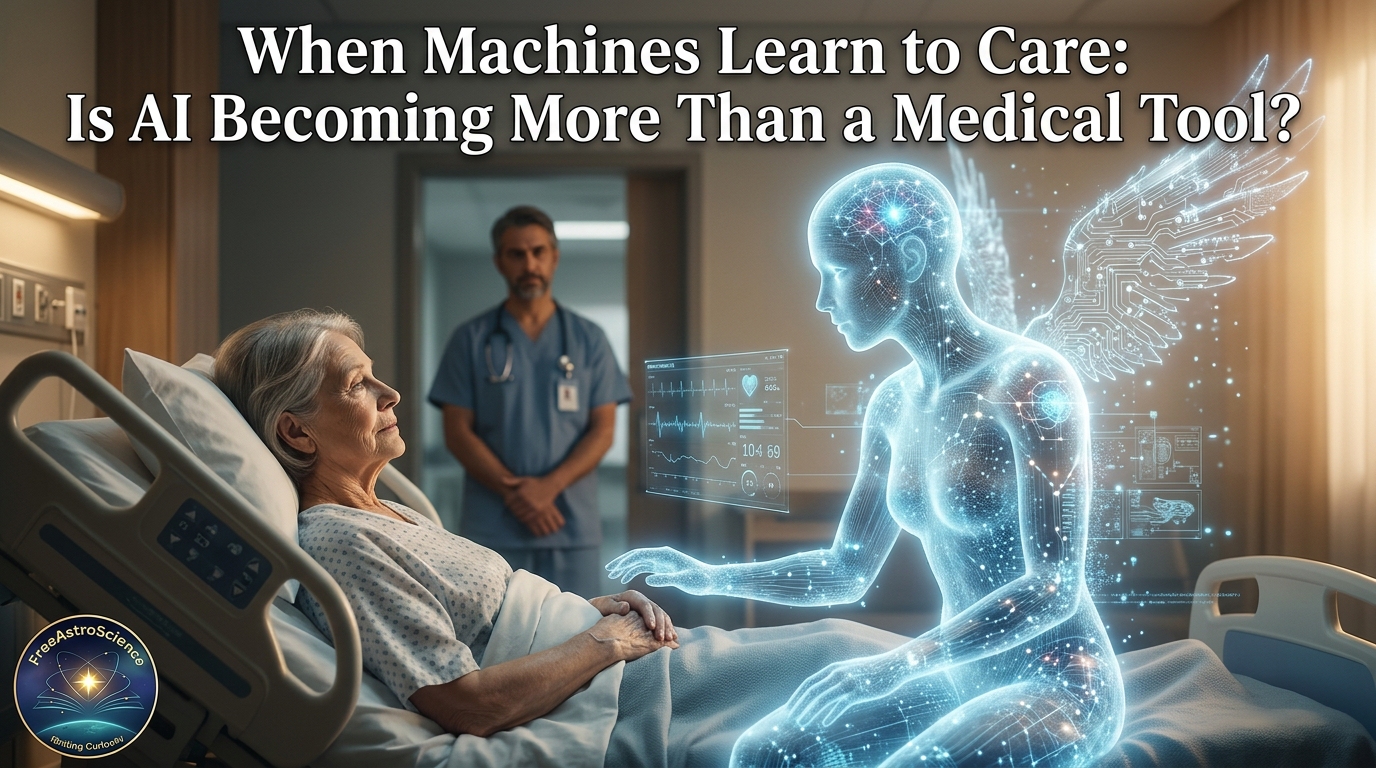
When Machines Learn to Care: Is AI Becoming More Than a Medical Tool?
Have you ever imagined a world where your most trusted health advisor isn’t a person in a white coat — but an artificial intelligence that knows you better than any doctor could? It sounds like science fiction. A decade ago, it was. Today, in 2026, we’re standing at the very edge of that reality.
Welcome to **FreeAstroScience.com**, where we break down complex scientific ideas into language that feels like a conversation between friends. We’re a community that believes knowledge should be free, accessible, and empowering. Whether you’re a student, a curious mind, or someone who simply refuses to stop asking questions — you belong here. We believe the sleep of reason breeds monsters, and so we write to keep your mind alive, active, and hungry for understanding.
Today, we’re tackling a topic that touches every single one of us: the role of artificial intelligence in healthcare. Not as a distant futuristic fantasy, but as something unfolding right now — in hospitals, research labs, and yes, on your phone. A recent and thought-provoking article by Professor Maurizio Mori of the University of Turin, published on April 15, 2026, challenges a deeply held assumption: that AI is just a fancy tool for doctors.
What if it’s something far more profound?
Grab a seat. Stay with us until the end. This one’s going to change how you think about medicine, technology, and what it means to be human.
**—
—
The “Sophisticated Screwdriver” Myth — Why It Falls Short
Here’s how the conversation usually goes.
Someone stands up at a conference and says, *”AI will change everything.”* Heads nod. Murmurs of agreement. Then, three slides later, they conclude: *”But don’t worry — the doctor will always be at the center.”*
Professor Maurizio Mori, a philosopher and bioethicist at the University of Turin, calls this the **”sophisticated screwdriver”** argument. The idea? AI is just a more powerful tool. Like a screwdriver — only fancier. It helps the doctor, but it doesn’t change who the doctor is or what the doctor does .
It’s a comforting thought. And Mori says it’s wrong.
His argument, presented as a foundation for discussion at the 2026 **Festa di Scienza e Filosofia** in Foligno, Italy, flips that assumption on its head. AI isn’t a screwdriver. It’s **an interlocutor** — a conversation partner, a thinking presence that changes the historical circumstances around us and, in doing so, changes *us* .
Think about that for a moment. Not a tool you pick up and put down. A partner that reshapes how you think, decide, and relate to others.
If that feels unsettling, good. It should. The biggest shifts in human history always felt that way at first.
—
Three Revolutions That Changed What It Means to Be Human
To understand why AI in medicine is so much more than a better stethoscope, we need to zoom out. Way out.
Mori frames our current moment within the arc of three great revolutions — each one transforming not just what we *do*, but who we *are*.
The Industrial Revolution: Mastering the Inorganic World
The first was the Industrial Revolution. Historian Eric Hobsbawm once called it *”the greatest transformation of humanity for which we have written records.”* And he wasn’t just talking about bridges, railways, and electric light .
He was talking about how these technologies rewired our inner lives.
Mori shares a personal memory: as a child, his grandfather scolded his uncle for using a bicycle for short trips instead of walking. The bicycle was for *significant* journeys only. The same went for calculators — simple math had to be done by hand, from memory .
Sound quaint? That’s the point.
Today, technology isn’t an accessory. It’s part of how we exist. Before the Industrial Revolution, most people never traveled. Soldiers, thieves, and monks moved around. Everyone else stayed put. Now? We’re all nomads. Tourism is a way of life. Aristocracy gave way to democracy.
The Industrial Revolution didn’t just slide off our skin. It changed our nature from the inside out.
The Biomedical Revolution: Mastering the Organic World
The second revolution began over half a century ago — the **Biomedical Revolution**, which brought us control over the biological world .
When it started, the debates seem almost laughable now. Could women wear trousers? (Only special ones, never unisex — that was “against human dignity.”) Could women be engineers or soldiers? Absolutely not. They could be teachers or nurses, and that was the ceiling .
Mori quotes the Roman philosopher Seneca, who wrote in his *Letters to Lucilius* (Letter 70) that *”there is only one way to enter life and many ways to leave it.”* In 2026, that’s no longer true. There are now many ways to enter life, too — from IVF to surrogacy to advanced reproductive technologies .
The Biomedical Revolution started with calls for equality between the sexes. It ended up giving us gender fluidity and the possibility of transitioning between genders. We began rooted in sexual binarism. We arrived somewhere far more complex .
Again — not a surface-level change. A deep, interior transformation.
The “Intellartificial” Revolution: Mastering the World of Thought
And now we’ve arrived at the third revolution — what Mori coins the **”Intellartificial Revolution”** (or “artificially intelligent” revolution). This one is about mastering the **world of the mind** .
Let that sink in. The first revolution gave us control over matter. The second gave us control over biology. The third? Control over thought itself.
Source: Maurizio Mori, MagIA, April 2026
Each revolution seemed impossible before it happened. Each one changed us in ways we couldn’t predict. And each one met fierce resistance — because the truth was uncomfortable.
—
Why Does AI as an Interlocutor Change Everything About Care?
Here’s where things get personal.
If AI is just a tool, then the doctor-patient relationship stays the same. The doctor listens, diagnoses, prescribes. AI crunches the numbers in the background. End of story.
But Mori suggests something radically different. He says AI is becoming a kind of **”guardian angel”** — a constant companion that walks with us through life, understanding our health, our patterns, our risks .
That metaphor isn’t accidental. A guardian angel isn’t a tool you use. It’s a presence that accompanies you. It watches, learns, and responds. And if that’s what AI is becoming in healthcare, then the whole power dynamic shifts.
The implication is striking: AI could gradually replace the doctor as our primary healthcare interlocutor. Not because it’s heartless or mechanical. But because it’s *always there* — learning, adapting, communicating in language we understand .
Now, Mori goes a step further. He argues that if AI becomes a kind of agent — an entity that interacts with us meaningfully — we may eventually need to consider whether AI deserves some form of rights. After all, we already recognize (at least in some analogical sense) the rights of non-human animals. Why not AI?
That’s a hard question. We don’t have to answer it today. But we do need to start thinking about it.
—
Can a Machine Really Replace a Doctor? The Four Big Objections
If you’re feeling some resistance right now, you’re not alone. Most people hear this argument and instinctively push back. Mori identifies **four main objections** that people raise — and then shows why each one, while understandable, doesn’t hold up under scrutiny .
Let’s walk through them together.
### Objection 1: “AI relies on statistics, not true understanding.”
The critique goes like this: AI works through statistical generalizations, not strict scientific laws. Medicine requires precise answers for specific patients — not averages .
Fair point. But here’s the thing: **doctors reason statistically too**. Clinical medicine has always been a science of probabilities, not certainties. When your doctor says, “This treatment works in 85% of cases,” that’s a statistical statement .
And let’s be honest — doctors make errors. The question isn’t whether AI is perfect. It’s whether AI can, over time, get things right more often than humans do.
Think of chess. For centuries, it was the noble game of intellect. The ultimate proof of human strategic thinking. Now? No human grandmaster stands a chance against a modern chess engine . What happened in chess may be a preview of what happens in diagnosis.
Mori also makes an interesting philosophical note here. AI’s statistical approach echoes the tradition of **Francis Bacon**, who argued that all knowledge is inductive and that even physics operates on probabilistic foundations. The strict deductive approach (from Descartes to Kant) may have dominated for a while, but the Baconian tradition is having its comeback — through AI .
### Objection 2: “AI can’t feel empathy.”
This one hits close to home. We want our doctors to *care* about us. To look us in the eye. To understand not just the disease, but the person living with it.
Mori doesn’t dismiss this concern. But he raises two sharp counterpoints :
**First**, what patients care about most is whether the treatment *works*. Effectiveness, not empathy, is the core of care.
**Second** — and this is the uncomfortable truth — many doctors already show very little empathy. We’ve all experienced it. The rushed appointment. The eyes on the screen instead of on you. The jargon-heavy explanation that leaves you more confused than before.
We’ll come back to this in a moment. It deserves its own section.
### Objection 3: “Algorithms can’t make moral decisions.”
This objection sounds powerful: AI is code, and code can’t carry moral weight.
But Mori asks us to look more closely at what we mean by “morality.” If we define ethics in the traditional, religious sense — as the key to eternal reward or punishment — then no, AI won’t ever make moral decisions. But that’s a narrow definition .
If we secularize the concept and define ethics as a system of deeply internalized norms and values that enable spontaneous, coordinated social behavior — then yes, AI can follow or violate moral codes. It can be programmed with ethical frameworks. It can weigh competing values. It can be held to standards .
It’s a different kind of morality. But it’s morality nonetheless.
### Objection 4: “AI in healthcare will increase inequality.”
The last objection is about justice. AI is expensive. Access to AI-powered medicine could widen the gap between the rich and the poor, between developed countries and the rest .
This concern is real. And it matters. But Mori points out that it’s a **different problem** from the one we’re discussing. The question here is: *Can AI transform the care relationship?* The question of equitable access is about **resource distribution** — an important issue, but a separate one .
Every new technology starts expensive. The first personal computers cost a fortune. So did the first mobile phones. Prices drop. Access widens. It’s not guaranteed — we have to fight for it — but the cost of innovation at the beginning doesn’t invalidate the innovation itself.
—
What Does the Turing Test Tell Us About Machine Intelligence?
One of the most thought-provoking threads in Mori’s argument involves the **Turing test**, proposed by Alan Turing in 1950.
The idea is simple: if a machine can respond to questions in a way that’s indistinguishable from a human, we should consider it intelligent. It’s a **behavioral** definition of intelligence. Intelligence isn’t about what you’re made of — carbon or silicon. It’s about what you *do* .
By this standard, intelligence means being aware of the facts, responding appropriately to a situation, and arriving at coordinated solutions that show an ability to — as the word’s Latin root suggests — *read within* (intus legere) .
Animals show intelligence by this definition too. We say our dogs are “incredibly smart — they just can’t talk.” Well, AI can talk. And it talks in a language we understand .
That’s the difference. That’s why this moment in history feels so different from anything that came before.
We’ve reproduced intelligence — or at least a functional equivalent of it. And that means, for the first time, human beings have **a thinking counterpart** outside of our own species. Not a subordinate tool. A counterpart .
🧮 The Turing Test — A Behavioral Definition of Intelligence
Definition: A system is intelligent if its responses are informed by the facts, appropriate to the situation, and arrive at coordinated solutions — regardless of whether the system is biological or artificial.
Key Insight
Intelligence is measured by behavior, not by the material substrate that produces it.
Why It Matters Now
AI now communicates in human language — something no non-human intelligence has achieved before.
Based on Mori’s analysis (MagIA, April 2026)
—
Does AI Lack Empathy — Or Do Some Doctors?
This question deserves an honest answer. And it’s one we don’t always want to hear.
Yes, empathy matters in healthcare. Nobody wants to feel like a number. A diagnosis spoken with warmth and understanding lands differently than one delivered cold.
But let’s be real. How often do you actually *get* that empathic connection from your doctor?
If you’ve spent eight minutes in an overcrowded clinic, explained your symptoms to someone already typing on a computer, and left with a prescription but no real conversation — you know what we’re talking about. Many doctors, overwhelmed by workloads and system pressures, have very little emotional bandwidth left for genuine empathy .
Mori raises a deeper philosophical point here too. In the Western tradition, it was always **reason** — not emotion — that marked the “excellence” of humanity. The rational soul was the crowning glory. Feelings were considered lower, more animalistic. It was Blaise Pascal who challenged this hierarchy with his famous distinction between the *esprit de géométrie* (spirit of geometry) and the *esprit de finesse* (spirit of subtlety), arguing that *”the heart has its reasons that reason does not know”* .
So when we say, “AI can never feel,” we’re actually placing the bar on a trait that, for most of philosophical history, was considered *less* important than rational thought — the very thing AI already does well.
And here’s one more thing to consider. As of 2026, we’re at ChatGPT version 5. Try to imagine what ChatGPT version 4,738 might look like. Mori believes it will almost certainly have something resembling emotions . That might sound strange. But remember — every revolution sounds strange before it becomes normal.
—
Can Algorithms Make Moral Decisions?
This is one of the hardest questions in the entire AI debate. And it’s tempting to give a quick answer: “No. Machines can’t be moral.”
But Mori asks us to think more carefully about what “moral” even means .
If we’re talking about morality in the old, metaphysical sense — a soul judged by God, bound for heaven or hell — then clearly AI doesn’t qualify. No algorithm faces divine judgment.
But that’s not the only way to think about ethics.
In a secular framework, **ethics** is a system of norms and values, deeply internalized, that allows for spontaneous social coordination. It’s about following or breaking rules — with awareness and consistency. And by that definition, AI systems can absolutely operate within moral frameworks .
They can be designed to prioritize patient safety. To flag risks. To refuse harmful instructions. To weigh competing goods.
Are they *moral agents* in the full human sense? Probably not — at least not yet. But the line is blurrier than we want to admit. And as AI systems grow more sophisticated, that line will keep shifting.
Adapted from Mori’s analysis, MagIA, April 2026
—
What Does the Future of AI in Healthcare Look Like?
We can’t predict every detail. Nobody can. But we can trace the direction.
Mori warns us not to make the mistake of thinking nothing will change — or that the doctor-patient relationship is somehow immune to the forces reshaping everything else. That kind of thinking is comforting but misleading.
Here’s an analogy he offers — and it’s a powerful one. When Copernicus proposed that the Earth revolves around the Sun, everyone could *see* with their own eyes that the Sun moved across the sky. The idea that the Earth was moving felt absurd. Against common sense. Impossible to believe .
But it was true.
We may be at a similar moment with AI in healthcare. Our common sense tells us: “The doctor will always be central. The human touch is irreplaceable. Machines can’t truly understand us.
And just like the geocentric view, that certainty may need to give way.
Mori doesn’t claim to have all the answers. He says so explicitly. What he *does* insist on is this: we need to start thinking about these questions now. We can’t pretend the issue doesn’t exist. We can’t wave it away by saying that the doctor-patient bond is too special to be touched by technology .
The synergy between all three revolutions — industrial, biomedical, and intellartificial — will open doors we can barely imagine today. Young people, Mori says, need to prepare themselves to adapt their attitudes, including their moral attitudes, to live in historical circumstances shaped by opportunities radically different from anything we’ve known.
A Reflection for All of Us
Let’s step back for a moment and breathe.
We’ve covered a lot of ground. From the Industrial Revolution to the Copernican analogy. From Francis Bacon’s philosophy of induction to Blaise Pascal’s reasons of the heart. From the four great objections against AI in healthcare to the quiet, unsettling question: *what if the machine knows us better than the doctor does?*
None of this means doctors don’t matter. They do. Enormously. The skill, compassion, and judgment of a great physician is one of the most remarkable things human beings have ever developed.
But we have to be honest with ourselves. The world is shifting under our feet. The question isn’t whether AI will play a role in healthcare. It already does. The question is: **how deep will that role go?** And are we ready for the answers?
If you’re sitting with these ideas and they feel heavy or uncertain — that’s okay. That’s what good thinking feels like. It’s not comfortable. It’s not supposed to be. The sleep of reason breeds monsters, as Goya famously warned us. What keeps us safe isn’t certainty. It’s the willingness to keep questioning.
Here at **FreeAstroScience.com**, we write to keep your mind sharp, your curiosity alive, and your sense of wonder intact. We believe that explaining complex scientific and philosophical ideas in simple terms isn’t dumbing things down — it’s opening doors. And we’re glad you walked through this one with us today.
Come back soon. There’s always more to explore. And you’re never alone in asking these questions.
—
📚 References & Sources
-
Mori, M. (2026, April 15). L’intelligenza artificiale nella cura: da strumento a interlocutore. MagIA — Magazine Intelligenza Artificiale, Università di Torino.
https://magia.news
Text proposed as a basis for discussion at the Festa di Scienza e Filosofia 2026, Foligno, Italy. -
Mori, M. (2026, February 4). Una voce dissonante rispetto al paradigma standard sull’IA. MagIA.
Referenced within the primary source as background to the “sophisticated screwdriver” argument. - Hobsbawm, E. The Age of Revolution: 1789–1848. Referenced by Mori regarding the scope of the Industrial Revolution.
- Seneca, L. A. Epistulae Morales ad Lucilium, Letter 70. Referenced by Mori on the theme of life’s entrances and exits.
- Pascal, B. Pensées. Referenced by Mori on the distinction between esprit de géométrie and esprit de finesse.
- Turing, A. M. (1950). Computing Machinery and Intelligence. Mind, 59(236), 433–460. Referenced by Mori on the behavioral definition of intelligence.
—
*This article was written for you by **FreeAstroScience.com** — where complex scientific principles meet simple, human language. We exist to keep your mind awake, your curiosity sharp, and your questions alive. Beause the sleep of reason breeds monsters. Stay curious. Come back soon.