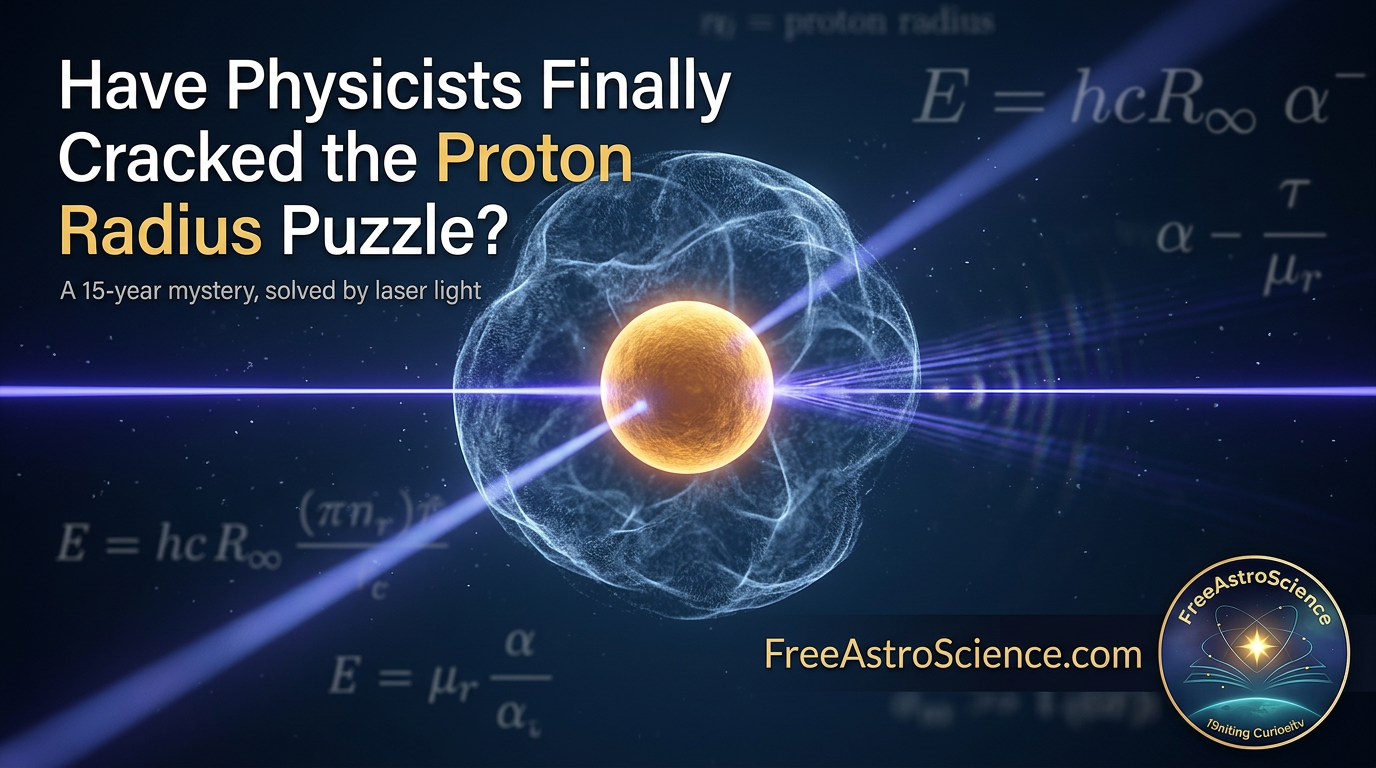
Have Physicists Finally Cracked the Proton Radius Puzzle?
What if the tiny heart of every atom in your body was different from what textbooks told us for decades? Welcome, dear reader, to FreeAstroScience.com. We’re glad you stopped by. Today we bring you a story of stubborn physicists, laser beams thinner than a human hair, and a particle so small it makes a grain of sand look like a planet. Stay with us to the very end. The payoff is worth it: you’ll walk away understanding something that kept the world’s brightest minds awake at night for fifteen years.
The Proton Just Got Smaller — And Physics Just Got Stronger
How a 15-Year Puzzle at the Heart of Matter Was Finally Put to Rest
For more than a decade and a half, physicists have been haunted by a number. Not a spooky, cosmic number like the age of the universe or the mass of dark matter — something far more intimate. The radius of the proton. The humble, ubiquitous particle sitting in the nucleus of every hydrogen atom in your body, in the sun, in the farthest galaxy. We thought we knew how big it was. Then, in 2010, an astonishing experiment suggested we were wrong by about 4%. And in physics, 4% is not a rounding error — it is a crack in the wall of reality.
That crack has now been sealed. In February 2026, a team at the Max-Planck-Institut für Quantenoptik in Garching published a measurement in Nature so exquisitely precise that it has effectively closed the book on the “proton radius puzzle.” The proton really is smaller than we used to think. The Standard Model of particle physics, far from cracking, emerges glittering and intact — tested to an unimaginable precision of 0.7 parts per trillion.
Let me walk you through why this is one of the most beautiful experimental results of the decade.
What Is the “Radius” of a Proton, Anyway?
First, a confession: the proton doesn’t really have a radius. Not the way a marble does. The proton is a roiling cloud of three quarks bound by the strong nuclear force, fizzing with virtual particles that pop in and out of existence. Asking “how big is it?” is like asking “how big is a storm?”
What physicists actually measure is the root-mean-square charge radius — a statistical description of how the proton’s electric charge is smeared out in space. Think of it as the fuzzy edge of a thundercloud. Small though it is — roughly 0.84 millionths of a billionth of a meter, or about 0.84 femtometers — this fuzziness has real, measurable consequences for atoms.
Here’s the magic: an electron orbiting a proton in a hydrogen atom is not really orbiting at all. In the quantum world, it exists as a smeared-out wave of probability, and part of that probability leaks inside the proton itself. When the electron is inside the cloud of charge, it feels a slightly different electric force than it would from a point-like charge. That tiny difference shifts the energy levels of the atom by a measurable amount — the so-called Lamb shift.
Measure the atom’s energy levels with enough precision, and the proton’s size falls out of the math. For decades, this was how we figured out how big protons are.
2010: The Bombshell from Muonic Hydrogen
In 2010, a group led by Randolf Pohl (a coauthor on this new paper, fittingly) pulled off a clever trick. Instead of using ordinary hydrogen, they built an exotic version: a proton orbited not by an electron but by a muon, the electron’s heavier cousin. The muon is roughly 200 times more massive than the electron, which means it orbits about 200 times closer to the nucleus. And because the probability of finding the muon inside the proton scales steeply with that proximity, muonic hydrogen is fantastically more sensitive to the proton’s size — by a factor of roughly ten million.
The expectation was that this ultra-precise measurement would nail down the proton radius once and for all, confirming the established value of about 0.877 femtometers.
It didn’t. The muonic measurement pulled out a value of around 0.841 femtometers — smaller by more than 5 standard deviations from the world average. In physics-speak, a 5-sigma discrepancy is the gold standard for “this is not a fluke.” Something was off.
The Puzzle Years
Possibilities tumbled out. Was the muonic experiment wrong somehow? Was there subtle new physics — an unknown particle that interacted differently with muons than with electrons, shifting the energy levels? Was quantum electrodynamics (QED), the most precisely tested theory in all of science, somehow incomplete? Or was the old electron-based measurement simply not as accurate as we thought?
Over the next fifteen years, a parade of experiments took aim at the problem. The Garching group’s own 2017 measurement of the 2S–4P transition in hydrogen leaned toward the smaller, muonic value but couldn’t conclusively rule out the larger one. Subsequent experiments — some using the 1S–3S transition, others measuring the Lamb shift directly, still others targeting the 2S–8D transition or the ionization energy of the 2S level — produced a bewildering spread of results. Some agreed with the muonic value. Some disagreed with each other. None were precise enough to deliver the knockout punch.
The puzzle refused to die. And every year it lived, a small part of the physics community kept hoping: maybe this is it. Maybe this is the hairline fracture that leads us to the new physics beyond the Standard Model.
The Experiment That Settled It
The new Garching measurement, led by Lothar Maisenbacher and Vitaly Wirthl, targets a specific atomic transition: 2S–6P in ordinary atomic hydrogen. An atom sitting in the metastable 2S state is hit with a 410-nanometer laser, kicking its electron up to the 6P level. The 6P level promptly decays — mostly via the energetic “Lyman-ε” photon back to the ground state — and that flash of fluorescence is the signal.
The frequency of this transition, measured with extraordinary precision, can be combined with the already-known 1S–2S transition frequency and the equations of QED to extract the proton radius. And the precision here is genuinely staggering:
ν₂S₋₆P = 730,690,248,610.79 ± 0.48 kHz
That uncertainty — less than half a kilohertz on a frequency of roughly 730 terahertz — corresponds to pinning down the transition to about one part in 15,000 of the experimental linewidth. That is, to the authors’ knowledge, unprecedented in laser spectroscopy. It is like measuring the distance from New York to Los Angeles to within the width of a human hair.
The proton radius that falls out is:
rₚ = 0.8406 ± 0.0015 fm
It is 2.5 times more precise than any previous measurement from ordinary hydrogen, four times more precise than the old CODATA 2014 world average, and in beautiful, almost eerie agreement with the 2010 muonic value of 0.84060 fm. The disagreement with the old, larger value now stands at 5.5 sigma. Puzzle solved.
The Technical Wizardry Behind the Measurement
Getting a number to this level of precision is not a matter of turning a knob more carefully. It is a battle against every subtle effect that can whisper into the atoms and shift the result.
A few of the adversaries the team had to defeat:
The Doppler shift. Atoms in the beam are moving, and moving atoms see light at a slightly shifted frequency. To cancel this out, the team shone the laser through the atomic beam from both sides using a specially designed “active fibre-based retroreflector.” They even periodically tilted the beam by tiny angles to probe how the effect behaved.
The Light Force Shift. This is wonderfully exotic. When a matter wave — and atoms are matter waves in quantum mechanics — crosses a standing wave of light, it can diffract like a light wave off a grating, an effect predicted by Kapitza and Dirac back in 1933. At just the right transverse velocity, the atoms hit a Bragg resonance that shifts the apparent frequency by hundreds of kilohertz. The team built a detailed quantum-mechanical model of partially coherent atomic matter waves to account for this effect — and tested it directly by deliberately tilting the beam and watching the predicted shift appear.
Quantum interference. When two nearby excited states can each be reached by and decay through similar paths, the quantum amplitudes interfere and can pull the apparent line center off-kilter. The team suppressed this by choosing a “magic” polarization angle of 56.5° for their laser and by using large detectors that gather fluorescence from most of the sky around the atoms.
Stray electric fields. A Faraday cage coated with colloidal graphite shielded the atoms, and the team used the atoms themselves as field sensors by deliberately applying bias voltages and watching the lines shift.
And so on: blackbody radiation, pressure shifts, Zeeman shifts, the frequency standards used as references — each contributed a correction measured in fractions of a kilohertz. The final result comes from 3,155 individual laser scans accumulated across three multi-week measurement runs over the course of months, with the entire data analysis deliberately “blinded” (an offset frequency added so the researchers couldn’t see the true answer) until every systematic effect had been pinned down. A second team member redid the whole analysis independently as a cross-check.
This is what modern precision physics looks like. It is not a eureka moment. It is a years-long siege.
The Standard Model Passes With Flying Colors
Here is where the story becomes genuinely profound. Once you have the 2S–6P frequency and the proton radius from the muonic experiment, you can ask QED — specifically, bound-state QED, the machinery that predicts how electrons behave when they are tethered to a nucleus — to predict the frequency.
The prediction: 730,690,248,610.79 kHz, with an uncertainty of 0.23 kHz.
The measurement: 730,690,248,610.79 kHz, with an uncertainty of 0.48 kHz.
They agree to within 0.00 ± 0.53 kHz.
This is a test of the Standard Model at a relative precision of 0.7 parts per trillion — comparable to the best tests ever performed, rivaling the precision of measurements of the electron’s magnetic moment. At this level, the experiment is sensitive to three-photon QED corrections (contributions scaling as α⁵, the fine-structure constant to the fifth power) and reaches the regime of muonic and hadronic vacuum polarization — the ephemeral “flicker” of virtual muon-antimuon pairs and quark-antiquark pairs that briefly exist around every electron in every atom.
None of it is out of place. The Standard Model, a theory first pieced together in the 1970s, predicts the behavior of a hydrogen atom down to thirteen significant digits — and the atom obeys.
A Bittersweet Triumph
If you were hoping for a revolution in physics, this result is, admittedly, a little deflating. No new force. No hidden particle. No crack in the wall. Just the Standard Model, unbowed and seemingly unbreakable, even at precisions that would have been unthinkable a generation ago.
But read the story the other way. For fifteen years, we did not know whether the foundations of physics were secure. We had a discrepancy that might have been, as some hoped, a window onto a whole new realm of physics — perhaps a lightweight boson mediating an unknown force that coupled differently to muons and electrons. The experimentalists did what experimentalists are supposed to do: they hunted the anomaly down with ever-sharper tools, refused to be satisfied with partial answers, and in the end, showed us precisely where the truth lies.
The proton is smaller than we once believed. The old measurements were off. And the theory — this extraordinary, seven-decade-old edifice of quantum electrodynamics and the Standard Model — really does work, down to one part in more than a trillion.
That is not a defeat. That is one of the most stunning confirmations of a physical theory in the history of science.
What Comes Next?
The authors note that the techniques demonstrated here can be applied to other 2S–nP transitions in hydrogen and its heavier isotope, deuterium. Each new measurement tightens constraints on QED and on potential new physics — including, intriguingly, the possibility of weakly-interacting bosons with masses in the kilo-electronvolt range. The hunt for physics beyond the Standard Model continues on many fronts: in highly-charged ions, in molecular hydrogen ions, in precision measurements of the electron’s magnetic moment, in the anomalous magnetic moment of the muon, and in cosmic observations.
For now, though, the proton radius puzzle is over. The muon and the electron tell the same story about the tiny fuzzy ball at the center of hydrogen. And somewhere in Garching, in the basement of a physics institute, the cryogenic nozzle keeps spraying hydrogen atoms into a laser beam — because in precision physics, the next significant digit is always a promise worth chasing.
This post is based on Maisenbacher et al., “Sub-part-per-trillion test of the Standard Model with atomic hydrogen,” Nature vol. 650 (26 February 2026), doi:10.1038/s41586-026-10124-3. Open access.