
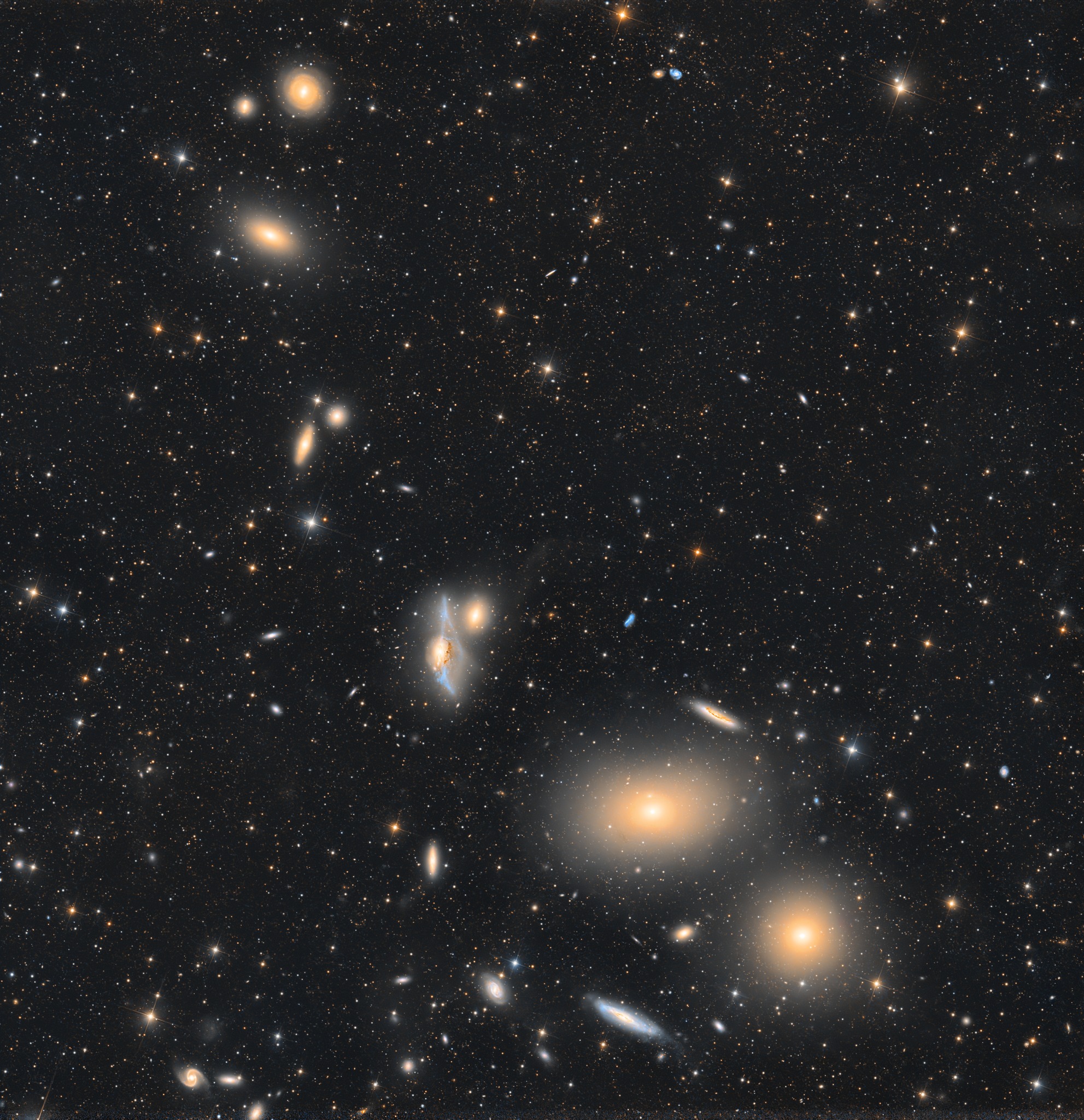
Have you ever looked up at the night sky and wondered what lies beyond the stars we see? Welcome to FreeAstroScience.com, where we turn cosmic mysteries into stories you can understand. Today, we’re taking you on a journey 50 million light-years away, to a place where galaxies line up in a cosmic parade—Markarian’s Chain, nestled in the heart of the Virgo Cluster. Here, ancient giants, cosmic collisions, and the fingerprints of legendary astronomers come together in a spectacle that’s as real as it is awe-inspiring. We believe that to truly appreciate the universe, you should never turn off your mind—the sleep of reason breeds monsters. So, join us as we unravel the secrets of this galactic chain. Read to the end, and you’ll see the universe—and maybe yourself—a little differently.
Table of Contents
- A Cosmic Parade of Galaxies Across 50 Million Light-Years of Space
- What Exactly Is the Virgo Cluster, and Why Should We Care?
- What Is Markarian’s Chain — and What Makes It Special?
- Meet the Main Players: What Lives Inside This Galactic Chain?
- Galaxy Comparison Table
- What Are Lenticular Galaxies, and How Do Galaxies Lose Their Arms?
- How Does a Tidal Bridge Breed New Stars Between Two Colliding Galaxies?
- How Do Astronomers Know Which Galaxies Are Really Connected?
- Who Discovered These Galaxies — and When Did the Story Begin?
- What’s the Latest Science Saying About the Virgo Cluster?
- How Can You See Markarian’s Chain From Your Own Backyard?
- Conclusion: What Does a Chain of Galaxies Say About Us?
- Image Credit
- References
A Cosmic Parade of Galaxies Across 50 Million Light-Years of Space
What Exactly Is the Virgo Cluster, and Why Should We Care?
The Virgo Cluster is the closest large gathering of galaxies to our own Milky Way. Imagine a city in space, home to between 1,300 and 2,000 galaxies, all packed into a region about 54 million light-years away. That’s the Virgo Cluster—our cosmic neighbor and the central hub of the Virgo Supercluster, which even includes our Local Group.
At its heart sits the giant galaxy M87, but the cluster itself stretches more than 10 degrees across the sky. That’s twenty times the width of the full Moon! The cluster’s center is at right ascension 12h 27m, declination +13° 10′. But what really makes the Virgo Cluster fascinating is what fills the space between its galaxies: the intracluster medium (ICM). This is a hot plasma, heated to a blistering 30 million Kelvin, glowing in X-rays and stripping gas from galaxies as they speed through. The ICM is so massive—about 3 × 10¹⁴ times the mass of our Sun—that it shapes the fate of every galaxy inside. It’s a place where stars, planetary nebulae, and even globular clusters drift between galaxies, lost and found in the cosmic tide.
What Is Markarian’s Chain — and What Makes It Special?
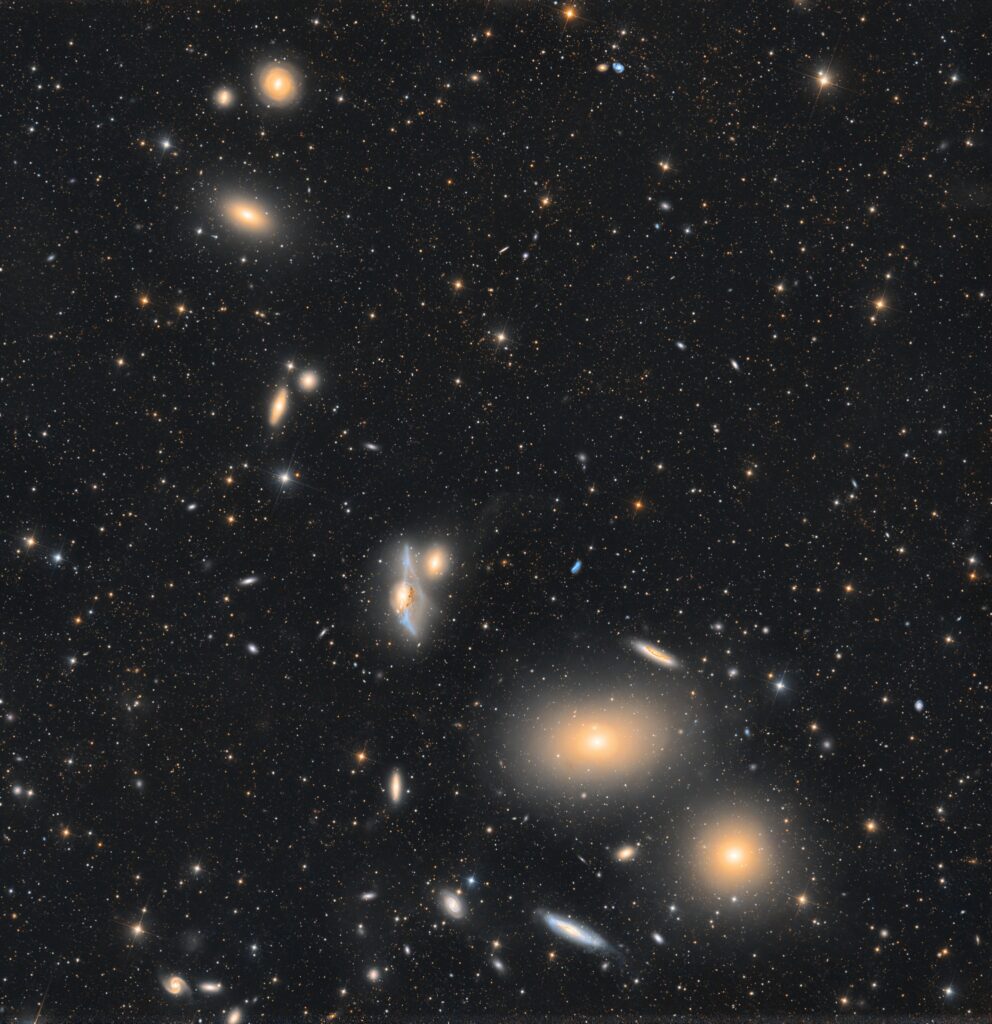
Near the cluster’s core, a string of galaxies forms a gentle arc across the sky. This is Markarian’s Chain—a cosmic parade stretching about 1.5 degrees, or roughly 1.5 million light-years if you could measure it end to end. You’ll find it halfway between the stars Denebola (in Leo) and Vindemiatrix (in Virgo), a spot that’s easy to find on a spring night.
What sets Markarian’s Chain apart isn’t just its beauty. At least seven of its galaxies are truly connected, moving together through space at similar speeds—like dancers in a cosmic waltz. Others just happen to line up from our point of view, but are actually much farther away or closer. The chain’s main members, from southwest to northeast, are M84, M86, the interacting pair NGC 4438 and NGC 4435 (nicknamed “The Eyes”), NGC 4458, NGC 4461, NGC 4473, and NGC 4477. The chain gets its name from Benjamin Markarian, the Armenian astronomer who, in 1961, proved that these galaxies share a common motion—a discovery that changed how we see clusters forever.
Meet the Main Players: What Lives Inside This Galactic Chain?
M84 — The Jet-Powered Giant
M84 is a giant elliptical galaxy (some call it a lenticular, S0), sitting 54.9 million light-years from us. It shines at magnitude 9.1, with a true brightness (absolute magnitude) of −22.41. Spanning about 104,000 light-years, it’s home to a supermassive black hole weighing in at 1.5 billion Suns. Two radio jets shoot from its core, a sign of active galactic life. M84 also boasts around 1,775 globular clusters and has hosted several supernovae—cosmic fireworks in a city of ancient stars.
M86 — The Galaxy Flying Toward Us
M86 is the brightest in the chain, a lenticular (S0) or elliptical galaxy about 52 million light-years away. It’s huge—about 134,000 light-years across—and shines at magnitude 8.9. What makes M86 truly wild is its motion: it’s racing toward us at 244 km/s, the highest blueshift of any Messier object. As it plows through the Virgo Cluster’s hot gas, it leaves a trail of X-ray-emitting plasma behind. Ionized gas filaments even connect it to NGC 4438, hinting at past encounters.
NGC 4438 and NGC 4435 — The Eyes That Tell a Story of Collision
NGC 4438 was once a grand spiral galaxy, but a high-speed collision with its neighbor NGC 4435 about 100 million years ago changed everything. Now, NGC 4438 is a peculiar galaxy, stretched and scarred, with much of its gas stripped away. It’s about 128,000 light-years across, shines at magnitude +10, and hosts a black hole of several hundred million solar masses. Its northwestern tail glows with new stars, born just 10 million years ago.
NGC 4435, the smaller companion, is a barred lenticular galaxy about 35,500 light-years wide. Its core is young—just 190 million years old—thanks to the same collision. Together, these galaxies are known as “The Eyes” (Arp 120), a pair that shows how cosmic violence can spark new life.
Galaxy Comparison Table
| Galaxy Name | Type | Distance (Mly) | App. Magnitude | Physical Size (ly) | BH Mass (M☉) | Special Feature |
|---|---|---|---|---|---|---|
| M84 | E1 (Elliptical/Lenticular) | 54.9 | 9.1 | 104,000 | 1.5 × 10⁹ | Radio jets, AGN, 1,775 globular clusters |
| M86 | S0(3)/E3 (Lenticular/Elliptical) | 52 | 8.9 | 134,000 | ~few × 10⁸ | Highest blueshift, X-ray gas trail, 3,800 globular clusters |
| NGC 4438 | Peculiar (Sa pec/S0 pec) | 50–52 | 10 | 128,000 | ~few × 10⁸ | Tidal bridge, star-forming tail, AGN-like activity |
| NGC 4435 | Barred Lenticular (SB0 pec) | 52 | 10 | 35,500 | ~few × 10⁷–10⁸ | Young core, rapid rotation, “The Eyes” pair |
What Are Lenticular Galaxies, and How Do Galaxies Lose Their Arms?
Lenticular galaxies, or S0s, are the “armless disks” of the universe. They have a central bulge and a disk, just like spirals, but no spiral arms. Their stars are old and yellowish, and they’ve run out of the gas needed to make new stars. Think of them as the retired athletes of the galaxy world—once active, now settled.
How do spirals lose their arms and become lenticulars? In clusters like Virgo, galaxies race through the hot intracluster medium at hundreds of kilometers per second. The ICM acts like a cosmic wind, stripping away their gas—a process called ram-pressure stripping. Tidal harassment, or repeated close encounters with other galaxies, can also stretch and distort their disks, erasing the spiral pattern. Over time, the arms fade, and the galaxy becomes a smooth, featureless disk.
How Does a Tidal Bridge Breed New Stars Between Two Colliding Galaxies?
When two galaxies pass close by, their gravity pulls on each other, stretching out streams of stars, gas, and dust. The material drawn from the near sides forms a tidal bridge—a glowing connection between the galaxies. The far sides stretch into tidal tails, flung out into space.
Inside these bridges, gas clouds get squeezed and jostled, triggering bursts of star formation. In the case of NGC 4438 and NGC 4435, their high-speed collision about 100 million years ago created a bridge filled with newborn stars, some just 10 million years old. It’s like two cars colliding and the flying debris suddenly lighting up with new life. Sometimes, these bridges even seed new “tidal dwarf galaxies” at their tips.
How Do Astronomers Know Which Galaxies Are Really Connected?
Not every galaxy in Markarian’s Chain is truly part of the group. Some just happen to line up from our viewpoint. To tell the difference, astronomers use spectroscopy—splitting a galaxy’s light into a rainbow and measuring the shift in its spectral lines. If the lines are shifted toward red, the galaxy is moving away; if blue, it’s coming toward us. Galaxies that share similar velocities (within the cluster’s velocity dispersion, about 900 km/s) are likely moving together.
For example, seven galaxies in the chain have velocities ranging from −452 to +2,173 km/s. Others, with very different speeds or distances, are just background or foreground impostors. Astronomers also use distance indicators like surface brightness fluctuations, Cepheid stars, and Type Ia supernovae to confirm who’s really in the club.
Distance Modulus Formula:
m − M = 5 × log₁₀(d / 10 pc)
- m = apparent magnitude
- M = absolute magnitude
- d = distance in parsecs (1 Mly = 1,000,000 × 3.26 = 3,260,000 pc)
Worked Example for M84:
Distance: 54.9 Mly = 16,840,000 pc
m − M = 5 × log₁₀(16,840,000 / 10) = 5 × log₁₀(1,684,000) = 5 × 6.226 = 31.13
Apparent magnitude m = 9.1
Absolute magnitude M = 9.1 − 31.13 = −22.03 (matches published value)
Who Discovered These Galaxies — and When Did the Story Begin?
Charles Messier (1730–1817): The Man Who Hunted Comets and Found Galaxies
Charles Messier was born in France in 1730. After losing his father at age 11, he found inspiration in the Great Comet of 1744 and Halley’s Comet in 1758. Working for the French Navy, he became obsessed with finding comets. But he kept stumbling on fuzzy objects that weren’t comets at all—they were galaxies and nebulae. To help himself and others, he started a catalog. By 1781, it listed 103 objects, including M84 and M86, which he discovered on March 18, 1781. Today, the Messier catalog is a treasure map for deep sky observers everywhere.
William Herschel (1738–1822): The Musician Who Mapped the Universe
William Herschel was born in Germany but moved to England, where he first made his name as a musician. In his 40s, he turned his gaze upward, building his own telescopes and, in 1781, discovering Uranus—the first new planet found in modern times. With his sister Caroline, he cataloged thousands of nebulae and star clusters. In April 1784, he discovered several of the NGC galaxies in Markarian’s Chain, including NGC 4435 and NGC 4438. Herschel also discovered infrared radiation, showing that the universe is richer than what our eyes can see.
Benjamin Markarian (1913–1985): The Armenian Who Revealed the Chain’s True Nature
Benjamin Markarian was born in Armenia in 1913. Working at the Byurakan Observatory, he noticed something odd in the early 1960s: several galaxies in the Virgo Cluster seemed to move together. His 1961 paper, “Physical chain of galaxies in the Virgo cluster and its dynamic instability,” proved that Markarian’s Chain was more than a pretty alignment—it was a real, physical structure. Markarian went on to lead the First Byurakan Survey, cataloging over 1,500 galaxies with unusual ultraviolet light, and his work still shapes how we study galaxy clusters today.
What’s the Latest Science Saying About the Virgo Cluster?
The Virgo Cluster is a hotbed of research. The Next Generation Virgo Cluster Survey (NGVS) has mapped over 3,600 member galaxies in stunning detail, revealing ultra-diffuse galaxies, globular cluster systems, and faint tidal features. The ViCTORIA project, using LOFAR and MeerKAT radio telescopes, is mapping the cluster’s hydrogen gas and radio emission, uncovering the effects of ram-pressure stripping and galaxy interactions.
The VESTIGE survey uses deep Hα imaging to show that star formation is strongly suppressed in the cluster’s core, while X-ray telescopes like Chandra and eROSITA map the hot intracluster medium. Studies of dwarf galaxies and globular clusters are helping us understand dark matter and the assembly history of galaxies. In short, the Virgo Cluster is a living laboratory for galaxy cluster evolution.
How Can You See Markarian’s Chain From Your Own Backyard?
You don’t need a spaceship to see Markarian’s Chain—just a clear spring night and a telescope. The best months are March through May, when Virgo rides high in the sky. Look halfway between Denebola (in Leo) and Vindemiatrix (in Virgo), or start at the 5th-magnitude star Rho Virginis and move north to M84 and M86.
A 4-inch (100mm) telescope under dark skies will reveal M84 and M86 as faint smudges. For the fainter NGC galaxies, you’ll want an 8-inch (200mm) or larger scope. Use a wide-field eyepiece (1–2 degrees) to capture the whole arc. The chain is highest around midnight in late March and April. If you’re into astrophotography, a wide-field setup will let you capture the entire parade, while longer focal lengths reveal the details of each galaxy. And remember, a dark-sky site makes all the difference.
Conclusion: What Does a Chain of Galaxies Say About Us?
Markarian’s Chain is more than a line of galaxies—it’s a story written across 50 million light-years. It’s a place where ancient giants drift, where cosmic collisions spark new stars, and where the work of three astronomers—Messier, Herschel, and Markarian—reminds us that discovery is a chain, too. The Virgo Cluster shows us how galaxies live, change, and sometimes collide, all under the watchful eye of the hot, X-ray-bright intracluster medium.
As we gaze at this cosmic parade, we’re reminded that our universe is full of wonders waiting to be explored. At FreeAstroScience, we believe you should never turn off your mind—the sleep of reason breeds monsters. Keep asking questions, keep looking up, and come back to FreeAstroScience.com to keep your curiosity alive.
Image Credit: Chuck Ayoub
References
- NASA Hubble: Messier 84
- NASA Hubble: Messier 86
- SEDS Messier Catalog: M84
- Wikipedia: Markarian’s Chain
- Wikipedia: Virgo Cluster
- Wikipedia: Charles Messier
- Wikipedia: William Herschel
- Wikipedia: Benjamin Markarian
- Britannica: Charles Messier
- Britannica: William Herschel
- NASA: Messier 84
- NASA: Messier 86
- ESA Hubble: NGC 4438
- arXiv: NGC 4438/4435 Interaction
- NASA Chandra: Virgo Cluster X-ray


