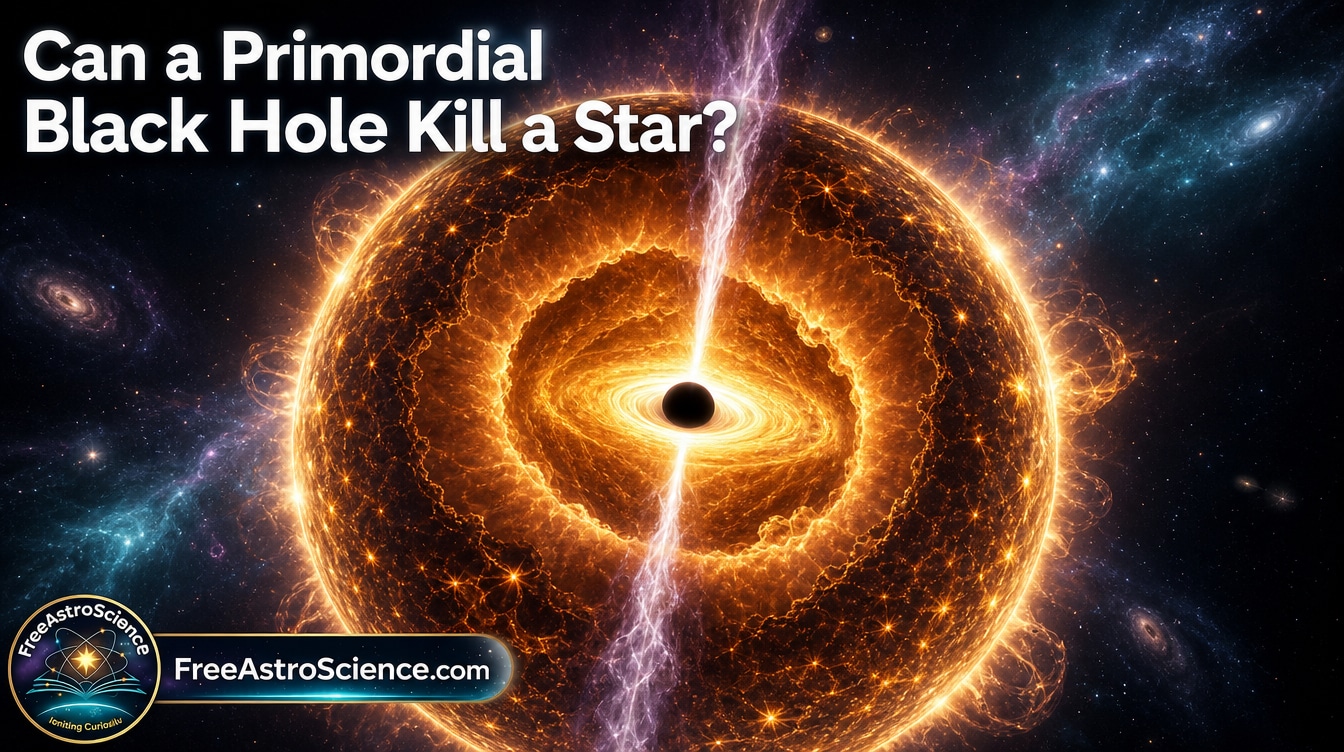
Have you ever wondered how something that gives off no light at all can still set a whole galaxy on fire?
That’s the riddle pulling us into today’s story, and it leads straight to a death scene roughly 26,000 light-years from Earth. Welcome, dear reader — we wrote this one for you at FreeAstroScience.com, where we turn knotted physics into plain, steady prose. Pour yourself something warm, get comfortable, and stay with us until the last paragraph. What you’ll learn about black holes, shredded stars, and a paper that just rewrote a 40-year-old theory — well, we think it’s worth the ride.
📖 On This Page
- The Great G2 Fizzle of 2014
- What Really Is a Tidal Disruption Event?
- Why Did the Old Theory Need 10 Billion Particles to Fall?
- What Did Kubli and His Team Actually See?
- How Does a Black Hole’s Spin Steal the Show?
- Which Telescopes Will Test This Story Next?
- Closing Thoughts
What Happens When a Black Hole Tears a Star Apart?
The Great G2 Fizzle of 2014 {#g2-fizzle}
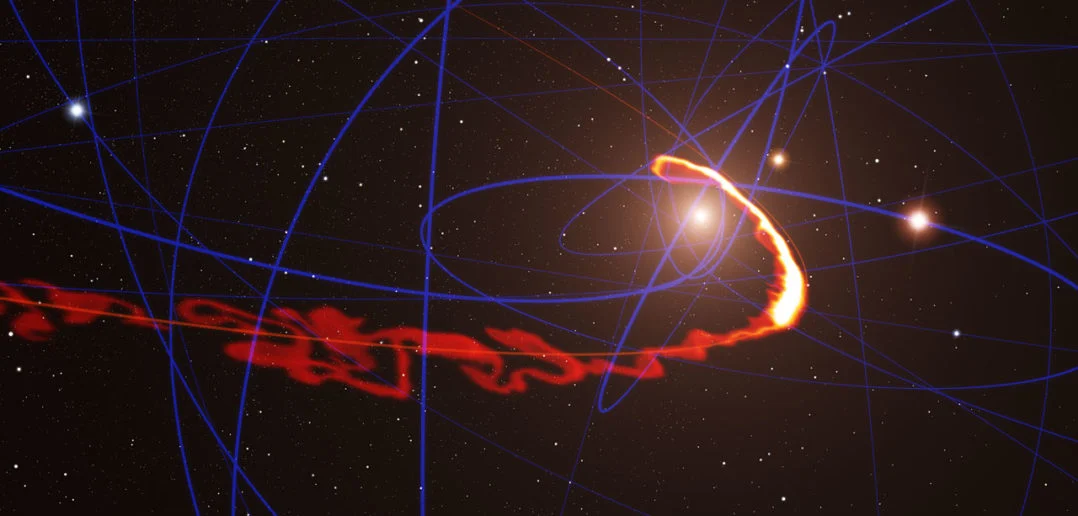
Back in 2014, every major observatory on Earth pointed at a small, dusty object called G2. Astronomers thought they were about to witness a cosmic bonfire. G2 was heading straight for Sagittarius A*, the four-million-solar-mass black hole squatting at the heart of our Milky Way.
The predictions were bold. G2 would be shredded. Sag A* would flare. Headlines would write themselves.
Then… nothing.
G2 slingshotted around the black hole, survived, and carried on its way. Later observations hinted it wasn’t a simple gas cloud at all — more likely a dusty protostellar object, perhaps even a pair of merged stars wrapped in their own cocoon of debris. A cosmic fizzle, as writer Carolyn Collins Petersen put it.
Yet that non-event left us with a haunting question: if G2 had been torn apart, what would we have seen, and why?
What Really Is a Tidal Disruption Event? {#what-is-tde}
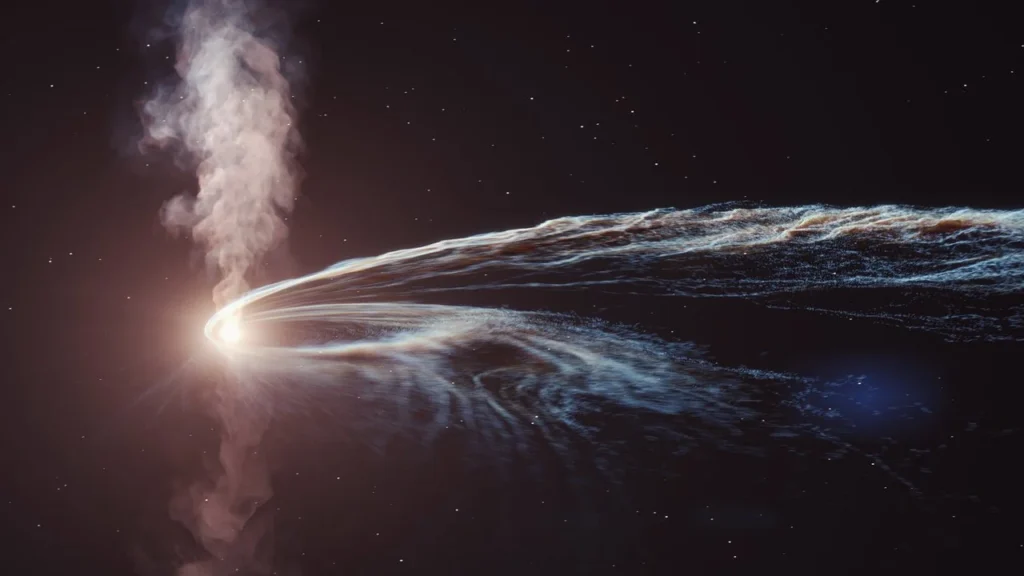
When a star strays too close to a supermassive black hole, gravity on the near side pulls harder than gravity on the far side. That difference — called a tidal force — stretches the star like taffy until it simply comes undone.
Astronomers call this grisly end a tidal disruption event, or TDE. The shredded star’s guts don’t fly off in every direction. Instead, the debris forms a long, thin stream that loops back toward the black hole. Half the material escapes into space. The other half begins to swirl around the drain, pile up into an accretion disk, and — under the right conditions — shine brighter than the entire host galaxy.
That’s the trick. A black hole emits no light of its own. The light comes from the star it’s eating.
The critical distance where the shredding begins is called the tidal radius. Here’s the formula, in plain sight:
Tidal radius — how close before a star tears apart:
rtidal = R★ × ( MBH / M★ )1/3
R★ is the star’s radius, MBH is the black hole’s mass, M★ is the star’s mass.
For a Sun-like star meeting a million-solar-mass black hole, that distance works out to about 100 solar radii. Closer than that, the star is doomed.
Why Did the Old Theory Need 10 Billion Particles to Fall? {#old-story}
For nearly four decades, two competing explanations tried to account for the flash of light we see in a TDE. Both sounded reasonable. Only one could be right.
Story A — The stream-stream collision (Rees, 1988). As the debris swings around the black hole, relativity twists its orbit. The incoming and outgoing arms eventually slam into each other. That violent crash heats the gas and makes it glow.
Story B — The “nozzle shock” (Kochanek, 1994 and later). As the stream squeezes through its closest approach to the black hole, it gets compressed vertically like dough through a pasta roller. That compression creates shocks, the shocks dissipate energy, and the gas lights up even before the streams collide.
For twenty years, Story B gained ground. Simulation after simulation showed the stream widening dramatically at pericenter — a sign that energy was being dumped as heat. Case closed, it seemed.
Except for one whisper that kept coming back: what if the widening wasn’t real? What if it was just numerical noise — the digital equivalent of a blurry photograph?
A few voices, including Bonnerot & Lu in 2022 and Huang and colleagues in 2024, pointed out that as researchers ran their simulations at higher resolution, the widening shrank. Maybe the “shock” was an artifact of our computers, not a feature of the universe.
Enter Noah Kubli and his collaborators.
What Did Kubli and His Team Actually See? {#new-story}
In March 2026, a paper landed in The Astrophysical Journal Letters that settled the argument. Noah Kubli (University of Zurich), Alessia Franchini (Milan), Eric R. Coughlin (Syracuse), Chris Nixon (Leeds), Sebastian Keller (CSCS), Pedro Capelo, and Lucio Mayer (both Zurich) ran the highest-resolution TDE simulation ever performed — up to 10 billion particles.
They used a brand-new code called SPH-EXA on the Grace Hopper GPUs of the ALPS supercomputer at the Swiss National Supercomputing Centre. SPH stands for smoothed-particle hydrodynamics — a method that treats a star as a huge swarm of tiny fluid parcels, each obeying the same equations that govern water flowing through a pipe. Scale it up to ten billion parcels, and you get a view of stellar guts so sharp it’s almost indecent.
Their setup was the textbook case: a Sun-like star (1 M☉, 1 R☉) falling toward a supermassive black hole of one million solar masses. The star takes about three hours to reach its closest pass. The bound debris starts returning around 19 days later. By day 26, the streams begin to collide.
Here’s what the team found, presented as a resolution-by-resolution story:
| Particles | Outgoing stream width | Energy dissipated at pericenter | Physical? |
|---|---|---|---|
| 1 million | Very wide, fan-like | Huge (overestimated) | No — numerical noise |
| 16 million | Still too wide | ~10⁻³ of kinetic energy | No |
| 128 million | Narrower, still spreading | ~10⁻⁴ | Partly |
| 512 million | Visibly tighter | ~3 × 10⁻⁵ | Closer |
| 10 billion | Incoming = outgoing | ~10⁻⁵ of kinetic energy | Yes — the real answer |
Look at that bottom row. At ten billion particles, the outgoing stream is just as thin as the one coming in. The energy dumped during the close pass is one hundred-thousandth of the gas’s kinetic energy — basically zero. The “nozzle shock” melts away when you look at it with enough resolution.
In the authors’ own words, the paradigm of significant dissipation at pericenter is incorrect. The widening streams that filled dozens of earlier papers? A by-product of simulations that simply weren’t sharp enough.
So Story A — the old Rees 1988 picture of cold streams crashing into each other — turns out to be correct after all. A theory from 1988, confirmed by GPUs that didn’t exist when it was written. Science sometimes moves sideways before it moves forward.
How Does a Black Hole’s Spin Steal the Show? {#spin}
Here’s where the story gets personal for every black hole.
The gravitational pull of the supermassive black hole is only half the tale. Its mass, its spin rate, and the tilt of its spin axis compared to the star’s orbital plane all shape what happens next. Spinning black holes drag spacetime itself around with them, producing a subtle wobble known as nodal precession.
If the precession is strong, the debris stream gets nudged sideways each time it passes the black hole. The two arms of the stream can miss each other entirely, or barely graze. The flare is dim, delayed, or absent. In some cases, the debris has to loop around several more times before the streams finally meet and ignite.
That single insight may solve one of astronomy’s stubborn puzzles: no two TDEs look alike. Some brighten in days, others take months. Some fade fast, others linger. Some behave so oddly that astronomers argue for years about what they even were.
The Kubli team’s simulations hint that spin is a major culprit behind the diversity. If the Rees picture is right — if stream collisions are what light the flare — then where and when those collisions happen depends sensitively on the spinning black hole at the center. Each TDE becomes a fingerprint of the black hole that caused it.
For us, the people watching from a small blue planet, that changes everything. TDEs stop being cosmic curiosities and become probes. Tools for measuring black holes we can’t see any other way.
Which Telescopes Will Test This Story Next? {#future}
Until recently, we caught maybe a few TDEs a year. That’s about to change dramatically.
The Vera C. Rubin Observatory in Chile began full science operations this year and will scan the entire southern sky every few nights. Astronomers expect it to find hundreds of TDEs per year — an enormous increase in data.
The Nancy Grace Roman Space Telescope will add infrared sensitivity, helping peer through the dust that hides events like our own Sagittarius A*, which sits behind thick clouds of gas and grit. X-ray missions and radio arrays round out the picture.
With so many events to compare, we’ll be able to check the new theory against reality. If the Kubli team is right, we should see TDE light curves cluster into families based on the spin and mass of the black holes that made them. If we don’t, the theory will need another revision — and that’s fine too. That’s how physics breathes.
As Eric Coughlin put it, we study tidal disruption events to learn about black holes hidden from view. Each shredded star is a flare in the dark that says: I’m here. Come look.
Closing Thoughts {#closing}
So — can a dying star really outshine its galaxy? Yes. For a few bright months, the last scream of a Sun-like star can drown out the collective glow of a hundred billion stellar siblings. The light comes not from the black hole itself but from the violent meeting of the star’s own scattered body parts, circling back for one final collision.
What we love about this story is how deeply human it feels. A theory proposed in 1988 looked beaten. Newer simulations seemed to have replaced it. Yet the real answer needed GPUs, ten billion particles, and a code called SPH-EXA running on a Swiss supercomputer before the original idea could come home vindicated. Science isn’t a straight line. It’s a spiral, and sometimes the spiral brings you back to where a clever mind stood forty years ago — only now you can prove it.
We wrote this piece for you at FreeAstroScience.com because we believe hard ideas deserve plain words, and curious minds deserve honest answers. We also believe something Francisco Goya hinted at on a cold night in Madrid two centuries ago: the sleep of reason breeds monsters. Never turn off your mind. Keep it restless. Keep it hungry. Keep asking how a black hole that emits no light can still light up the sky — and then keep asking what other stories the universe is waiting to tell you.
Come back and see us soon. There’s always another flare on the horizon, and we’d love to watch it with you.
📚 Sources & Further Reading
- Kubli, N., Franchini, A., Coughlin, E. R., Nixon, C. J., Keller, S., Capelo, P. R., & Mayer, L. (2026). Tidal Disruption Events with SPH-EXA: Resolving the Return of the Stream. The Astrophysical Journal Letters, 999:L40. https://doi.org/10.3847/2041-8213/ae4748
- Petersen, C. C. (2026, April 17). How a Black Hole and a Shredded Star Could Light Up a Galaxy. Universe Today. https://www.universetoday.com/
- Rees, M. J. (1988). Tidal disruption of stars by black holes of 106–108 solar masses in nearby galaxies. Nature, 333, 523.
- Bonnerot, C., & Lu, W. (2022). MNRAS, 511, 2147.
- Huang, X., Davis, S. W., & Jiang, Y.-f. (2024). ApJ, 974, 165.
- Ivezić, Ž., et al. (2019). LSST: From Science Drivers to Reference Design and Anticipated Data Products. ApJ, 873, 111.
Article written specifically for you by FreeAstroScience.com — where complex science meets plain language, and where we remind you never to let reason sleep.