What If Everything We Thought About Earth’s Birth Was Wrong?
Have you ever looked up at the night sky and wondered where you actually come from — not just biologically, but atomically? Every grain of rock beneath your feet, every drop of water in your glass, every breath you take — where did all that stuff originate?
Welcome to FreeAstroScience, where we break down the biggest discoveries in science so they make sense to everyone. Whether you’re a physics student, a curious stargazer, or someone who just loves a good cosmic mystery, this one’s for you.
A brand-new study published in Nature Astronomy in April 2026 has shaken the foundations of planetary science. According to researchers Paolo Sossi and Dan Bower at ETH Zürich, Earth may have formed entirely from material in the inner Solar System — with little to nothing arriving from the cold, distant reaches beyond Jupiter . That’s a dramatic departure from what many scientists believed for years.
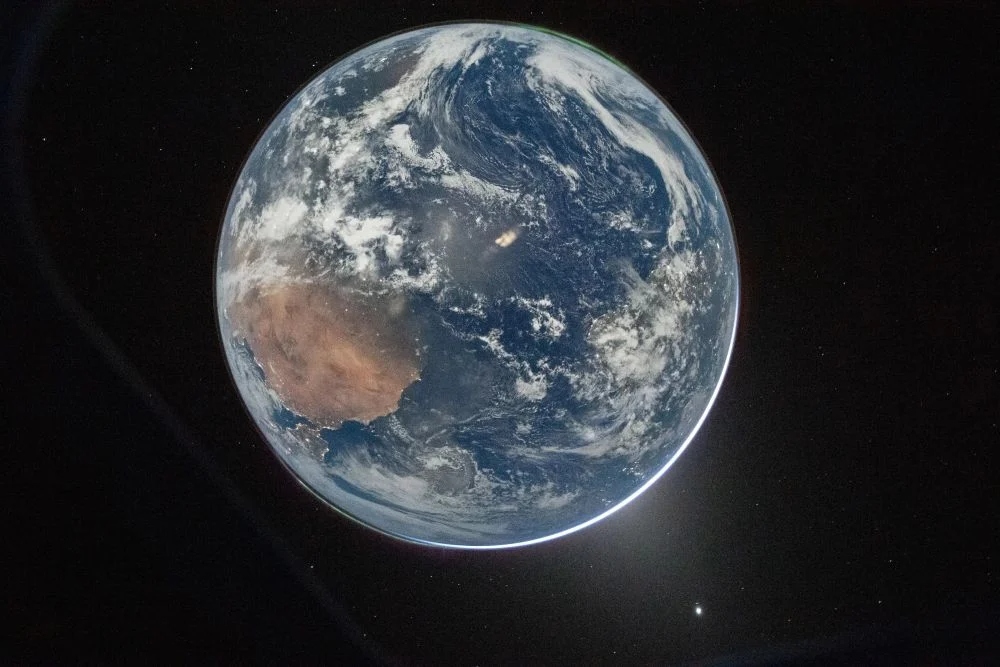
Earth as imaged by Artemis II Commander Reid Wiseman. There are many questions about how Earth formed, where the material originated, and how it got its water. A new study of isotopic compositions among meteorites and asteroids shows that Earth may have formed entirely from inner Solar System material. Image Credit: NASA/Reid Wiseman
Stay with us. By the time you reach the end, you’ll see our home planet — and maybe yourself — in a whole new light.
📑 Table of Contents
- 1. Why Do Meteorites Hold the Key to Earth’s Past?
- 2. What Is the NC–CC Dichotomy?
- 3. How Did Ten Isotope Systems Change Everything?
- 4. Did Jupiter Act as a Cosmic Gatekeeper?
- 5. So Where Did Earth’s Water Come From?
- 6. What Does the Math Actually Look Like?
- 7. What Can This Tell Us About Mercury and Venus?
- 8. Why Does This Discovery Matter to All of Us?
1. Why Do Meteorites Hold the Key to Earth’s Past?
We can’t rewind 4.5 billion years and watch Earth being born. No camera existed. No satellite orbited the young Sun. But nature left us clues — and they come hurtling through the atmosphere as meteorites.
Since the vast majority of meteorites originate from asteroids, studying them is like reading pages from a very, very old diary . Asteroids and meteorites are the leftover debris from the time when the rocky planets — Mercury, Venus, Earth, and Mars — pulled themselves together from a swirling disk of gas and dust.
Here’s what scientists have long debated: How much of Earth came from the inner Solar System, and how much drifted in from the cold outer regions beyond Jupiter?
Previous estimates ranged wildly. Some models suggested only about 6% of Earth’s mass arrived from the outer Solar System. Others pushed that figure as high as 40% . That spread isn’t a minor disagreement. It’s the difference between two very different stories about how our planet was born.
The answer, it turns out, might be far simpler — and far more surprising — than anyone expected.
2. What Is the NC–CC Dichotomy?
To understand this new research, we need to talk about one of the most important discoveries in modern cosmochemistry: the isotopic dichotomy between two families of meteorites .
What Are Isotopes, Exactly?
Think of isotopes as siblings in the same family. They share the same number of protons (that’s what makes them the same element), but they carry different numbers of neutrons. Oxygen, for example, has three stable isotopes: ¹⁶O, ¹⁷O, and ¹⁸O .
By measuring the ratios of these isotopes in different rocks, scientists can trace which rocks share a common birthplace — kind of like a cosmic DNA test.
Two Populations, Two Birthplaces
Around 15 years ago, researchers discovered something remarkable. Meteorites fall neatly into two groups based on their isotopic fingerprints :
- Non-carbonaceous (NC) meteorites — these likely formed in the inner Solar System, closer to the Sun.
- Carbonaceous (CC) meteorites — these probably formed in the outer Solar System, beyond Jupiter, and tend to carry more water.
This NC–CC split, first spotted in chromium (ε⁵⁴Cr) and titanium (ε⁵⁰Ti) isotopes, was later confirmed in heavier elements like molybdenum, zirconium, and ruthenium . The dichotomy has become one of the guiding principles in understanding how our Solar System organized itself in those chaotic first few million years.
The big question was always: Where does Earth fit on this map?
3. How Did Ten Isotope Systems Change Everything?
This is where the new study — titled “Homogeneous accretion of the Earth in the inner Solar System” — rewrites the playbook .
The Problem With Past Studies
Earlier work typically relied on just one or two isotopic systems at a time to figure out Earth’s origins. That’s like trying to identify someone from a single fingerprint when you could use ten . Different isotope pairs sometimes pointed in different directions, leaving Earth’s provenance — as the researchers put it — “equivocal” .
The Power of Ten
Sossi and Bower gathered data on ten nucleosynthetic isotope anomalies across meteorites and planets:
| Isotope Ratio | Element | Geochemical Type | Nucleosynthetic Group |
|---|---|---|---|
| ε48Ca | Calcium | Lithophile | Iron-peak |
| ε50Ti | Titanium | Lithophile | Iron-peak |
| ε54Cr | Chromium | Lithophile | Iron-peak |
| ε54Fe | Iron | Siderophile | Iron-peak |
| ε64Ni | Nickel | Siderophile | Iron-peak |
| ε66Zn | Zinc | Lithophile | Iron-peak |
| ε96Zr | Zirconium | Lithophile | Heavy |
| ε94Mo | Molybdenum | Siderophile | Heavy |
| ε95Mo | Molybdenum | Siderophile | Heavy |
| ε100Ru | Ruthenium | Siderophile | Heavy |
Source: Sossi & Bower, Nature Astronomy (2026)
They fed all this data into a technique called Bayesian Latent Factor Analysis (B-LFA), combined with Principal Component Analysis (PCA) — statistical tools rarely used in geochemistry but enormously powerful for pattern recognition .
The Stunning Result
When they plotted every meteorite group and planet across these ten isotopic dimensions, a clear picture appeared. The line defined by non-carbonaceous inner Solar System bodies — ordinary chondrites and enstatite chondrites — always extended straight through Earth’s measured isotopic composition, within one standard deviation .
No detour through CI chondrites. No mix of outer Solar System material needed.
As Sossi put it in a press release: “Our calculations make it clear: the building material of the Earth originates from a single material reservoir” .
Co-author Dan Bower added: “We were truly astonished to find that the Earth is composed entirely of material from the inner Solar System distinct from any combination of existing meteorites” .
And here’s another twist: Earth’s isotopic composition doesn’t match any known chondrite. Our planet is an endmember — sitting at one extreme of the non-carbonaceous family tree, not in the middle . Earth isn’t a blend. It’s its own thing.
4. Did Jupiter Act as a Cosmic Gatekeeper?
If outer Solar System material barely reached Earth, something must have kept it out. The prime suspect? Jupiter.
The gas giant grew massive very early in the Solar System’s history — within the first few million years . As it ballooned in size, it carved a deep gap in the protoplanetary disk, the spinning ring of gas and dust from which all the planets formed.
Think of it this way: imagine a wide, fast-moving river with a dam in the middle. Material on one side can’t easily cross to the other. Jupiter’s gap worked the same way, keeping carbonaceous, water-rich pebbles from drifting sunward into the inner Solar System .
Scientists already knew about this “Jupiter barrier.” But they weren’t sure how effective it really was. This new study suggests the answer is: extremely effective. The outer Solar System may have contributed less than 2% of Earth’s bulk composition — and quite possibly 0% .
The maximum permissible mass fraction of CI chondrite material (a proxy for outer Solar System contribution) in Earth’s silicate mantle is constrained to less than about 0.3% by ruthenium isotopes and less than 2% by calcium isotopes . Those numbers are dramatically lower than any previous estimate.
5. So Where Did Earth’s Water Come From?
This is the question that keeps planetary scientists up at night — and the one you’re probably asking right now.
For decades, a popular hypothesis said that comets and icy bodies from the outer Solar System delivered water to Earth during the late stages of its formation . It’s a beautiful story: icy wanderers plunging sunward, slamming into the young Earth, leaving behind the oceans we swim in today.
But if the outer Solar System contributed almost nothing to Earth’s mass, that story runs into trouble.
The Alternative: Water Was Always Here
The other broad hypothesis says that water was produced internally. Chemical reactions between hydrogen and oxygen in Earth’s early mantle could have generated water without any cosmic delivery service .
The new results from Sossi and Bower lean heavily toward this second idea. If Earth is built almost entirely from inner Solar System non-carbonaceous rock, then the water we drink, the rain that falls, the oceans that cover 71% of our planet’s surface — all of it may have been here from the start, locked inside the very minerals that built our world .
That said, a tiny amount of carbonaceous material — as little as 0.1% of the bulk silicate Earth — would be enough to deliver Earth’s entire budget of nitrogen, carbon, and hydrogen . So the door isn’t completely shut. A whisper of outer Solar System material may have slipped through Jupiter’s blockade, and that whisper may have carried life’s essential volatile elements.
The truth is, this debate isn’t settled. And Sossi himself acknowledged it: “The scientific discourse over the building blocks of Earth is far from over, despite the new findings” .
We love that honesty. Science doesn’t pretend to have all the answers. It has the best questions.
6. What Does the Math Actually Look Like?
For those of you who appreciate the numbers behind the narrative, let’s take a peek under the hood. Don’t worry — we’ll walk through this together.
The Isotope Anomaly Notation
Scientists express isotopic differences using a quantity called epsilon (ε), measured in parts per ten thousand :
Isotope Anomaly Definition
εiX = ( iX / jX )reservoir ( iX / jX )standard − 1 × 10,000
Where i and j are the isotopic masses, and X is the element. A positive ε means the reservoir is enriched in isotope i relative to the standard; a negative ε means it’s depleted.
The Signed Euclidean Distance
To compare how “far apart” different planetary bodies sit in isotopic space, Sossi and Bower used a signed Euclidean distance across latent factor dimensions :
Signed Euclidean Distance
dsA−B = √[ (LF1A − LF1B)² + (LF2A − LF2B)² ]
The sign is determined by the cross product of a reference axis pointing away from body B and the vector from B to A. This lets us place bodies on a positive–negative scale, not just measure absolute distance.
They then defined a dimensionless ratio R that compares any body’s distance from the BSE (Bulk Silicate Earth) against a fixed reference :
Isotopic Euclidean Distance Ratio
RA = dsA−B dsC−B
With B = BSE (so RBSE = 0) and C = OC (so ROC = 1), the ratio for enstatite chondrites yields a constant: REC = 0.43 ± 0.10 across all isotopic systems. That consistency is remarkable.
Why Does This Matter?
Here’s the punchline. When the enstatite chondrite distance ratio stays at 0.43 ± 0.10 no matter which isotope you use — iron-peak elements, heavy elements, siderophile or lithophile — it means the arrangement of Solar System bodies along this isotopic axis is real, not an artifact of cherry-picking one or two elements .
The math is telling us: Earth belongs firmly within the inner Solar System family, and its composition didn’t change over the course of accretion.
| Body | RA | Semimajor Axis (AU) |
|---|---|---|
| Earth (BSE) | 0 | 1.00 |
| Mars | 0.69 ± 0.07 | 1.52 |
| Vesta | 1.55 ± 0.07 | 2.36 |
| Venus (predicted) | −1.05+0.01−0.00 | 0.72 |
| Mercury (predicted) | −1.78 ± 0.07 | 0.39 |
Data: Sossi & Bower (2026)
Notice the pattern? The farther a body sits from the Sun, the larger its R value. That’s not a coincidence. It’s a spatial or temporal gradient baked into the very formation of the inner Solar System .
7. What Can This Tell Us About Mercury and Venus?
Here’s where the study gets genuinely bold. We don’t have rock samples from Mercury or Venus — no rover has scooped up their soil, no sample-return capsule has brought us a piece. But Sossi and Bower used the patterns they discovered to predict what those planets should look like isotopically .
Their reasoning goes like this. The mass distribution of the terrestrial planets follows a rough Gaussian curve centered around 0.9 AU from the Sun. Earth and Venus account for the bulk of that mass. The peripheral bodies — Mercury, Mars, and Vesta — sit in the tails of the distribution, sampling more extreme compositions .
Using a mass-conserving Gaussian model, the researchers predicted:
- Venus should have an isotopic Euclidean distance of R = −1.05, placing it beyond Earth along the NC trend.
- Mercury should sit even farther out, at R = −1.78 .
In plain terms: Mercury and Venus should have even more extreme isotopic compositions than Earth . They’re predicted to be even more “non-carbonaceous” than our planet.
“Based on our analysis, we can theoretically predict the composition of these two planets,” Sossi said .
The only way to confirm this? Sample return missions to the inner planets. The researchers explicitly call for them. And honestly, after reading this paper, so do we.
8. Why Does This Discovery Matter to All of Us?
You might be thinking: Okay, isotopes and meteorites are cool, but why should I care?
Fair question. Let us give you three reasons.
We’re Made of Local Stuff
If these findings hold up, then everything on Earth — every mountain, every ocean, every organism, you — was assembled from material that formed in our cosmic neighborhood, within a few astronomical units of the Sun. We aren’t a patchwork of imports from distant corners of the Solar System. We’re homegrown.
There’s something profoundly grounding about that. In a universe that often feels incomprehensibly vast, knowing that our building blocks are local makes Earth feel a little less random and a little more like it belongs exactly where it is.
It Changes How We Think About Exoplanets
If Earth formed this way, do rocky exoplanets in other star systems follow a similar pattern? Do they, too, form from material local to their orbital zone, blocked from mixing with outer-disk material by their own gas giants? These are the questions Sossi and Bower want to explore next .
The answers could reshape how we search for habitable worlds.
The Method Is a Game-Changer
The statistical approach used here — Bayesian Latent Factor Analysis applied to geochemistry — is itself a breakthrough. “Our studies are actually data science experiments,” Sossi said. “We carried out statistical calculations that are rarely used in geochemistry, even though they are a powerful tool” .
That kind of cross-disciplinary thinking — borrowing tools from machine learning and applying them to planetary science — is exactly how breakthroughs happen.
A Few Things We Still Don’t Know
Let’s be honest about the open questions. Good science doesn’t just answer — it also asks:
- If water wasn’t delivered from the outer Solar System, exactly how did Earth generate enough of it internally? The chemical pathways in the early mantle are still being worked out.
- Could small amounts of carbonaceous material — less than 0.1% — still have delivered life-essential elements like nitrogen and carbon? The math says yes, it’s possible .
- Are the predictions for Mercury and Venus correct? We won’t know until we bring back samples. That could take decades.
- Does this “homogeneous accretion” model apply to rocky planets around other stars? That’s the billion-dollar question.
And as Sossi and Bower themselves wrote: these results don’t end the debate. Science is incremental. But this study — with its ten isotopic systems, its Bayesian statistics, and its dramatic conclusions — might be one of the most important steps forward in understanding Earth’s birth that we’ve seen in years .
Conclusion: We’re Children of the Inner Solar System
Let’s step back and take in the full picture.
For years, the story of Earth’s formation was a tale of mixing — a cocktail of inner and outer Solar System ingredients, shaken together by comets, asteroids, and the gravitational chaos of giant planets. That story was elegant, and parts of it may still be true in small measure.
But this new research, published in April 2026 by Paolo Sossi and Dan Bower in Nature Astronomy, tells a simpler and, in many ways, more beautiful story: Earth formed from a single reservoir of inner Solar System material . The outer Solar System — that vast, cold region beyond Jupiter’s orbit — may have contributed essentially nothing to our planet’s bulk composition.
Jupiter, it seems, stood guard. A cosmic gatekeeper that kept the inner and outer Solar Systems apart during the most critical window of planet formation .
And our water? It may have been here all along, born from chemical reactions deep inside the young Earth, rather than delivered by icy comets from afar.
These are not small claims. They reshape how we think about planetary formation, about the origin of water, and about what makes Earth Earth.
Here at FreeAstroScience.com, we believe that complex scientific ideas should never be locked behind jargon and paywalls. We explain them in simple terms because we believe in something Francisco Goya warned us about centuries ago: the sleep of reason breeds monsters. Never turn off your mind. Keep it active. Keep asking questions. Keep looking up.
Come back to FreeAstroScience.com whenever your curiosity calls. We’ll be here, translating the universe into words that make sense — one discovery at a time.
📚 References & Sources
- Gough, E. (2026). “The Outer Solar System Contributed Nothing To Earth.” Universe Today, April 7, 2026. universetoday.com
- Sossi, P. A. & Bower, D. J. (2026). “Homogeneous accretion of the Earth in the inner Solar System.” Nature Astronomy. doi.org/10.1038/s41550-026-02824-7
- Warren, P. H. (2011). “Stable-isotopic anomalies and the accretionary assemblage of the Earth and Mars.” Earth Planet. Sci. Lett. 311, 93–100.
- Burkhardt, C. et al. (2021). “Terrestrial planet formation from lost inner solar system material.” Sci. Adv. 7, eabj7601.
- Piani, L. et al. (2020). “Earth’s water may have been inherited from material similar to enstatite chondrite meteorites.” Science 369, 1110–1113.
- Broadley, M. W. et al. (2022). “Origin of life-forming volatile elements in the inner Solar System.” Nature 611, 245–255.
Written with scientific rigor and human warmth by Gerd Dani, President of Free AstroScience – Science and Cultural Group. Because the universe is too extraordinary to keep to ourselves.