How Do Solar Prominences Stay Alive Inside a Million-Degree Furnace?
What if we told you there’s a mountain range bigger than Earth, floating above the Sun, made of cool gas that refuses to melt inside a million-degree oven? Sounds absurd, right? Welcome, dear reader. We’re glad you’re here with us at FreeAstroScience.com, where we break down the hardest science into words you can actually use. Stay with us to the very end of this article, because what solar physicists just figured out in April 2026 changes how we’ll forecast the next big solar storm heading toward your phone, your power grid, and your satellites.
📑 Table of Contents
- What exactly is a solar prominence?
- Why do physicists call them “impossible”?
- What did the Max Planck team actually discover?
- Which two engines keep a prominence alive?
- How cold is “cold” on the Sun?
- Why should you care about this on Earth?
- Conclusion
What exactly is a solar prominence?
Picture a flame the size of a continent, frozen in slow motion, hanging above the Sun for weeks. That’s a prominence. Technically, it’s a cloud of cool plasma, around 10,000 °C, suspended inside the Sun’s corona, where temperatures soar past one million degrees.
Some prominences stretch a few thousand kilometers. Others reach hundreds of thousands, dwarfing anything in our Solar System. And here’s the kicker: their density is more than 100 times greater than the surrounding corona . Imagine a mountain of matter dangling in mid-air. That’s not a metaphor. That’s the physics.
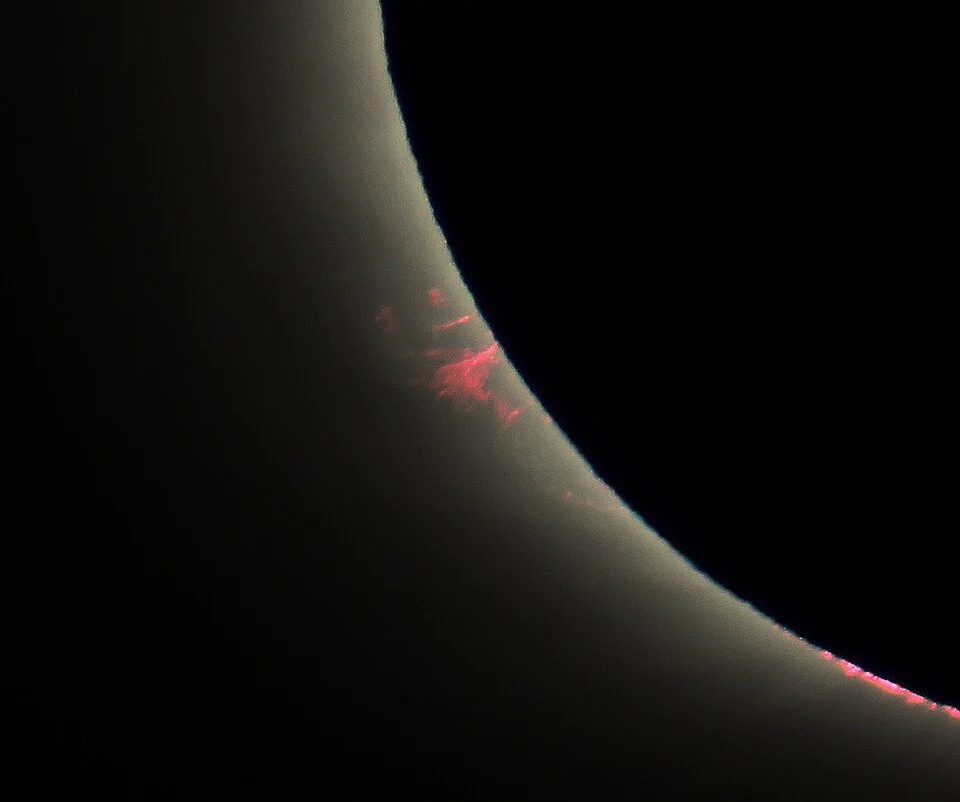
Solar prominence seen in true colour during totality of a solar eclipse (Credit : ESA/CESAR)
Why do physicists call them “impossible”?
Cool, dense gas inside a furnace should either fall back down or evaporate. Prominences do neither. They just sit there. For weeks. Sometimes months.
The trick is the Sun’s magnetic field. Magnetic loops arch out of the surface and form little dips, kind of like the two humps on a dromedary. Cool plasma pools inside that dip and gets trapped. Think of an iceberg floating inside a pizza oven, refusing to melt. That image isn’t far from the truth.
But here’s the puzzle that bugged scientists for decades: a prominence constantly loses material. Some of its plasma “rains” back down into the lower Sun. So how does it keep going for weeks without drying up?
What did the Max Planck team actually discover?
On April 22, 2026, a paper landed in Nature Astronomy from the Max Planck Institute for Solar System Research (MPS) in Germany . The first author, Lisa-Marie Zeßner-Ondratschek, led simulations that did something nobody had done before: they modeled not just the Sun’s atmosphere, but also the churning layers below its visible surface .
Why does that matter? Because those deeper, turbulent layers are where the Sun’s magnetic field is actually born. Ignoring them is like studying a river without ever looking at the spring that feeds it.
The team focused on smaller prominences, the ones reaching “only” about 20,000 km into the corona. They assumed a magnetic architecture shaped like two arches side by side, with a gentle dip between them. The prominence settles in that dip and stays put .
Which two engines keep a prominence alive?
The simulations revealed a beautiful, messy balancing act. Two very different mechanisms work together:
- Injection from below: Turbulent magnetic movements in the chromosphere fire bursts of cool plasma upward. These blobs get trapped in the magnetic dip .
- Condensation from above: Hot coronal plasma flows along the magnetic arches, cools down, and condenses into the dip, like dew forming on a leaf.
Some plasma always rains back down. But the two processes keep refilling the tank faster than it drains. Mark Thompson put it beautifully: “Like a waterfall that is always falling but never runs dry” .
Earlier models only saw the condensation part, because they ignored everything below the surface . That’s why this new work closes a real gap in our knowledge.
How cold is “cold” on the Sun?
Let’s put those numbers somewhere you can actually see them:
| Solar Layer | Typical Temperature | Role in Prominences |
|---|---|---|
| Solar surface (photosphere) | ~6,000 °C | Anchors the magnetic field lines |
| Chromosphere (lower atmosphere) | up to 20,000 °C | Launches plasma bursts upward |
| Prominence body | ~10,000 °C | The cool plasma trapped in the magnetic dip |
| Corona (outer atmosphere) | > 1,000,000 °C | Feeds condensation from above |
Look at that gap. The prominence is 100 times cooler than the gas right next to it. The density ratio runs in the other direction: the prominence is more than 100 times denser than that same surrounding corona
A simple formula for the density contrast
// Density contrast (approximate)
ρprominence / ρcorona ≳ 100
// Temperature contrast
Tcorona / Tprominence ≈ 106 / 104 = 100
Why should you care about this on Earth?
Here’s where it gets personal. Prominences don’t always fade quietly. Sometimes they erupt, throwing billions of tonnes of charged particles into space . When that cloud slams into Earth’s magnetic shield, we get two flavors of consequence:
- The beautiful kind: auroras lighting up the sky at latitudes where they rarely appear.
- The costly kind: fried satellites, scrambled GPS, disrupted power grids, and grounded flights .
Sami K. Solanki, director of the “Sun and Heliosphere” department at MPS, said it plainly: “To protect Earth’s infrastructure in time, reliable forecasts of dangerous space weather are needed. A deeper understanding of prominences is a crucial piece of the puzzle” .
In other words, every power company, airline, and satellite operator on the planet has a stake in what Zeßner-Ondratschek just modeled on a supercomputer.
Conclusion
So what did we learn together today? That the Sun builds continent-sized mountains of cool plasma inside a million-degree atmosphere, and keeps them alive by juggling two refueling systems at once, one from below, one from above. Scientists at the Max Planck Institute just pulled back the curtain on how this juggling act really works, and they did it by finally looking beneath the Sun’s skin instead of only at its surface.
Beyond the beauty of the discovery, there’s a practical thread: the better we understand these fragile giants, the better we’ll predict the solar storms that could one day knock out the systems we depend on every day. That’s science doing what science does best, turning wonder into protection.
This article was written specifically for you by FreeAstroScience.com, where we take complex scientific principles and explain them in simple terms. Our mission is to keep you from ever switching off your mind, because as Goya warned us, the sleep of reason breeds monsters. Come back soon. Your curiosity has a home here, and there’s always more sky to look up at.
— Gerd Dani, President of Free AstroScience
📚 References & Sources
- Zeßner-Ondratschek, L.-M. et al. (2026). Self-consistent numerical simulations for the formation and dynamics of solar prominences. Nature Astronomy, published 22 April 2026. Max Planck Institute for Solar System Research (MPS)
- Thompson, M. (2026). The Sun’s Impossible Floating Mountains. Universe Today, 28 April 2026. universetoday.com