The Day the Sky Cracked Open Over Siberia
What if we told you that just over a century ago, something hit our planet with the force of a thousand Hiroshima bombs, and nobody can say for certain what it was?
Welcome, dear reader. We’re glad you’re here. This story begins in a boggy Siberian forest at breakfast time on June 30, 1908, and it still refuses to end. Stay with us to the final line. By the time you finish, you’ll see the sky differently, and you’ll understand why Earth keeps holding its breath.
What happened on that June morning in 1908?
Picture a quiet taiga. Just insects, larch trees, wind. Then, at 7:14 a.m. local time, a farmer named Semen Semenov, sitting outside the Vanavara Trading Post, saw “the sky split in two”. Fire ran high and wide over the forest. Heat punched his face. A thump followed, cannons roared through the air, and the earth shook.
Semenov sat 65 kilometers (40 miles) from ground zero. That’s closer to Manhattan than Philadelphia is, and he still got thrown off his bench.
The numbers are hard to hold in one hand:
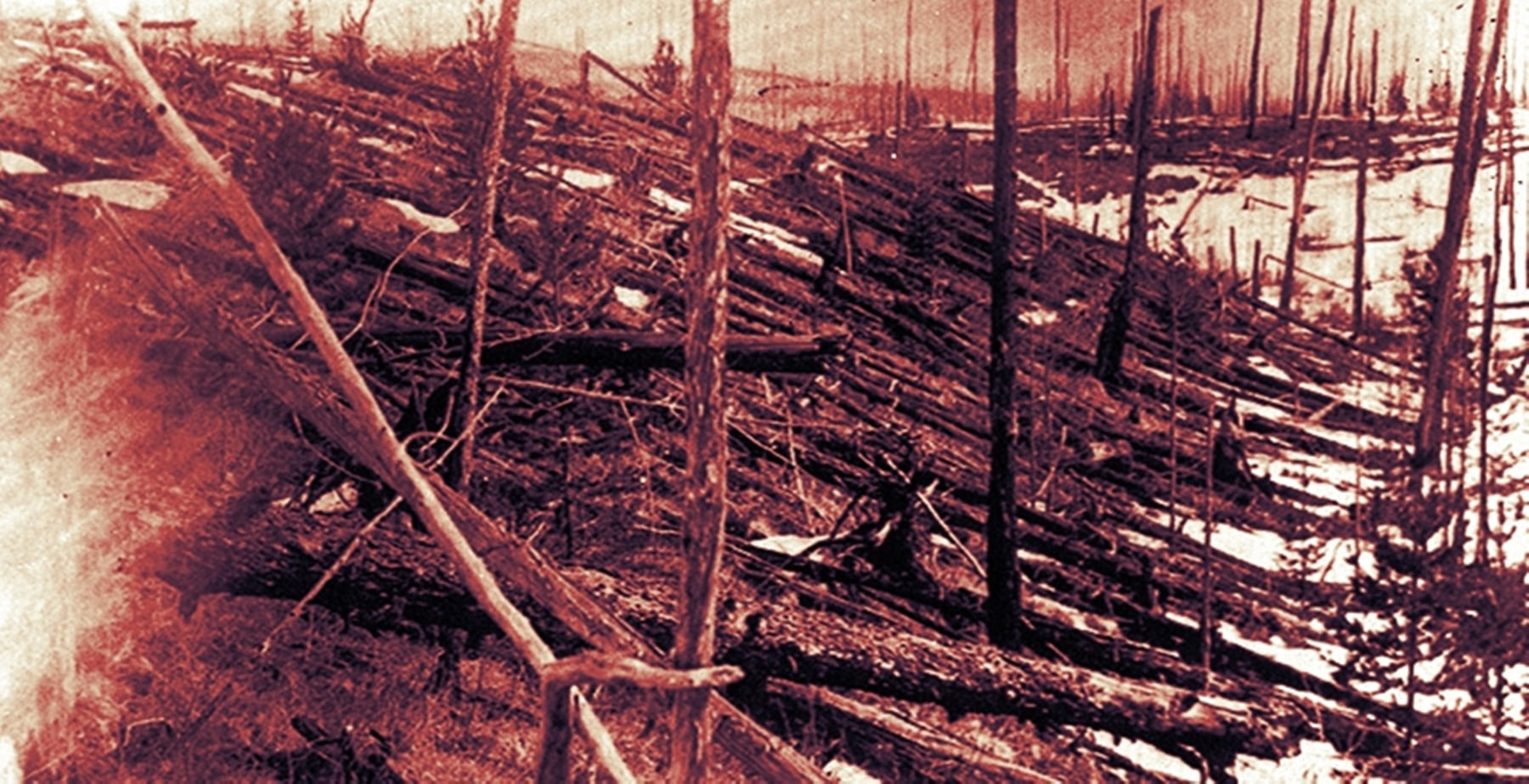
Roughly 80 million trees came down across more than 2,000 square kilometers. Windows shattered hundreds of miles away. Seismic stations across Europe twitched. For nights afterward, the sky over Europe glowed so brightly people could read their newspapers at midnight without a lamp.
And the crater? There wasn’t one. That small detail is what turned a catastrophe into a century-long head-scratcher.
Who was Leonid Kulik and what did he find?
Here’s the strange part. For almost two decades, nobody went to look. The Russian Empire fell. The Soviets rose. Civil war raged. A forest in central Siberia, far from railways and newspapers, waited.
Then in 1927, a meteorite specialist from the Russian Academy of Sciences, Leonid Kulik, finally arrived and led the first Soviet research expedition to investigate. He expected a crater. He expected chunks of iron.
He got neither.
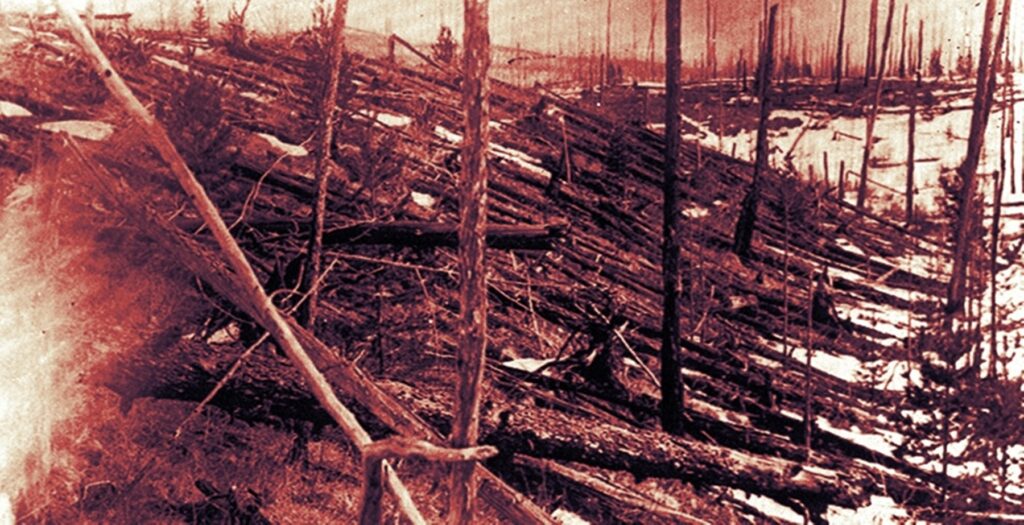
What he saw instead made his jaw drop. Millions of trees lay flat in a butterfly-shaped pattern covering more than 2,000 square kilometers. Trunks pointed outward from a central spot like spokes on a wheel. At ground zero, a weird stand of trees still stood upright, stripped of their branches. Researchers later called them “telegraph poles.”
Imagine the feeling. You hike through swamp and mosquito clouds, expecting a big rock, and you get nothing you can pick up. Kulik led several expeditions in the 1920s and 1930s. No crater. No iron. Just a wound in the forest that wouldn’t speak its name.
What are the leading theories?
The empty hands of Kulik’s team opened a door wide enough for every kind of idea to walk through. Let’s sort them.
Was it a stony asteroid airburst?
This is the front-runner, and it’s held the top spot for decades. A stony asteroid, roughly the size of a 25-story building, came screaming in at about 33,500 miles per hour. Air resistance compressed it. Heat and pressure built. Somewhere between 3 and 6 miles up, it blew apart in mid-air.
No impact, no crater. Just a downward column of superheated gas flattening everything beneath.
Researchers at NASA Ames and Sandia National Laboratories ran models that matched the flattened-forest pattern, showing the falling body became an expanding jet of high-temperature gas moving at supersonic speeds, driving energy downward. Still sobering. The Hiroshima bomb was 15 kilotons. Tunguska was at least 200 times stronger.
Could it have been a comet?
For years, some scientists leaned this way. A comet is mostly ice and dust. Hit the atmosphere hard enough and it vaporizes completely. No meteorite fragments, no crater, and lots of dust tossed high into the sky, which would explain those glowing nights over Europe.
Poetic? Absolutely. Destruction by stardust. The trouble is that comets travel on long, looping orbits, arrive faster, and hit Earth much less often than asteroids do. If Tunguska was a comet, it would be a one-off event.
What about methane gas from below?
Some researchers proposed that swamp gas, maybe sparked by lightning, blew up. Siberia sits on enormous methane reserves. Plausible at first glance.
The problem is simple. Witnesses saw a fireball streaking across the sky before the blast. Gas from underground doesn’t produce that. It also doesn’t produce the radial tree-fall pattern pointing outward from a single aerial point. Volcanic and mining-style explanations were ruled out early for lack of physical evidence.
Black holes, antimatter, and aliens?
This is where things get fun. In the 1970s, some physicists suggested a tiny black hole had passed straight through Earth. Others floated antimatter — a bit of the universe’s mirror-twin meeting regular matter and annihilating.
Both ideas have a small problem: evidence. A black hole should have left an exit wound on the other side of the planet. It didn’t. Antimatter would have left huge radiation traces. It didn’t.
And then, in 1946, the science-fiction writer Alexander Kazantsev published a story suggesting an alien spacecraft had exploded over Siberia. The idea caught fire in popular culture and still shows up in TV, film, and comics. Wonderful fiction. Thin on evidence.
Did scientists finally crack the case in 2013?
Here’s where the story turns. In 2013, a team of Ukrainian, German, and American researchers published work that changed the conversation.
Victor Kvasnytsya of the National Academy of Sciences of Ukraine and his colleagues studied microscopic fragments pulled from a layer of partially decayed peat that dates to the summer of 1908. Using modern imaging and spectroscopy, they found tiny aggregates of carbon minerals — diamond, lonsdaleite, and graphite.
Lonsdaleite matters. It forms when carbon-rich material gets hit with a sudden shock wave, the kind produced when a meteorite slams into Earth. Inside those lonsdaleite specks, the team found even smaller grains of troilite and taenite — iron sulfides and iron-nickel alloys that are signature minerals of space rocks.
Translation: a meteorite did cause Tunguska. It tore apart on a low-angle entry, so almost nothing big reached the ground intact. What survived became microscopic specks, fossilized in the peat for a century.
The mystery isn’t fully gone. But a big piece clicked into place.
How did Chelyabinsk help us read Tunguska?
On February 15, 2013 — the same year as the Kvasnytsya paper — a fireball lit up the sky over Chelyabinsk, Russia, about 1,500 miles west of Tunguska. Dashboard cameras caught every second. CCTV networks gave fixed reference points. Scientists finally had a Tunguska-class event on video.
The Chelyabinsk object was a stony asteroid about the size of a five-story building. It broke apart roughly 15 miles up, releasing the energy of a 500-kiloton blast — around 30 times the Hiroshima bomb. The shockwave blew out about a million windows and injured more than 1,000 people, most of them hit by flying glass after the flash drew them to the window.
Think of Chelyabinsk as a smaller sibling of Tunguska, caught on camera. Researchers fed the footage into modern models and rebuilt the Tunguska event with fresh confidence [[10]].
Are we ready for the next one?
Here’s the math we don’t love thinking about. Researchers estimate that a Tunguska-sized impact happens somewhere on Earth roughly every 200 to 1,000 years. Chelyabinsk-scale events land every 10 to 100 years on average [[10]].
In 1908, a vast section of Siberia was nearly empty. Reindeer died. A handful of people may have perished. Had that same object detonated over New York, Tokyo, London, or Mumbai, the entire city center would be gone.
We got lucky. Luck is not a defense strategy.
That’s why NASA’s Planetary Defense Coordination Office exists, and why astronomers around the world now watch for near-Earth objects (NEOs) as a full-time job. In 2022, NASA’s DART spacecraft smashed into the small asteroid moon Dimorphos and measurably shifted its orbit — the first time humans nudged another world on purpose. The European Space Agency’s Hera mission, launched on October 7, 2024, is headed to the same system and should arrive in late December 2026 to study what DART did.
The kinetic energy of an incoming asteroid follows E = ½mv². Double the speed and the punch quadruples. A 60-meter stony body at 54,000 km/h carries roughly the energy of a 4-megaton bomb. Mass matters. Speed matters more.
What lingers when the dust settles?
We wrote this article for you, right here at FreeAstroScience.com, where we take hard science and turn it into plain language anyone can follow. Our goal is simple. We don’t ever want you to turn off your mind. Keep it awake. Keep it asking. The sleep of reason breeds monsters, and the best defense against those monsters is a reader who refuses to stop thinking.
Tunguska teaches us three things worth carrying home. First, our planet is not sealed off from the cosmos. The sky can open without warning, as it did at 7:14 a.m. on a June morning in Siberia. Second, science moves slowly, sometimes painfully so — close to two decades before the first expedition, 105 years before microscopic lonsdaleite grains gave us the closest thing to a confession. Third, we are no longer passive. DART proved we can push back.
So the next time you stand under a clear night sky, remember the Evenki people who saw the pillar of fire, Leonid Kulik wading through bogs, and the scientists still reading peat cores for answers. Remember that a city-killer can arrive in eight minutes from the edge of the atmosphere.
Then come back to FreeAstroScience.com. We’ll keep translating the universe for you, one honest sentence at a time. Your curiosity is the first line of planetary defense.