Have you ever looked up at the midday Sun and wondered whether what you see is actually what’s there? That blazing white disc in the sky — is it really yellow? Is it really a “dwarf”? And compared to the stars in our cosmic neighborhood, what does it even mean to call it ordinary?
Welcome, dear reader. Here at FreeAstroScience.com, we believe the universe belongs to everyone — no matter your age, background, or how long it’s been since you last opened a physics textbook. I’m Gerd Dani, president of the Free Astroscience Science and Cultural Group, science blogger, and someone who has learned — from a wheelchair and from the best classrooms physics can offer — that asking the simplest questions leads to the most astonishing answers.
This article was written specifically for you. We’ve packed it with real science, real numbers, and real wonder. Read it to the end and we promise: you’ll never look at the Sun quite the same way again.
📋 Table of Contents
- What Does “Yellow Dwarf” Actually Mean?
- Is the Sun Really Yellow? The Surprising Truth
- The Physics of Color: Wien’s Displacement Law
- How Astronomers Classify Stars: The OBAFGKM Scale
- How Big Is the Sun, Really? A Scale Check
- Our Nearest Neighbors: The Alpha Centauri System
- Red Dwarfs vs. Yellow Dwarfs: No Comparison
- Proxima b — A World That Makes Us Dream
- What Will the Sun Eventually Become?
- Seeing Our Star With Honest Eyes
Our Sun: The Star We Live With But Have Never Truly Met
Every morning it rises. Every evening it sets. It powers every living thing on this planet. And yet, ask most people what kind of star the Sun is, and the answers get fuzzy fast. “A medium-sized yellow star” is usually the best you get. Let’s do better than that.
What Does “Yellow Dwarf” Actually Mean?
The label sounds almost insulting, doesn’t it? “Yellow dwarf.” Like we’re living around some cosmic also-ran. But the word “dwarf” in stellar astronomy is purely a matter of context — and the context changes everything.
Stars called “dwarfs” are main-sequence stars: they’re in the stable, middle-age phase of their lives, fusing hydrogen into helium in their cores. The word “dwarf” simply contrasts them with the bloated, dying stars that have swelled into giants and supergiants. Our Sun hasn’t reached that stage yet. It’s still working.
Consider Stephenson 2-18, a red supergiant in the constellation Scutum. Its radius is estimated at roughly 2,150 times that of the Sun — so large that if you placed it at the center of our solar system, its surface would stretch past the orbit of Saturn. Against something like that, sure, our Sun looks like a marble. But that comparison is like calling a golden retriever “small” because it isn’t an elephant.
Here’s the more honest picture: despite carrying the “dwarf” tag, our Sun outshines approximately 90% of all stars in the Milky Way. Most of the galaxy’s stellar population consists of far dimmer red and orange dwarfs, invisible without a telescope. Our Sun is, by galactic standards, a perfectly capable, luminous, life-sustaining star.
🔥 Staggering Fact: Every second, the Sun fuses approximately 600 million tons of hydrogen into helium. In doing so, it converts roughly 4 million tons of pure matter into energy — via Einstein’s famous E = mc². This has been going on for 4.6 billion years. And it still has about 5 billion to go.
Is the Sun Really Yellow? The Surprising Truth
Here’s one of those facts that sounds wrong the first time you hear it. The Sun is not yellow. It’s not orange. It isn’t even golden.
The Sun is white.
Tony Wong, professor of astronomy at the University of Illinois Urbana-Champaign, put it plainly: “The actual color of sunlight is white.” [web:23] Astronauts who see the Sun from orbit confirm the same. No yellow, no gold — just brilliant, blazing white.
So where does the yellowish appearance come from? It’s entirely our atmosphere’s doing. When sunlight enters the air, molecules scatter the shorter blue wavelengths in all directions — a phenomenon called Rayleigh scattering. That scattered blue light paints our sky blue. What reaches your eyes directly from the Sun has already lost much of its blue content, so it shifts toward yellow-white. [web:2] At sunrise and sunset, sunlight cuts through far more atmosphere on its way to you, and the result is the warm orange-red display we all love photographing.
Take the atmosphere away, and the Sun’s true color — clean, white, unfiltered — is revealed. The “yellow dwarf” label is partly astronomical tradition, partly atmospheric illusion.
The Physics of Color: Wien’s Displacement Law
If you want a precise answer — and we always do here at FreeAstroScience — physics delivers one. Wien’s Displacement Law gives us the wavelength at which a star emits the most light, based solely on its surface temperature. It’s one of the most elegant equations in astrophysics:
⚛️ Wien’s Displacement Law
λmax = b / T
Where:
λmax = peak wavelength of emitted light (meters)
b = Wien’s displacement constant = 2.898 × 10⁻³ m·K
T = surface temperature of the star (Kelvin)
Applied to our Sun (T = 5,778 K):
λmax = 2.898 × 10⁻³ ÷ 5,778 ≈ 501 nanometers
501 nm falls squarely in the green portion of the visible spectrum — not yellow, not white. The Sun’s blackbody emission peaks in green light.
Wait — so the Sun peaks in green, but looks white? Exactly. The Sun emits light so uniformly across the entire visible spectrum that all the colors blend, and our eyes interpret the combination as white. The green peak simply can’t be isolated by the naked eye when every other color is shouting alongside it. Lucas Guliano, an astronomer at the Harvard-Smithsonian Center for Astrophysics, explained it precisely: the Sun’s visible output peaks in the green wavelengths, but its emission of all colors together makes it appear white.
The Sun is, in short, a star that defies its own nickname at every level.
How Astronomers Classify Stars: The OBAFGKM Scale
Every star in the observable universe gets a letter. Astronomers use the Harvard Spectral Classification System, which sorts stars from hottest to coolest using the sequence: O, B, A, F, G, K, M.
The classic student mnemonic for remembering the sequence? “Oh Be A Fine Guy/Girl, Kiss Me.” Not the most poetic phrase in science history, but it works.
The Sun’s full classification is G2V:
- G — Surface temperature of 5,200–6,000 K; white to slightly yellow-white color
- 2 — Sub-class within the G range (toward the hotter end, closer to F-type)
- V — Luminosity class V = main-sequence (“dwarf”) star, still fusing hydrogen
Here’s the full picture of all seven spectral types, with the Sun’s place clearly marked:
| Type | Perceived Color | Temperature Range (K) | Notable Examples | % of Milky Way |
|---|---|---|---|---|
| O | Blue | > 30,000 | Theta Orionis C, Alnitak | ~0.00003% |
| B | Blue-white | 10,000 – 30,000 | Rigel, Spica | ~0.13% |
| A | White | 7,500 – 10,000 | Sirius, Vega | ~0.6% |
| F | Yellow-white | 6,000 – 7,500 | Procyon, Canopus | ~3% |
| G ☀️ | White (labeled “yellow”) | 5,200 – 6,000 | The Sun, Alpha Cen A, Tau Ceti | ~7% |
| K | Orange | 3,700 – 5,200 | Alpha Cen B, Arcturus | ~12% |
| M | Red | < 3,700 | Proxima Centauri, Betelgeuse | ~76% |
The Sun sits right in the middle of this scale. Not the blazing-hot O-type monster, not the dim M-type red dwarf. Just a solid, capable G-type star — which is, as we keep discovering, a lot more impressive than the word “just” implies.
How Big Is the Sun, Really? A Scale Check
The Sun’s diameter stretches approximately 1.39 million kilometers. Earth’s diameter is 12,742 km. That means you could line up about 109 Earths side by side across the Sun’s face. [web:19] It holds 99.8% of all the mass in our entire solar system — every planet, moon, asteroid, and comet we know of makes up just the remaining 0.2%.
Still, park our Sun next to Stephenson 2-18 — with a radius of 2,150 solar radii and a volume roughly 10 billion times greater— and the Sun disappears like a pinhead on a basketball court. Compared to that, our star genuinely looks tiny.
Scale is astronomy’s great humbler. It reminds you that “large” and “small” are always relative — and that perspective is everything.
Our Nearest Neighbors: The Alpha Centauri System
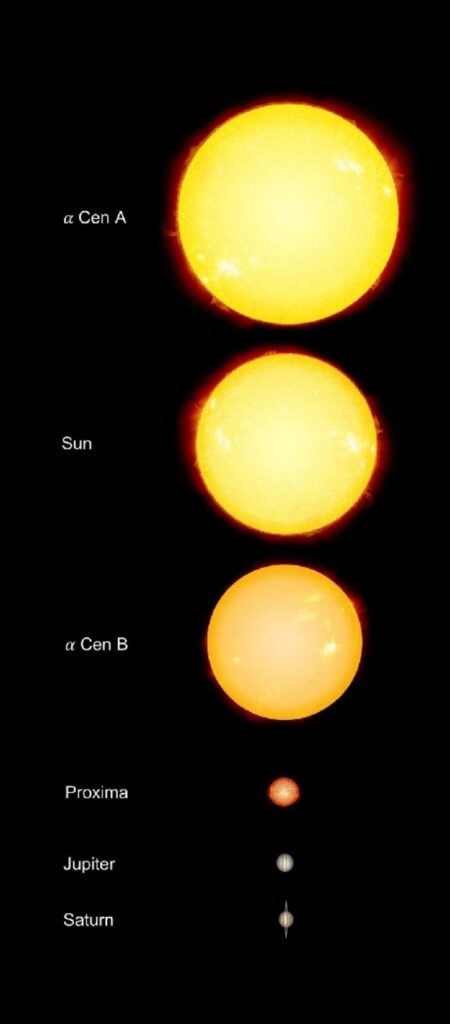
Just 4.37 light-years from Earth sits the Alpha Centauri system — our closest stellar neighborhood. It’s a triple-star system, and its three members tell three completely different stories about the stars that share our cosmic corner.
Alpha Centauri A (Rigil Kentaurus) — The Sun’s Near-Identical Twin
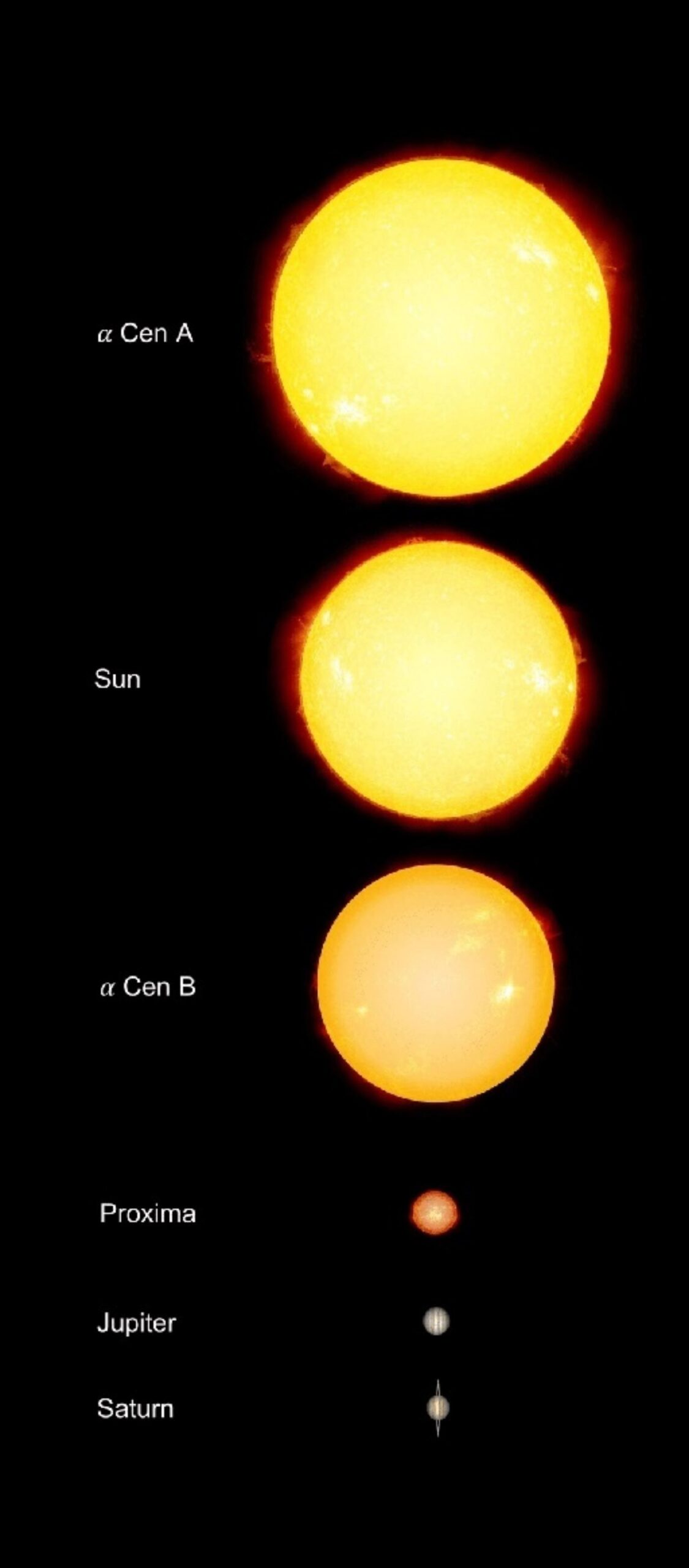
Alpha Centauri A carries spectral classification G2V — the same as our Sun. It’s slightly larger, slightly brighter, and marginally more massive than the Sun, but astronomers consider it a near-perfect solar twin. It’s one of the most heavily studied stars in astrophysics, largely because comparing it to the Sun helps us understand our own star in finer detail.
On any scale diagram, Alpha Centauri A and the Sun look almost identical — like mirrors of each other, separated by just over four light-years of empty space. Finding a solar twin this close to home is genuinely rare.
Alpha Centauri B (Toliman) — The Orange Companion
The second star in the system carries the classification K1V. It’s smaller and cooler than the Sun, with a warm amber tone. Alpha Centauri A and B orbit each other in a slow gravitational waltz, completing one full orbit roughly every 79.9 years. They’re a binary pair, bound together while Proxima Centauri orbits them both from a much greater distance.
Proxima Centauri — The Red Dwarf at Our Doorstep
Then there’s the third member. Proxima Centauri is a red dwarf of spectral class M, and it holds a record: at 4.24 light-years, it’s the closest individual star to Earth. Despite that proximity, it’s so intrinsically faint you can’t spot it without a telescope.
Its size is striking. Proxima Centauri’s radius is only about 1.5 times that of Jupiter — a giant planet in our own solar system. Proxima is far more massive than Jupiter (it fuses hydrogen, making it a true star), but visually, on any scale comparison chart, it looks almost planetary. It’s a reminder that “star” covers an extraordinary range of objects.
| Star | Spectral Class | Distance from Earth | Key Feature |
|---|---|---|---|
| The Sun ☀️ | G2V | 8.3 light-minutes | Center of our solar system; 99.8% of system mass |
| Alpha Centauri A | G2V | 4.37 light-years | Solar twin; slightly larger and brighter than the Sun |
| Alpha Centauri B | K1V | 4.37 light-years | Smaller, cooler orange star; binary partner to Cen A |
| Proxima Centauri | M5.5Ve | 4.24 light-years | Closest star to Earth; radius ~1.5× Jupiter; hosts Proxima b |
Red Dwarfs vs. Yellow Dwarfs: No Comparison
Using the word “dwarf” for both the Sun and Proxima Centauri can give the impression they’re in the same league. They really aren’t.
Red dwarfs are M-type stars — cold, dim, and extraordinarily frugal with their fuel. Their surface temperatures stay below 3,700 K. They burn hydrogen so slowly that some of the least massive ones can live for up to 14 trillion years — nearly 1,000 times the current age of the universe. Every single red dwarf ever born still exists today. Not one has had time to die.
The Sun works on a very different schedule. As a G-type star, it has a total main-sequence lifespan of roughly 10 billion years, and it’s currently about 4.6 billion years in — just past the halfway mark. Red dwarfs are the tortoises of the stellar zoo: barely moving, barely glowing, but essentially immortal on any timescale we can imagine. G-type stars like the Sun are more like sprinters — bright, energetic, warm, and built for a meaningful but finite run.
📊 By the numbers: Red dwarfs (M-type) account for roughly 75–76% of all stars in the Milky Way. [web:38] G-type yellow dwarfs like the Sun make up only about 7%. Yet those G-type stars are among the best-lit, best-positioned candidates for supporting life on orbiting planets — including, of course, our own.
Proxima b — A World That Makes Us Dream
One discovery from our cosmic neighborhood deserves its own moment. A planet named Proxima b orbits Proxima Centauri inside the star’s habitable zone — the narrow region where liquid water could theoretically exist on a planet’s surface. Scientists confirmed it using radial velocity spectroscopy, measuring tiny wobbles in Proxima Centauri’s motion caused by the planet’s gravitational pull.
The orbital geometry is extreme. Proxima b circles its star at roughly 20 times closer than Earth orbits the Sun. Yet because Proxima Centauri is so cool and dim, that tight orbit still puts Proxima b in the right temperature range — receiving approximately 65% of the solar radiation that Earth gets from the Sun.
Does that mean life could be there? Possibly. But there’s a serious complication. Red dwarfs like Proxima Centauri are wildly active stars. They fire off powerful flares and floods of high-energy radiation. A planet orbiting that close would take a constant bombardment. Whether Proxima b can maintain an atmosphere under that assault remains one of astronomy’s most genuinely open debates. We’re dreaming — but we’re doing it rigorously.
What Will the Sun Eventually Become?
Our Sun won’t burn steadily forever. In roughly 5 billion years, when it exhausts the hydrogen supply in its core, the outward pressure of nuclear fusion will drop. Gravity will take over. The core will compress and heat up, and the outer layers will expand dramatically — transforming the Sun into a red giant.
At that point, it’s likely to engulf Mercury and Venus. Whether Earth survives or gets swallowed is still debated — but even if it does survive the expansion, life as we know it will have ended long before that, as the Sun’s luminosity increases gradually over the next billion years.
After the red giant phase, the Sun won’t explode. It doesn’t have enough mass to go supernova. Instead, it will gently push its outer layers outward, forming a glowing shell of gas called a planetary nebula. The exposed core — now called a white dwarf — will be roughly Earth-sized but carrying about half the Sun’s current mass. It will cool slowly over trillions of years, eventually fading to darkness.
Yellow dwarf. Red giant. Planetary nebula. White dwarf. That’s the full arc of our star’s life — a story measured not in years, but in billions of years. Knowing it is humbling. Knowing it is also beautiful.
Seeing Our Star With Honest Eyes
So — is the Sun a yellow dwarf? Technically, yes. The G2V classification is accurate and universally recognized. But as we’ve seen, almost every part of that label needs unpacking.
“Yellow” is an atmospheric illusion produced by Rayleigh scattering. The Sun’s true color is white, and its emission spectrum actually peaks in green light at around 501 nm, as Wien’s Displacement Law tells us. “Dwarf” is a relative label — it places the Sun correctly on the main sequence and distinguishes it from giants and supergiants, but it says nothing about the Sun’s genuine dominance in our solar system, where it holds 99.8% of all mass.
We live in a rich stellar neighborhood. Alpha Centauri A mirrors our Sun almost exactly, at 4.37 light-years away. Alpha Centauri B is a cooler orange companion. And Proxima Centauri — the single closest star to Earth — is a tiny, restless red dwarf hosting a potentially habitable planet, Proxima b, that scientists are still studying with tremendous excitement.
Every time you look up at the Sun, you’re watching a G2V main-sequence star midway through a 10-billion-year life — a star that is, by every galactic measure, nothing remarkable, and yet by every human measure, the source of everything. That tension between ordinary and extraordinary is what makes astronomy so endlessly rewarding.
At FreeAstroScience, we don’t settle for easy answers or popular myths. We follow the physics. We read the data. We ask why the sky is blue and why the Sun isn’t green even though its spectrum peaks there. That commitment to honest science is exactly how we protect you from the misinformation that floods the internet every day.
We’ve always believed this: never turn off your mind, never let curiosity go quiet — because the sleep of reason breeds monsters. Stay awake. Keep asking. And come back to FreeAstroScience.com, where the universe is always explained in plain, honest language — one star at a time.
📚 References & Sources
- Britannica Editors. Sun. Encyclopædia Britannica, updated March 2026. britannica.com/place/Sun
- Wikipedia contributors. G-type main-sequence star. Wikipedia. en.wikipedia.org/wiki/G-type_main-sequence_star
- Wikipedia contributors. Stellar classification. Wikipedia. en.wikipedia.org/wiki/Stellar_classification
- Wong T., Guliano L., quoted in: Is the Sun Really a Dwarf Star? Live Science, December 2025. livescience.com
- Metzger P. What Type of Star is the Sun? February 2026. philipmetzger.com
- Proxima Centauri b: Habitable Paradise or Infernal World? Insane Curiosity, February 2026. youtube.com
- Vaia Physics. Stellar Classification. 2024. vaia.com
- Star-Facts.com. Stephenson 2-18: Largest Star Known. 2023. star-facts.com
- Universe Today. What is the Life Cycle of the Sun? universetoday.com
- NASA. Star Types. NASA Science, 2020. science.nasa.gov