What happens when you try to slow down a one-ton rover on a planet whose atmosphere is barely 1% as thick as ours? Welcome, dear reader, to FreeAstroScience.com. We’re glad you’re here. Today, we’ll walk you through one of the most extreme engineering feats humans have ever pulled off: landing a spacecraft on Mars using a parachute that opens while moving faster than a rifle bullet. Stick with us to the end — the physics behind those “seven minutes of terror” is far wilder than most space documentaries let on, and by the time you finish this piece, you’ll look at every Mars landing with new eyes.
Why Is Landing on Mars So Brutally Hard?
Here’s the cruel joke of Martian geography: Mars has just enough atmosphere to roast a spacecraft during entry, yet not enough to slow it down safely. If the planet had a thick atmosphere like Earth, classic aerobraking and parachutes would do the job. If it had no atmosphere at all, like the Moon, engineers would simply use rockets from top to bottom.
Mars sits in the worst middle ground. Its thin air can’t decelerate a spacecraft to a gentle touchdown speed using a heat shield and parachute alone. And the planet is big — so gravity still pulls hard. That’s why every Mars mission needs a layered, almost paranoid approach to braking.
How Thin Is the Martian Atmosphere, Really?
Roughly 1% of Earth’s atmospheric density at sea level. That’s it.
Imagine jumping off a diving board and finding the pool almost empty. That’s the situation a parachute faces over Mars. A parachute that could land a skydiver safely on Earth would barely tug at a spacecraft falling through Martian skies.
As one Smithsonian writer put it memorably, creating enough drag to stop a craft in that thin air is “about as easy as trying to sew yourself a parachute after you’ve already jumped”.
Why Do Mars Parachutes Open at Supersonic Speed?
On Earth, parachutes open at a few hundred km/h — safely subsonic.
On Mars? We can’t afford that luxury. The air is so thin that if engineers waited for the vehicle to drop to subsonic speeds, the ground would already be rushing up to meet them. So the parachute has to open while the capsule is still flying at Mach 1.5 to 2.2 — about 1,500–2,000 km/h.
That’s why Mars parachutes are designed from scratch to open while supersonic. A regular skydiving canopy would shred itself in milliseconds.
Why does supersonic deployment break normal chutes?
This is where the story gets humbling. During NASA’s Low-Density Supersonic Decelerators (LDSD) project, engineers built chutes twice the size of Curiosity’s. In wind tunnel tests, they worked beautifully. In real-world high-altitude tests, the fabric snapped inward and shredded in an instant, just as the canopies neared full inflation.
Why? A team at Stanford led by Professor Charbel Farhat found something counterintuitive: the parachute experiences more stress while unfolding than when fully deployed. The wind tunnel tests had unfurled the chutes subsonically and extrapolated. Reality didn’t cooperate. In genuine supersonic flow, “true, supersonic air ripped across the surface of the nylon, like a billion tiny whips”.
All it took was a few tiny tears to unravel everything.
What Is a Disk-Gap-Band Parachute?
Mars parachutes aren’t the classic round umbrella shape you see in cartoons. They’re called DGB — Disk-Gap-Band — and the name describes exactly what they are:
- A disk on top
- A gap (an intentional ring-shaped opening)
- A band of fabric around the bottom
That gap isn’t a flaw. It’s the whole point. It lets supersonic air escape in a controlled way, which cuts down on violent oscillations and stops the canopy from collapsing in on itself.
Mars chutes are also enormous. For the same payload mass, you need a canopy 5 to 10 times larger on Mars than on Earth to generate the same braking force. The second-stage ExoMars parachute, for example, stretches 35 meters wide — the largest parachute ever built to fly on another world, made from over 800 square meters of fabric and more than 4 kilometers of suspension cord. It takes around three days just to fold it into its bag.
The fabric itself? Featherweight. About 40 grams per square meter — roughly half the weight of a sheet of paper. Light, yet reinforced with Kevlar (the same material in bullet-proof vests) to survive those supersonic whips.
How Do the Three Braking Stages Work Together?
A Mars parachute is not a gentle device that floats a rover to the dirt. It’s a supersonic emergency brake — one link in a chain. The real magic is the choreography of three stages working in sequence.
ESA confirms the basic physics: the descent module has to bleed off roughly **21,000 km/h in about six minutes** to land softly . Most of that supersonic velocity is killed by the aerodynamic drag on the heat shield. The parachute handles the middle chunk. Rockets finish the job .
### The math, in plain English
A parachute’s drag force scales with atmospheric density. Mars density ≈ 0.01 × Earth density. So the same parachute produces **about ten times less braking force**. That’s why engineers compensate with bigger canopies, faster deployment, and clever shapes — and why **even the best parachute can’t land a rover alone**. Without rockets, you crash. Period.
## What Happened During Perseverance’s Descent?
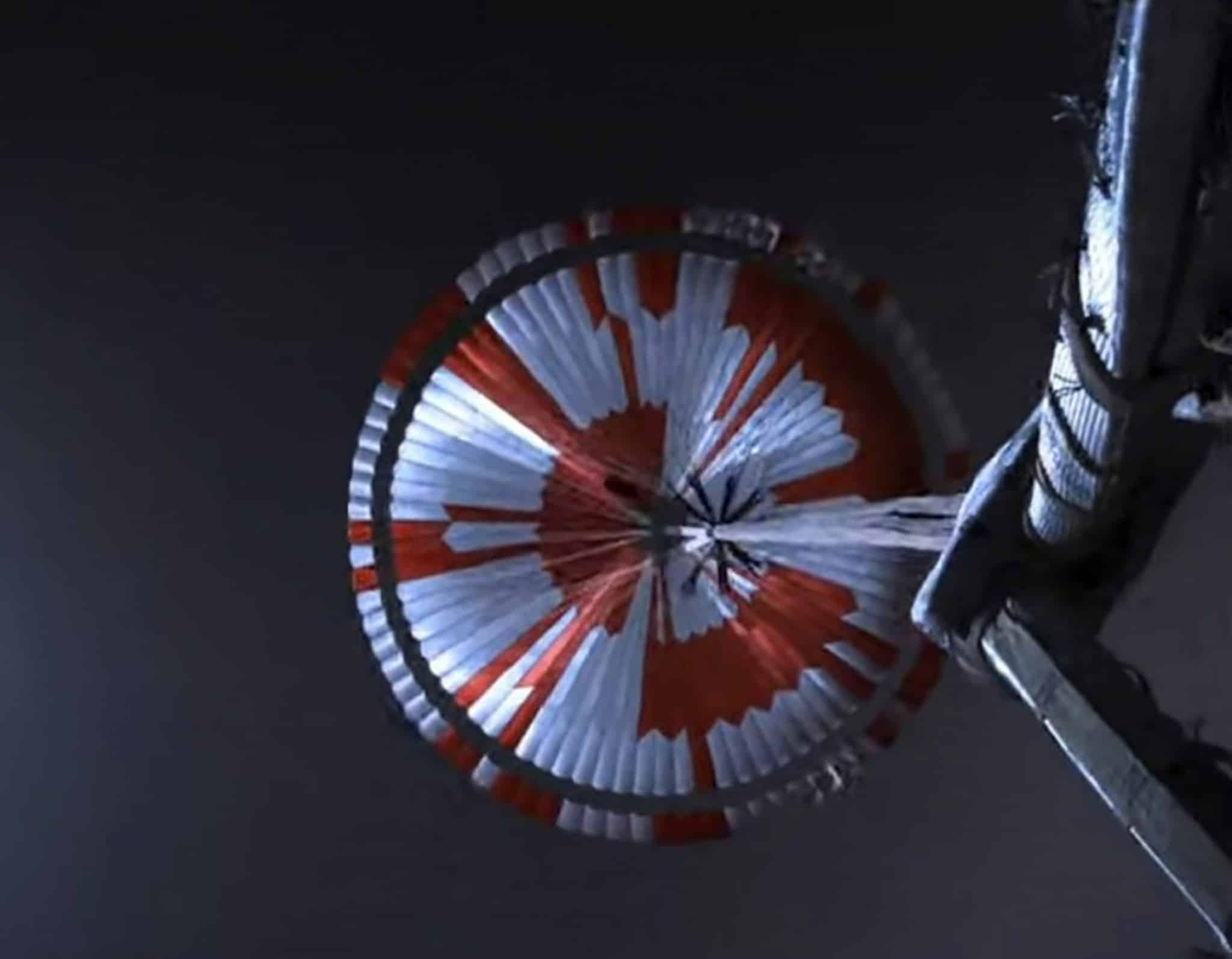
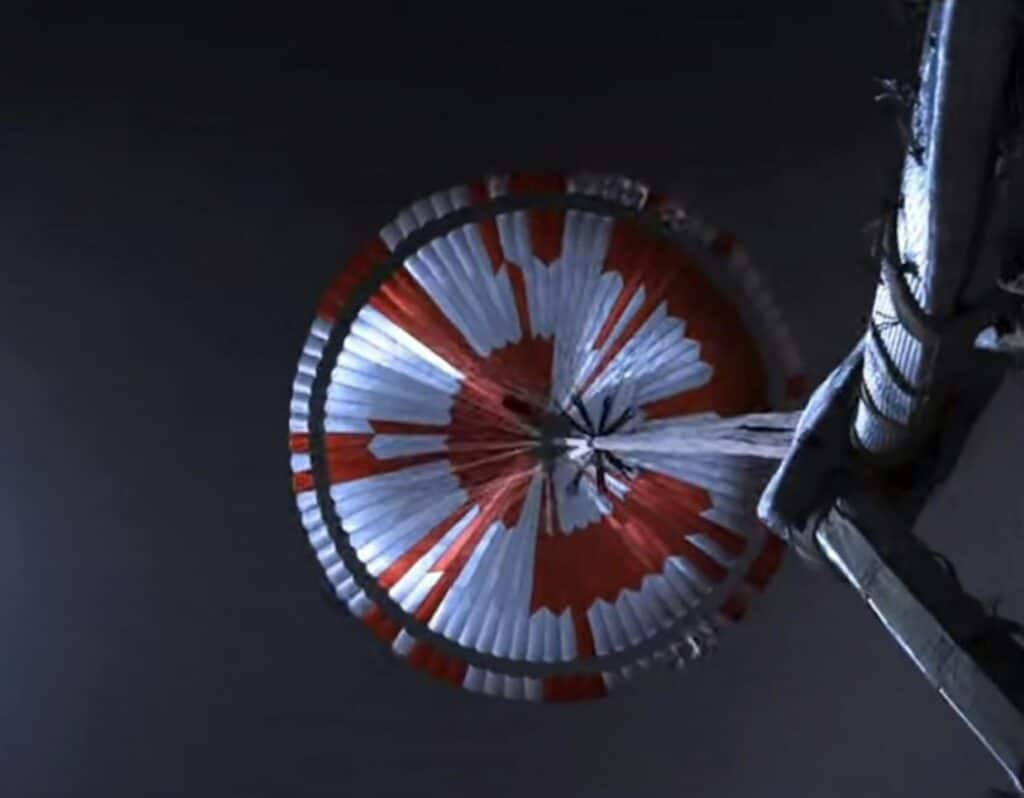
On **February 18, 2021**, NASA’s Perseverance rover screamed into the Martian atmosphere. The image you may have seen — a red-and-white canopy billowing against a dark sky — captures the moment the supersonic DGB parachute deployed.
Perseverance followed the same “sky crane” playbook pioneered by Curiosity in 2012 . After the parachute slowed the craft, the rocket-powered descent stage separated, four engines further decelerated the fall, and a tether lowered the rover gently to the ground. Once the computer sensed touchdown, it cut the tether and the sky crane flew off to crash at a safe distance.
Every second of that choreography had to happen autonomously. Radio signals from Mars take around 14 minutes to reach Earth, while the entire landing takes only about 7 minutes . By the time mission control hears “parachute deployed,” the rover is either already alive on the surface or already dead. That’s why engineers call it the seven minutes of terror.
How Is ESA Pushing Parachute Tech Even Further?
The European Space Agency’s ExoMars mission, which will carry the Rosalind Franklin rover, is flying what ESA calls “the most complex parachute system to ever deploy on Mars”.
Instead of one main canopy, ExoMars uses two, each with its own pilot chute:
- First main parachute: 15 m wide, a variant of the design used for ESA’s Cassini–Huygens probe that landed on Titan
- Second main parachute: 35 m wide, the largest ever to fly beyond Earth
On 7 July 2025, at the Esrange Space Center in Kiruna, Sweden, a dummy descent module was dropped from a stratospheric helium balloon at an altitude of 29 km — three times higher than commercial aircraft cruise. That altitude was chosen because it mimics the exact combination of density and velocity the real capsule will hit on Mars . The dummy free-fell for about 20 seconds, reaching almost the speed of sound, and the chutes deployed successfully .
ESA’s verdict: “We have a parachute design that can work on Mars” .
Final Takeaway
The Martian parachute isn’t a soft landing device. It’s a brutal, supersonic emergency brake — the middle rung on a three-step ladder down. It opens while the spacecraft screams through the upper atmosphere at nearly twice the speed of sound, catches air that’s barely there, and hands off the job to rockets long before touchdown.
We, at FreeAstroScience, wrote this article just for you. Our mission is to translate complex scientific principles into clear ideas — because we believe you should never switch your mind off. As Goya warned us, the sleep of reason breeds monsters. Curiosity is the antidote.
So the next time you watch a Mars landing livestream, picture this: 800 square meters of fabric thinner than paper, stitched with Kevlar, snapping open at 2,000 km/h in air that’s barely there — while a billion tiny whips of supersonic wind try to shred it. That’s not luck. That’s decades of physics, simulation, and fabric-folding patience.
Come back to FreeAstroScience.com soon. There’s much more sky to explore together.