Have you noticed how the loudest climate skeptics suddenly sound reasonable?
Welcome, dear reader. We’re glad you stopped by FreeAstroScience today, because this story matters to your wallet, your health, and the air your kids will breathe in twenty years. The old script, the one that shouted “global warming is a hoax,” has mostly been retired. Something slipper has taken its place, and it talks in a calm voice about bills, jobs, and common sense. Stay with us to the end. We’ll show you what changed, who’s pulling the strings, and what you can do when a lie starts dressing up like prudence.
The Quiet Revolution in Climate Lies
Why did climate denial trade shouting for whispering?
For years, the playbook was blunt. Put a lone contrarian scientist on TV. Stretch the uncertainty. Stage a fake “both sides” debate, as if physics needed a popularity vote. That trick worked when the public barely knew the numbers.
Then the numbers got loud. Human activity, mostly through greenhouse gas emissions, has unequivocally warmed the planet. Between 2011 and 2020, the average global surface temperature sat about 1.1 °C above the 1850–1900 baseline. Every extra tenth of a degree piles on risks, locks in high-emission infrastructure, and shrinks our menu of fixes.
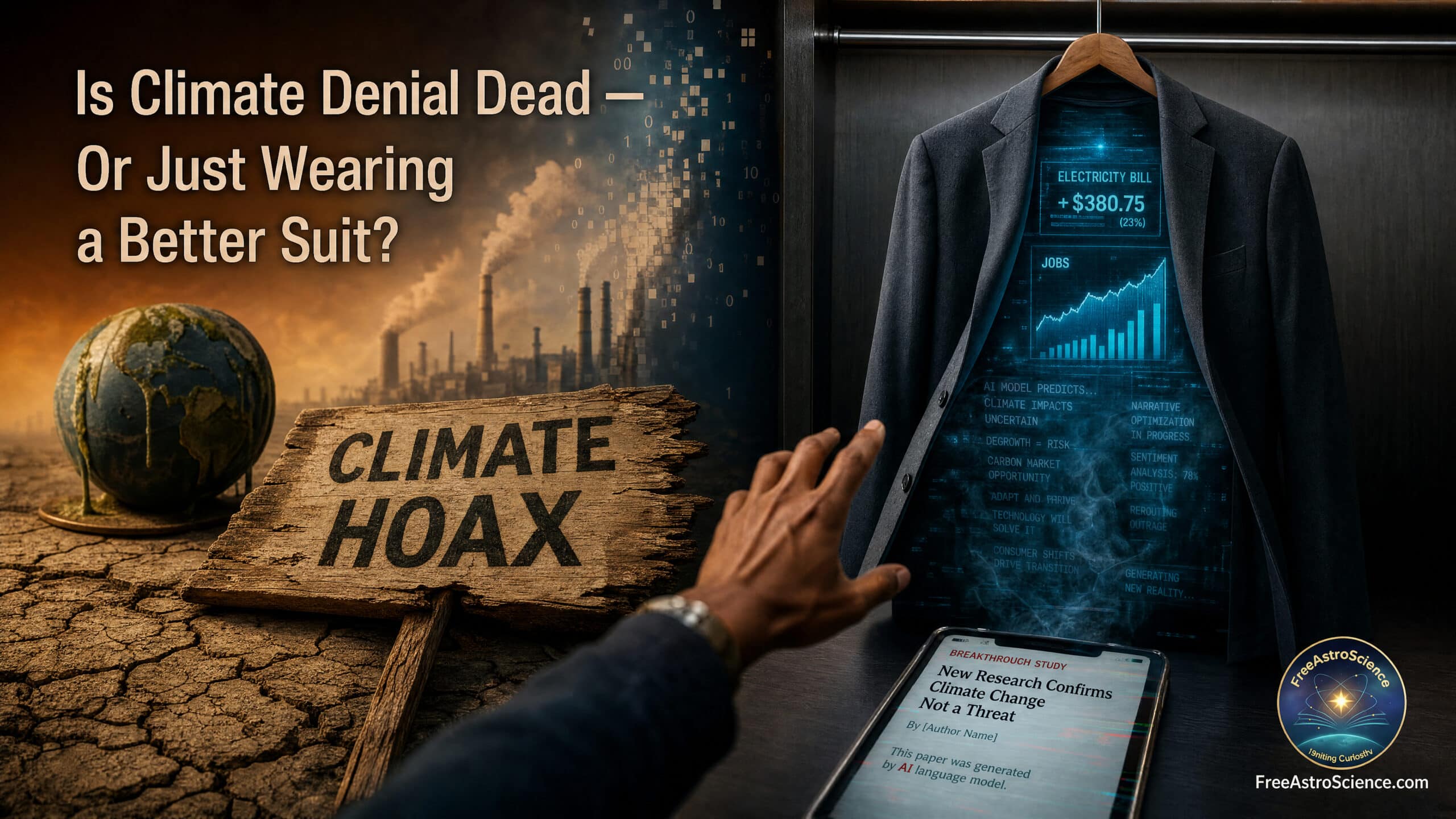
So the lie adapted. A new essay by James Kennon Rice, published in PLOS Climate on May 4, 2026, lays out exactly how. The shift is from blunt denial to sophisticated delay and deflection. The new script goes something like this: “Yes, the climate is changing. But acting now costs too much. The transition is imposed from above. Renewables are a bubble. Gas is a bridge we should cross slowly. Let China and India move first.”
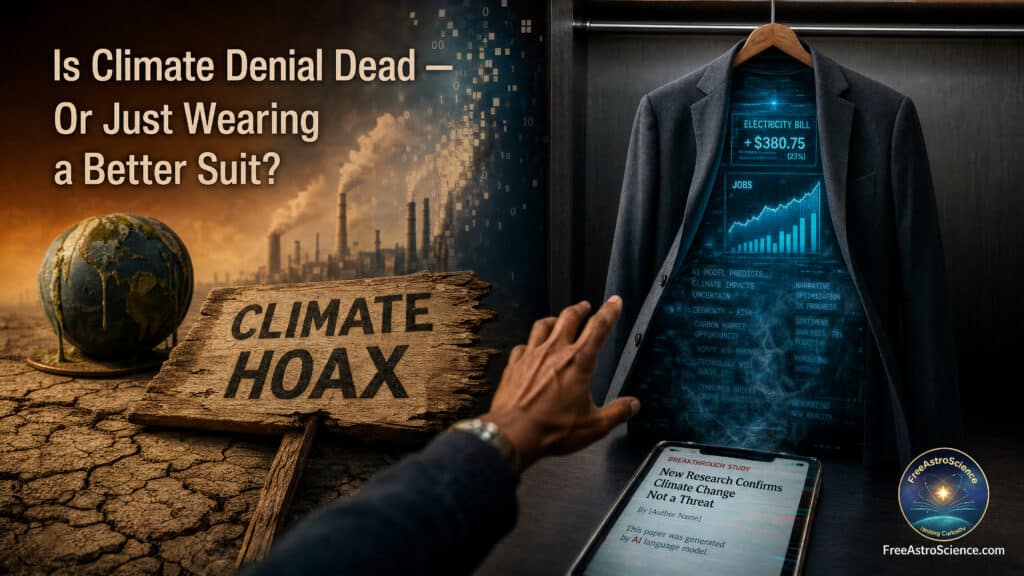
Notice the trick? Every sentence accepts the science, then quietly argues for doing nothing.
Who is the target audience now?
The new misinformation speaks to families staring at energy bills, to truckers squeezed by European rules, to farmers tangled in red tape. It paints climate policy as a hobby for educated city elites who ask sacrifices from the living room while their radiators hum. Some of that anger rests on real grievances. A badly managed transition does hurt people with thin margins first. The lie slides into that crack and pries it wider.
—
How is AI turbocharging the new lies?
Here’s the part that keeps us awake at night. Generative AI can now produce text, images, charts, fake interviews, fake experts, synthetic documentaries, and polished pseudo-scientific papers that mimic journals like *Science* and *Nature*. The old hoax had visible stitches. The new one shows up with a clean layout, measured tone, tidy bibliography, and a graph that looks real.
Rice projects that within roughly two years, the majority of climate misinformation could be AI-generated. Even scarier: these systems can adapt in real time to fact-checks, spinning out new variants faster than debunkers can type.
What fake “evidence” are we talking about?
| Type | What it looks like | Why it’s dangerous |
|---|---|---|
| Synthetic temperature data | Fabricated time series with plausible trends | Feeds false “the planet is cooling” stories |
| Manipulated satellite imagery | Altered photos of glaciers, forests, oceans | Visual lies spread faster than corrections |
| Fake peer-reviewed papers | Articles mimicking Science or Nature format | Wears a lab coat to sell a lie |
| Deepfake expert testimonials | Video interviews with non-existent scientists | Weaponizes our trust in human faces |
| Rigged economic charts | Graphs showing “green bubbles” or “speculative renewables” | Scares investors and voters at once |
Source: Rice, *PLOS Climate*, 2026
When does the climate become a political weapon?
Climate misinformation doesn’t stop at national borders. The message changes language, accent, and target, but the job stays the same: turn climate action into an identity threat.
- In Brazil, misinformation frames Amazon protection as a sovereignty attack.
- In India, climate policy gets cast as Western imperialism trying to block development.
- In Europe and North America, the pitch hammers on transition costs and alleged economic decline.
Echo chambers across continents
A fake claim is born in one corner of the internet. It gets reposted, liked, and commented across international denial networks. Then it returns to mainstream debate wearing a shiny coat of “international validation.” Russian state media, for example, amplifies Western climate skeptics who are then quoted back home as proof of global consensus. That’s credibility laundering, plain and simple.
The geopolitical layer
Climate change will sharpen fights over water, fertile land, migration routes, and critical minerals. Misinformation campaigns can help deflect blame, justify border militarization, and sabotage finance negotiations at COP summits. Fossil fuel executives sitting at the negotiation table don’t hurt either.
Why does fact-checking keep arriving too late?
Classic debunking still helps. But it shows up when the emotional damage is already done. A good correction takes hours of careful work. A machine spits out a fresh false variant in seconds.
The attention economy rewards whatever keeps your thumb moving, even when that content corrodes public reasoning. Platforms aren’t neutral pipes. Their engagement-driven ad models actively feed polarizing material.
The math of delay
A simple way to read it:
Cost of action(today) < Cost of adaptation(tomorrow) + Locked-in warming
What can we actually do about it?
We don’t believe in doom-scrolling. Rice and colleagues suggest a toolkit that works on three levels.
Personal defense: lateral reading
Don’t trust a single source. When you see a dramatic climate claim, open three or four tabs and check independent outlets. Look at who funds the website. Check the author. Search the quoted scientist’s name on Google Scholar.
Community voices beat slogans
The green message stalls at the door of working-class neighborhoods. What works? Trusted local figures, doctors, teachers, mayors, technicians who can talk about clean air, lower bills, better jobs, safer homes. A nurse explaining asthma rates beats a policy brief every time.
Structural reform
Platforms should be required to reveal how their algorithms pick content, with independent audits. Their ad-based model rewards engagement over truth, and that has to change. Schools need to teach critical thinking, not just facts, from an early age.
Frame climate action around benefits, not sacrifice
Research shows that highlighting co-benefits, like jobs, energy independence, and cleaner air, builds support across political lines. Climate policy lands when it shows up as a better hospital, a warmer house with lower bills, a train that runs on time.
The Bottom Line
Every day of delay adds warming, pushes up adaptation costs, and narrows the window for safe temperature limits. The lie about climate isn’t a parlor debate anymore. It’s a gear in the machine that decides how much we’ll pay and who pays first.
The new misinformation doesn’t scream. It murmurs about being reasonable. It cites your electricity bill, your cousin’s job at the plant, your distrust of distant capitals. Some of those worries are real. That’s what makes the trick work. The answer isn’t to dismiss the pain. The answer is to separate the pain from the hijacking of that pain.
This post was written for you by FreeAstroScience, where we break down complex scientific ideas into language anyone can follow. We want you to keep your mind awake, because the sleep of reason breeds monsters. Come back soon. There’s more to learn, and the world needs readers who refuse to be fooled twice.