
What if every atom in your body, every star overhead, every grain of sand beneath your feet — had an exact opposite? And what if that opposite vanished before the universe was a second old?
Welcome to FreeAstroScience, where we explain complex scientific ideas in plain, human language — because science belongs to everyone, not just those with lab coats. We’re Gerd Dani and the FreeAstroScience team. Today, we’re sitting down with one of the most electrifying topics in modern physics: antimatter.
Don’t let the name fool you. This isn’t science fiction. Antimatter is as real as your morning coffee. Scientists produce it in laboratories. Your body creates it right now. And in the first heartbeat of the universe, there was just as much antimatter as there was ordinary matter.
Then, nearly all of it vanished.
Where did it go? That question has haunted physicists for decades. And the answer — when we find it — might tell us why anything exists at all.
Grab a seat. Stay with us through the last paragraph. We promise you’ll see the universe differently by the time we’re done.
What Exactly Is Antimatter?
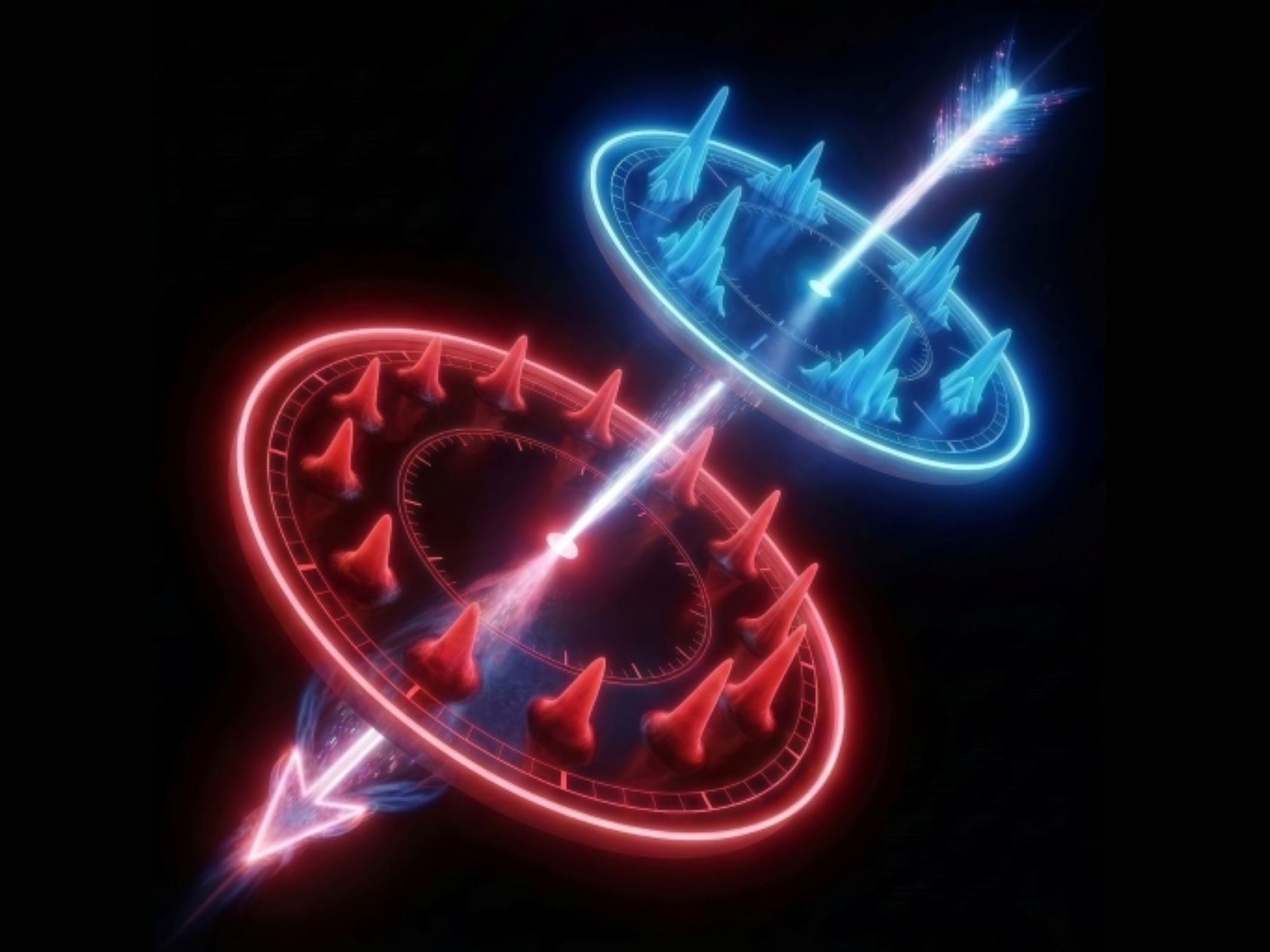
In the simplest terms, antimatter is the mirror image of ordinary matter . Every particle of matter has a twin — called an antiparticle — with the same mass but the opposite electric charge .
Picture it this way. An electron carries a negative charge of -1. Its antimatter partner, the positron, carries a positive charge of +1 . Same weight on the cosmic scale. Opposite sign on the electric tag.
The proton, with its positive charge, pairs with the antiproton — which carries a negative charge . Combine an antiproton with a positron, and you get antihydrogen: the antimatter version of hydrogen, the most common element in the universe .
This pattern runs through all of particle physics. For every kind of matter particle, there's an antimatter counterpart . Quarks pair with antiquarks. Electrons pair with positrons. Even composite particles like neutrons have antimatter versions — the antineutron .
How Do Particles and Antiparticles Compare?
Here's a side-by-side look at some key particles and their antimatter twins:
| Matter Particle | Charge | Antimatter Partner | Charge | Notes |
|---|---|---|---|---|
| Electron (e⁻) | −1 | Positron (e⁺) | +1 | First antiparticle discovered (1932) |
| Proton (p) | +1 | Antiproton (p̄) | −1 | Made of 3 antiquarks |
| Neutron (n) | 0 | Antineutron (n̄) | 0 | Different internal quark structure |
| Hydrogen atom | 0 (net) | Antihydrogen | 0 (net) | First anti-atom created at CERN (1995) |
| Neutrino (ν) | 0 | Antineutrino (ν̄) — or itself? | 0 | May be its own antiparticle |
A few particles break the pattern. Photons — particles of light — are their own antiparticles . The Higgs boson, too. And then there's the neutrino: that ghostly, near-massless particle that barely interacts with anything. Scientists still aren't sure whether neutrinos and antineutrinos are the same particle or two different ones . As we'll see shortly, that open question could hold the key to one of physics' deepest mysteries.
What Happens When Matter Meets Antimatter?
Here's where things get dramatic.
When a particle meets its antiparticle, they don't bounce off each other. They don't merge. They annihilate . Both particles vanish. Their combined mass converts entirely into energy — typically high-energy gamma-ray photons.
Quite literally, they disappear in a flash .
This annihilation follows Einstein's most famous equation:
g
Because c² (the speed of light squared) is an enormous number — roughly 9 × 10¹⁶ m²/s² — even a tiny speck of antimatter annihilating with matter releases a staggering burst of energy .
Let's put that in perspective. If you could annihilate just 1 gram of antimatter with 1 gram of ordinary matter, you'd release about 180 trillion joules of energy. That's around 43 kilotons of TNT — nearly three times the energy of the bomb dropped on Hiroshima.
From a single gram.
Now you can see why engineers and science-fiction writers get excited about antimatter as a fuel source . And why the universe's early moments were so unimaginably violent.
Where Did All the Antimatter Go?
This is the big question. The one that keeps cosmologists awake at 3 a.m.
Our best models of the Big Bang tell us the early universe should have produced equal amounts of matter and antimatter . Energy turned into particle-antiparticle pairs — appearing and disappearing in the hot, dense plasma of those first fractions of a second .
If that picture is correct, every speck of matter should have met its antimatter twin and annihilated. The universe should be nothing but a cold bath of leftover radiation. Empty. Dark. No stars, no planets, no people.
And yet — here we are. Stars burn. Galaxies spiral. You're reading this sentence. The cosmos is overwhelmingly made of matter, and large-scale antimatter is nowhere to be found .
What Is the Matter-Antimatter Asymmetry?
Physicists call this puzzle the baryon asymmetry — and it ranks among the greatest unsolved problems in all of science .
The best explanation so far? Some unknown process, in the first fractions of a second after the Big Bang, generated a tiny excess of matter over antimatter . How tiny?
About one extra matter particle for every billion matter-antimatter pairs .
One in a billion.
When the titanic annihilation was over, that minuscule leftover was all that survived. From that sliver of surplus came every galaxy, every star, every molecule of water, every breath you've ever taken .
We don't yet know what tipped the balance. But two leading ideas are getting serious attention:
CP violation. In 1964, physicists discovered that certain processes involving matter and antimatter aren't perfectly symmetrical . This broken symmetry — called CP violation — means that matter and antimatter don't always behave as perfect mirror images. Researchers at CERN's LHCb experiment continue to study these asymmetries, finding CP violation in processes involving strange quarks (1964), bottom quarks (2001), and charm quarks (2019) .
Neutrinos as their own antiparticles. If neutrinos turn out to be Majorana particles — particles that are their own antiparticles — they could have helped tilt the cosmic balance toward matter in the early universe . Experiments searching for a rare process called neutrinoless double beta decay are designed to test this hypothesis .
Neither theory has been fully confirmed. The case file remains open .
Can We Create Antimatter in the Lab?
Yes. Scientists do it regularly — just not in large amounts.
What Does CERN's Antimatter Factory Do?
The European Organization for Nuclear Research (CERN), near Geneva, Switzerland, operates what's called the Antimatter Factory . At its heart sits the Antiproton Decelerator — a machine that slows antiprotons down so physicists can study them with astonishing precision .
CERN first created atoms of antihydrogen in 1995, though those early anti-atoms moved too fast to study . Since then, a constellation of experiments has been chipping away at antimatter's secrets :
- ALPHA has measured properties of antihydrogen to 12 significant digits .
- BASE has compared proton and antiproton charge-to-mass ratios to 11 digits of precision — the most precise baryonic matter-antimatter test ever .
- ALPHA-g confirmed that antimatter falls downward under gravity, just like regular matter .
- PUMA will use antiprotons to probe the structure of neutron-rich nuclei .
But here's the sobering truth: even if CERN ran its Antimatter Factory around the clock for an entire year, it would produce only about 30 million antihydrogen atoms — a mass of roughly 3 × 10⁻²⁰ kilograms . If every single one of those atoms annihilated at once, the energy released would amount to a few thousandths of a joule. That's about the energy you'd spend tapping your phone screen with your finger .
All the antiprotons produced in a full year? About 500 joules — enough to light a 100-watt bulb for five seconds .
We can make antimatter. We just can't make very much of it. Not yet.
Does Nature Produce Antimatter Too?
Here's a fact that might change the way you look at your fruit bowl.
Bananas produce antimatter .
Bananas contain a trace amount of radioactive potassium-40. As that potassium decays, it emits positrons — the antimatter counterpart of electrons. An ordinary banana releases about one positron every 75 minutes .
No need to panic. Those positrons annihilate almost instantly when they bump into nearby electrons, producing tiny flashes of gamma radiation far too faint to notice — or to cause any harm .
Your body does the same thing, by the way. The potassium-40 in your cells is always producing small amounts of antimatter . You are, in a very literal sense, a walking antimatter factory.
Beyond bananas and human bodies, antimatter also appears naturally in:
- Cosmic ray collisions with Earth's atmosphere
- High-energy environments near black holes and pulsars
- Various types of radioactive decay
What Real-World Applications Does Antimatter Have?
How Do PET Scans Use Antimatter?
The most widespread practical use of antimatter is already saving lives in hospitals worldwide.
Positron Emission Tomography (PET) scans rely on antimatter to detect diseases like cancer . A patient receives an injection of a radioactive tracer that emits positrons. When those positrons meet electrons inside the body, they annihilate and produce pairs of gamma rays. Detectors surrounding the patient pick up those gamma rays and construct detailed 3D images of the body's internal activity.
It's antimatter at work in medicine. Every single day.
Could Antimatter Power a Spacecraft?
NASA has studied the idea . The energy released by matter-antimatter annihilation is so immense that, in theory, it could propel a spacecraft to Mars — or even to another star system.
One concept explored sending a probe to Alpha Centauri, our nearest stellar neighbor, by accelerating to 10% the speed of light using energy from antimatter collisions. The probe could then slow itself and explore that system for decades .
The catch? Cost and production. A 2006 estimate put the price tag for just 10 milligrams of positrons — enough for a crewed Mars mission — at around $250 million . And current production rates at CERN are nowhere near that scale.
For now, antimatter spacecraft remain a beautiful idea waiting for technology to catch up. But the physics works. That's what matters.
How Was Antimatter Discovered?
The story of antimatter stretches back more than a century. Here are the key moments:
-
1898Physicist Arthur Schuster coins the term "antimatter" in two letters to Nature, speculating about antiatoms and even a whole antimatter solar system.
-
1928Paul Dirac writes an equation combining quantum mechanics and special relativity. It predicts a particle like the electron but with a positive charge — the first theoretical prediction of antimatter.
-
1932Carl Anderson at Caltech discovers the positron in cosmic ray experiments — the first antiparticle ever observed.
-
1933 & 1936Dirac wins the Nobel Prize in Physics (1933); Anderson wins it in 1936 — both for their contributions to the discovery of antimatter.
-
1964Discovery of CP violation — the first evidence that matter and antimatter don't always obey perfect mirror symmetry.
-
1995CERN creates the first atoms of antihydrogen, though they move too fast to study in detail.
-
2000CERN's Antimatter Factory begins operations with the Antiproton Decelerator.
-
2017The BASE experiment measures the antiproton's magnetic moment to 1.5 parts per billion — more precise than the equivalent proton measurement.
-
2021The ELENA ring comes online at CERN. First antimatter gravity experiments begin.
From Schuster's playful speculation in 1898 to CERN's precision measurements of antihydrogen in the 2020s — antimatter science has come a remarkably long way in just over a century.
Why Should Any of This Matter to You?
We get it. Antimatter can feel distant. Abstract. Like something that belongs inside a particle physics lab, not in your daily life.
But here's the thing: your existence depends on antimatter's disappearance.
If not for that tiny, unexplained asymmetry — one extra particle for every billion pairs — the universe would be empty. No stars lighting the night sky. No water flowing through rivers. No music, no laughter, no love. No you, reading this right now.
The fact that anything exists at all is one of the most profound mysteries in science. And antimatter sits right at the heart of it.
Every experiment at CERN, every measurement of an antihydrogen atom, every search for CP violation in heavy-particle decays — all of it inches us closer to understanding why the cosmos chose to exist rather than annihilate itself into nothing.
That question is worth caring about. Because it's really a question about us.
A Final Thought
Let's take a breath and look at what we've covered together.
Antimatter is the mirror twin of ordinary matter — identical mass, opposite charge. When matter and antimatter meet, they destroy each other completely, converting their combined mass into pure energy through Einstein's E = mc². The early universe produced equal amounts of both, yet almost all the antimatter vanished. That mystery — the matter-antimatter asymmetry — stands as one of the biggest open questions in physics today.
We can produce antimatter at CERN, but only in breathtakingly small quantities. Nature makes it too — in bananas, in cosmic rays, in your own body. It already has a life-saving medical application in PET scans used in hospitals around the world. And one day, it might even power spacecraft to the stars.
The story of antimatter is, in a very real sense, the story of why we exist. And it's far from over.
Here at FreeAstroScience, we believe the most complex scientific ideas deserve clear, honest, human explanations — because the sleep of reason breeds monsters. Never let your curiosity go quiet. Keep your mind alive. Keep asking the big questions.
Come back to FreeAstroScience.com anytime you want to sharpen your understanding of the cosmos. We'll be here — one big question at a time.
— Gerd Dani & the FreeAstroScience Team