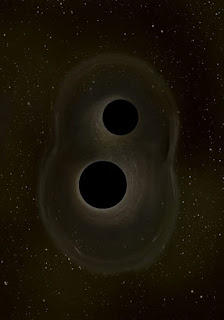
A recent study published in The Astrophysical Journal Letters suggests that black holes may be enveloped by dark matter, potentially unraveling one of the universe’s greatest enigmas. Dark matter constitutes approximately 85% of the cosmos’ total mass, remaining unseen to human eyes and scientific instruments. To detect its presence, astronomers rely on gravitational interactions between dark matter and ordinary matter.
In this groundbreaking research, scientists from the University of Education in Hong Kong (EdUHK) studied stars orbiting two black holes – A0620–00 and XTE J1118+480 – and found that these stars’ velocities decreased by roughly 1 millisecond per year. This unexpected slowdown hints at the possibility of dark matter surrounding black holes, generating a gravitational drag on the stars.
The research team employed a dynamic friction model of dark matter in a simulation, which revealed that stars subjected to these conditions could experience this effect. The model predicts a loss of energy in objects that gravitationally interact with this enigmatic matter. The simulation’s speed loss rates aligned with the observations.
In the absence of surrounding dark matter, the theoretical estimate for a black hole’s loss of orbital velocity would be a mere 0.02 milliseconds per year, making the observed rate 50 times higher. This suggests that the orbital decay of stars can be attributed to the presence of dark matter around black holes.
Chan Man Ho, the study’s lead author and associate professor in the Department of Science and Environmental Studies at EdUHK, stated, “This is the first study to apply the ‘dynamic friction model’ in an effort to validate and prove the existence of dark matter around black holes.”
This discovery holds promising implications for dark matter research. While black holes have long been suspected of consuming dark matter, direct observation has remained elusive. The research team plans to investigate other similar objects, as at least 18 binary systems exist within the Milky Way.
Unlike previous studies that used gamma rays and gravitational waves to search for dark matter near black holes, this research relies on measuring the orbital speeds of nearby stars and applying these observations to mathematical models.
Gerd Dani — Founder & Director Gerd Dani is the visionary in a wheelchair behind FreeAstroScience. An astronomy graduate and a master's in physics, he founded this blog in June 2020, driven by a passion for breaking down complex scientific and philosophical concepts into bite-sized, digestible pieces. As President, he is dedicated to making science accessible to everyone, from students to seasoned academics.
(()=>{async function handleCredentialResponse(response){try{const res=await fetch('https://freeastroscience.com/wp-login.php?action=googlesitekit_auth',{method:'POST',headers:{'Content-Type':'application/x-www-form-urlencoded'},body:new URLSearchParams(response)});/* Preserve comment text in case of redirect after login on a page with a Sign in with Google button in the WordPress comments. */ const commentText=document.querySelector('#comment')?.value;const postId=document.querySelectorAll('.googlesitekit-sign-in-with-google__comments-form-button')?.[0]?.className?.match(/googlesitekit-sign-in-with-google__comments-form-button-postid-(\d+)/)?.[1];if(!! commentText?.length){sessionStorage.setItem(`siwg-comment-text-${postId}`,commentText);}location.reload();}catch(error){console.error(error);}}if(typeof google !=='undefined'){google.accounts.id.initialize({client_id:'251104905146-eghigrtua82ec7aan4em9fle9u5f0ilc.apps.googleusercontent.com',callback:handleCredentialResponse,library_name:'Site-Kit'});}const defaultButtonOptions={"theme":"outline","text":"signin_with","shape":"rectangular"};document.querySelectorAll('.googlesitekit-sign-in-with-google__frontend-output-button').forEach((siwgButtonDiv)=>{const buttonOptions={shape:siwgButtonDiv.getAttribute('data-googlesitekit-siwg-shape')|| defaultButtonOptions.shape,text:siwgButtonDiv.getAttribute('data-googlesitekit-siwg-text')|| defaultButtonOptions.text,theme:siwgButtonDiv.getAttribute('data-googlesitekit-siwg-theme')|| defaultButtonOptions.theme,};if(typeof google !=='undefined'){google.accounts.id.renderButton(siwgButtonDiv,buttonOptions);}});/* If there is a matching saved comment text in sessionStorage,restore it to the comment field and remove it from sessionStorage. */ const postId=document.body.className.match(/postid-(\d+)/)?.[1];const commentField=document.querySelector('#comment');const commentText=sessionStorage.getItem(`siwg-comment-text-${postId}`);if(commentText?.length && commentField && !! postId){commentField.value=commentText;sessionStorage.removeItem(`siwg-comment-text-${postId}`);}})();
var astra = {"break_point":"921","isRtl":"","is_scroll_to_id":"1","is_scroll_to_top":"1","is_header_footer_builder_active":"1","responsive_cart_click":"flyout","is_dark_palette":"","revealEffectEnable":"","edit_post_url":"https://freeastroscience.com/wp-admin/post.php?post={{id}}&action=edit","ajax_url":"https://freeastroscience.com/wp-admin/admin-ajax.php","infinite_count":"2","infinite_total":"0","pagination":"number","infinite_scroll_event":"scroll","no_more_post_message":"No more posts to show.","grid_layout":{"desktop":3,"tablet":1,"mobile":1},"site_url":"https://freeastroscience.com","blogArchiveTitleLayout":"layout-2","blogArchiveTitleOn":"1","show_comments":"Show Comments","enableHistoryPushState":"1","masonryEnabled":"","blogMasonryBreakPoint":"0"};
//# sourceURL=astra-theme-js-js-extra